Sunday, 6 February 2022

Dividend Growth Investing Approach Actually Do More Harm Than Good?

Investing in dividend stocks can actually do more harm than good? I was looking at this local You-Tuber channel and his proclamation and nearly fainted. First and foremost, I think it is strange that someone can actually brand a particular type of investor as "growth investor" or "dividend investor". I am not sure whether such a simplistic view holds true given that most investors actually invest in a number of assets and stocks. Anyone, for me, I guess i am mostly a "dividend investor" mentioned by the You-Tuber so I will proceed to examine some of the interesting points raised by the You-Tuber below:

1. One should not invest just based on dividend criteria alone
Of course. I thought every investors know this. The high dividend yield trap is a well known phenomenon. We need to look at many aspects of the business and also macro-economic situation. 

If we look at dividend alone, then all investors would have invested 100% of their portfolio in Dasin Retail Trust for a 15% dividend distribution yield. But obviously, no one does that right- in view of the significant risk of default of bank loans. 

2. Dividend does not matter at all
According to this You-Tuber, whenever a company pays dividends, the stock price will drop by the same amount. Hence dividend does not matter at all and it is just a "forced withdrawal".  Yes or No? Yes according to Accounting Theory. But "No" based on imperfect market. For example, on 3rd January 2022, Keppel DC REIT was trading at S$2.47 per unit. Then on 31st Jan 2021 Ex-Dividend date, its price was only S$2.14 per unit which is a drop of S$0.33 per unit despite dividend declared of only S$0.04927 per unit for 2nd half of 2021. What I am trying to say is that real-life situation are complicated. 

3. Hard to compound/reinvest dividends that has been paid out.
The You-Tuber mentioned that if you get say S$40 dividends from your stock investments, it is hard to reinvest this back as the standard board lot size is 100 units. One would have to wait till the dividends grew to a significant amount to reach at least 100 units (the standard board lot size on SGX) to re-invest the dividends proceeds. I have to say that this is one of the weirdest point I ever heard. SGX took the effort to reduced the standard board size from 1,000 units to 100 units already since January 2015 for the benefit of all investors. 

Let's use Mapletree Industrial Trust as an example which cost S$2.52 per unit. 100 units will be S$252.  Assume one has S$40 of dividends, one just need to top up S$220 and above to participate in the reinvestment. This is actually quite easy to reinvest back the dividends. The only show stopper will be the high traditional brokerage fees which has a minimum charge of around S$30 per trade. However, since online brokerages like Tiger Brokers ramped up their businesses, they have been offering very attractive commission of 0.03% or minimum S$0.99 per order.

Parting Thoughts
A dividend strategy actually matters a lot to me personally. The "forced withdrawal" allows one to keep or re-deploy the cash generated from the business at regular intervals during the year. If anyone told you that they consistently know the exact exit time in the market to sell off their growth stocks, chances are that these are fake experts. Hence the dividend strategy instead provides much flexibility in terms of the options available on how to re-allocate resources for one's overall investment portfolios.

Sunday, 30 January 2022

Keppel DC REIT Market Price Collapse Nightmare- Should One Start Dumping All Units?

Recently, S-REITs unit price collapsed along with most of the world wide stock-markets. The once rising star of data centres focused REITs, Keppel DC REIT, plunged to a record 52 weeks low of S$2.16 per unit as at 28 January 2022 (Friday) . The speed of the devastating plunge in the last 2 weeks shell-shocked many retail investors as just 12 months ago, the price of Keppel DC REIT was at its 52 week high of S$3.040 per unit in the midst of the COVID pandemic and its meteoric rise looked unstoppable. So what has happened to this infallible bright star, that some investors proclaim is a REIT with the potential of a growth stock with numerous upcoming M&A opportunities yearly, to cause it to fall into the abyss? Should investors start dumping all units in Keppel DC REIT in view that prices seems to be plunging dramatically every day?
 
1. Upcoming macro-economic background changes- sky high inflation in US. 
The Federal Reserve has left interest rates and a key bond-buying taper plan unchanged on Wednesday 26th Jan 2022 but nevertheless, it has given a clear signal that the period of easy-money policies is coming to an end as inflation soars to a 40-year high and joblessness comes close to a half-century low. The current Federal Reserve fund rate is at 0% to 0.25%. The forecast by Analysts projected a 3-4 impending hikes for the Federal Reserve Fund rate of approximately 0.75% to 1.00% for FY2022 and 1.75% to 2.00% for FY2023. This will in turn push up world-wide interest rates. 

The severe decline in prices of Keppel DC REIT as well as other S-REIT is thus attributable to not just expected higher cost of borrowings but most importantly, if risk-free bond rate starts to go up, the expected returns from holding REITs by all investors will need to increase on top of current yield. To find the short term equilibrium pricing, ceteris paribus, the price of a REIT thus has to drop in order to adequately compensate investors for holding on. I expect the pricing volatility and the declining trend to continue for the next 2-3 months at least. 


2. What is the impact on REIT pricing and when will the price collapse bottom out? 
Let's use Keppel DC REIT distribution per unit as an example. Recent distribution per unit for FY2021 is 9.851 cents. Its price on average over the last 6mths is around S$2.50 per unit. 

This gives rise to a distribution yield of 4.1%. From a high level perspective, if risk free interest rate is expected to increase by an additional +0.75% to +1.0 % in the near term, one would expect a yield of 4.85% to 5.1% after the adjusted new risk free treasury rate.

This will mean a pricing range of S$1.89 to S$2.04 per unit eventually.  

However, I think that such simplistic basis and current panic mode is way too pessimistic on fair value assessment. I will also use another full data Centre focused REIT, Digital Core as comparative benchmarking to project my own assessment of a fair market value for a sanity check. Please see Pt 3 below. 
3. Proxy bench marking to other Data Centre REIT- Digital Core REIT.
The IPO price of Digital Core REIT is US$0.88 per unit. Taking into account many investors expecting the yield of 5.26% from its 2nd year onwards and the strong performance post IPO price of US$1.15 per unit, this will imply an expected yield of 4.03% for data centre assets despite the proclamation by the US Federal Reserve to increase interest rates. 

Personally, I view Keppel DC REIT to be vastly better than Digital Core REIT given that the former has a geographically wider diversification of its data centres relative to the latter. In addition, the sponsor of Keppel DC REIT is Keppel Corp with a strong pipeline of data centre in developments as well as the financial might of Temasek rallying behind them. 

Using 4.03% yield as proxy, Keppel DC REIT's fair valuation pricing should be around S$2.44 per unit. As at 25 Jan 2022, it is interesting to note that CGS-CIMB analysts have a target price of S$2.70 for Keppel DC REIT. 

Parting thoughts
Given the strong demand for data centres worldwide and the potential for acquiring yield-accretive assets in the pipelines for Keppel DC REIT, I think that the current interest rate hike issue has been overblown and that many investors have been beating it down way below its fair value at the current low price of S$2.16 per unit. For me personally, I have taken the opportunity in this recent sell down to increase my holdings in Keppel DC REIT. It has climbed to the top 3 investment holdings in my overall portfolio. 

Sunday, 9 January 2022

Don't Act Too Smart And Be Silly Instead- How To Survive In Workplace Full Of Office Politics.

Too busy to blog these days. I was busy chasing an interesting Chinese TV drama "Sword Snow Stride (雪中悍刀行)".  I like the story line a lot which reminds me of our workplace back at office. The story goes like this: Xu Feng Nian ( 徐凤年) is the son of the Great Grand Marshal General Xu of the Northern Army numbering 300,000 strong horsemen. Even the ruling emperor fear the Xu family due to their sheer military might.  As such, the emperor is constantly plotting against the Northern Army in a bit to weaken their leadership by all means which include assassination. The main lead, Xu Feng Nian, thus pretended to be a good for nothing since he was young who went around stirring trouble and womanizing in order to fool the imperial family into thinking that he is of no threat despite him being a genius. 
Similar to many workplaces, most people when joined a new company, tried hard to impress the boss or immediate superior by demonstrating their brilliance and capability in order to secure their confirmation and promotion. But sooner or later, one will come to a stage whereby one will realise such constant demonstration will only invite trouble. A sword that is constantly unveil tends to attract envy or hostility by colleagues or dumping of extra work by the boss or immediate superior and only marginal returns in terms of future staff remuneration. There are times when one will need to appear silly instead of striving to be in the limelight all the time which is akin to inviting one's own demise at the workplace.

As the saying goes, do things in moderation. Chasing after money and status are important but family relations and health are even more vital. Live long enough to enjoy life and be happy. Thanks for reading and have a great week ahead!

Sunday, 2 January 2022

The Merger Into Mapletree Pan Asia Commercial Trust- What Should Existing Mapletree Trusts Investors Do?

The talk of the town this week is the proposed merger between Mapletree Commercial Trust ("MCT") and Mapletree North Asia Commercial Trust ("MNACT") into a combined behemoth known as the Mapletree Pan Asia Commercial Trust with S$17.1 billion worth of assets under management. Through the proposed merger, MCT will gain ready access to footholds in key gateway cities across Asia, tapping on the established network, strong local expertise and on-the ground presence of both MNACT and their Sponsor, Mapletree Investment Group. Wider geographical exposure will also provide the combined entity a new trajectory for overseas growth. While the marketing materials make it seems everything is perfect, I will try to elaborate more on the elephant in the room for the upcoming merger: Yes- my thoughts are that this deal unfortunately does not bode well for certain group of unit-holders.

1. Existing downside risk for unit-holders of MNACT being transferred to MCT
(i) The biggest headache here is that the China and Hong Kong are still pursuing a zero COVID tolerance approach while many other countries have already started opening up and adopting a live with COVID strategy. Furthermore, Sinovac vaccines has been found in a recent Hong Kong study that it does not provide sufficient anti-bodies to neutralise the Omicron variant. It will be some time before things get back to normal before the pre-covid days. We can already see many negative rental reversion in the crown jewel Festival Walk of MNACT. Most Hong Kong retailers have remained conservative and cautious on committing to long-term leases.
There were 35 leases at Festival Walk in 1st half of 2021 that were renewed at an average -30% rental rate

Gateway Plaza at Beijing also have 13 office leases being renewed at an average negative rental reversion of -24% during the most recent results announcement.
Beijing office also performed badly with -24% rental reversion

(ii) Let me explain further here on another blip on the radar. Eventually, China and Hong Kong will have to open up their borders fully. This will lead to a stage whereby their healthcare system will be initially overloaded with many COVID cases and death rate will go up. This is similar to European countries and Singapore which have already went through this initial stage. Hence, there will be enhanced control measures in place which is obviously bad for business. I expect the opening up to be somewhere end of 2022 or even in 2023 which means that MCT will be picking up the tab for this issue while paying NAV price for MNACT. 

2. MNACT properties are not in the same league as MCT's Vivocity and Mapletree Business Parks
Compare Festival Walk, the China and Japan commercial office properties to Vivocity and Mapletree Business City- I don't think we need to discuss this further to know that existing MCT unit-holders will be getting the shorter end of the stick here. 
Vivocity
3. Should Unit-holders of MNACT sell off their units upon resumption of trading?
Well, this is the fun part which needs some form of mental acrobatics given that once the trading halt is lifted, the market price will fluctuate. Due to point 1 and point 2 as aforesaid mentioned, there is a very high probability that MCT will dip below S$2 as MCT unit-holders will most likely be frowning at being given the shorter end of the stick. As such, MNACT trading price will be below S$1.19 along with the fact that this deal is not done yet.

In short, we can expect MNACT to be trading in the range between S$1.11 per unit (the last traded price) to S$1.19 per unit. My guess is that it will hover around S$1.15 per unit for now. Of course, if the price of MCT suddenly shot up instead to more than S$2.0039 per unit (the offered consideration to MNACT), then one can consider keeping it.

To sell or not for existing MNACT unit-holders will ultimately depend on your own entry price, concentration of your own portfolio and other investment criteria.  For me personally, I maybe looking at exiting my MNACT current holdings as my entry price was around S$1.00 per unit for an immediate realization of my profits and re-deploy them to other undervalued commercial REITs. 
    
4. Should Unit-holders of MCT sell off their units upon resumption of trading?
As alluded to the above points, there are some short term downside risks being transferred over to MCT from MNACT. This has no doubt some short term repercussion. But current medical advancements against COVID is picking up pace. The long term picture still bodes well for unit-holders of MCT in terms of assets and geographical diversification. 

I plan to carry on holding my units in MCT to maintain sufficient portfolio diversification in my margin investment account portfolio. 
Mapletree Business City
Parting thoughts:
There will certainly be some unhappy unit-holders who would have preferred their own plain vanilla REIT focusing entirely on either overseas or Singapore. Another point that I want to bring up to everyone is that from long term perspective, I believe that the merged entity of Mapletree Pan Asia Commercial Trust will have economies of scale and more diversity of assets. Last but not least and most importantly, the sponsor is Mapletree and behind it is the financial might of Temasek supporting it- this is a premium factor in itself.  

P.S: I am currently an unit-holder of both MCT and MNACT units.

Investment Portfolios Updates- S$643k (31 Dec'21)- Upcoming Merger Between Mapletree Office And Retail Trusts

It is certainly great news that the SGX ended the last week of December 2021 with a little bang which brings much needed reprieve from the Omicron variant shock just over a month ago. The performance of Singapore REITs has so far been extremely disappointing.  It has been a lagger in 2021 compared to other sectors and if 2022 is good, hopefully, we can see at least 10% increase in capital appreciation which will bring my overall investment gross portfolio to over the S$1Mil mark. Saying that, as an income focused investor, I am happy to see my projected dividend growing gradually rather than the wild fluctuation up and down in stock prices throughout the year. Mapletree has also announced the proposed merger of 2 of its REITs into a $17 billion asset new entity known as the Mapletree Pan Asia Commercial Trust.

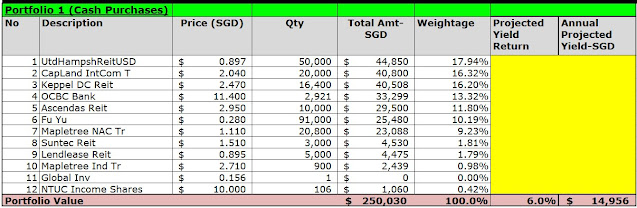
1. Portfolio 1- Stocks held in SGX Central Depository

During the past month, I have been accumulating units in Capitaland Integrated Commercial Trust ("CICT"). Its unit has dropped significantly since an all time high of S$2.35 per unit earlier this year to around S$2 per unit recently and I bought an additional 5,000 units in mid-December period.

On 27th December 2021 (Monday), I certainly regretted not buying more units of Mapletree North Asia Commercial Trust ("MNAC").  At that juncture, I was planning to add on another S$10K of investment into either MNAC or CICT. Since the price of MNAC surge suddenly (on hindsight, this seems most likely due to leakage of the upcoming corporate action), I decided to invest the additional funds into CICT instead. There is also an upcoming downside risk holding MNAC which I will probably elaborate more in another blog posting. Basically, this downside risk will also materialise in the proposed new entity but in a somewhat subdued form with the new geographical diversified property portfolio. Nevertheless, there will still be some adverse impact.

2. Portfolio 2- Margin purchased securities

I did not make any additional investments in the month of December 2021 into this portfolio. The only thing I did was to continue using my dividends received to pay down the borrowings from the margin facility. 

3. Portfolio 3 (with Tiger Brokers)- Venture into higher risk as well as capital growth stocks here

No change here for the month. 

Alibaba continued its downward slide. In short, terrible share price performance so far. 

Dasin Retail Trust is having problem getting the bankers to continue lending it money and was on the verge of syndicated bank loans default. A trading halt was called and an announcement was made that the loan renewal is still in discussion stage due to last minute new requests by some of the lenders. However, the bankers extended the loans by another 3 months to give it some much needed breathing space.

Parting thoughts
The venture into my portfolio 3 for capital growth using higher risk stocks seems to be doing badly. Good thing here is that I have restricted the funds being deployed here to keep it small. The rest of the portfolio following the income investing approach is still holding up well.  My StocksCafe is showing me a total of S$43K of dividends received this year (2021). Not too bad, considering the impact of COVID on low distributions declared from late 2020 to 1st half of 2021. 

Tuesday, 28 December 2021

Trading Halt For Both Mapletree Commercial Trust and Mapletree North Asia Commercial Trust

Trading halt was called since this morning for both Mapletree Commercial Trust ("MCT") and Mapletree North Asia Commercial Trust ("MNACT"). Looks like a possible merger and acquisition involving the two REITs to build up its size for greater synergy? Yesterday, I was trying to buy additional Mapletree North Asia Trust due to its high distribution yield of around 6.5% but was very surprised to see the price keep shooting upwards and have to give up. SGX  regulators ought to do better in preventing leakage of important information from leaking out before major announcements. In the end, I decided to invest the extra cash into Capitaland Integrated Commercial Trust (this is another story that I will share on another day). Let's keep our fingers crossed that Mapletree will come up with some value adding initiative in their upcoming announcement for all investors.

(Note: I am currently vested in both MCT and MNACT).

Tuesday, 14 December 2021

Dasin Retail Trust On The Verge Of Bankruptcy Declaration? Will It Be Suspended From Trading on SGX?

This is a follow up on my previous post on Dasin Retail Trust ("Dasin") on 18th September 2021 with regard to its debt crisis of S$500Mil since the syndicated bankers were willing to only grant a short term extension of 5 months from July 2021. The day of reckoning for Dasin approaches this week with the bank loan officially being in default on 19th December 2021 if it is unable to secure support from the syndicated bankers. Up till today, there is still no news being released by Dasin's new Trust Manager, Sino Ocean on SGX. Dasin's senior management has been silent since the last announcement made to the public on 7th November 2021 on the change in new Trust Manager. Unit prices for Dasin also dropped sharply and is now near its all time low at S$0.375 per unit in stark contrast to S$0.785 per unit during its peak this year. The silence for so many weeks in the face of imminent loan default is deafening. Are we witnessing the calm before the storm?
1. Taking calculated risk
I am still holding on to my small stake in Dasin Retail Trust as my investment thesis is that since the new Trust Manager, Sino Ocean which took over is a listed company on the Hong Kong Stock Exchange and well-known, the bankers will be willing to grant a long term extension of the due bank loan instead of rolling into a default and proceeding with creditor winding up process. Forced sales of investment properties is not going to be good for all stakeholders. Its current dividend yield is close to +14.2% based on its last unit price of S$0.375 per unit as at 14 December 2021.
2. Liquidation stress testing of realisable assets to repay bank loans and Unitholders
I have written in to the Customer Relation Officer on their website but till now have not received any reply on the status of its bank loan negotiation. In the worst case scenario, we have to assume that the fair value of the investment properties in Dasin's books have been severely inflated. If distressed selling price is at a discount of <-47.3%> of its last disclosed numbers, then this will mean a total loss for current investors-pls see below screenshot for illustrative simulation model. Not impossible given the case of Eagle Hospitality Trust. Also, given that China property debt crisis from Evergrande- if not managed well- may lead to a case of economic meltdown in the entire China market across all sectors. However, I am keeping my fingers crossed that the discounted selling price is at most only 40% off the last valuation in order to recoup back some of the investment costs. 
Parting thoughts
I have no idea how my tiny foray into Dasin will turn out. My investment thesis may turn out to be totally wrong. If so, this will be the 2nd SGX listed Trust (within this 2 years) that collapsed with investors losing all of their investments. The only good thing about Dasin is that the results will be known quickly by next Monday (20th Dec 2021) latest. It will either increase by maybe 50% from good news on renewal of bank loan or be suspended indefinitely due to default of bank loan when the announcement is released.


Please also see my previous posts on Dasin: