Friday, 18 March 2022

Don't Be A Full Time Employee- Be An Options "Investor" Instead- Say Goodbye to Your 9-5 Job!

Tim: "I earned S$6K per month."

Duncan: "Me too! I also earned around S$6K per mth."

Tim: " I also got to use the Company car and work from 9am to 5pm and need to do overtime work sometime".

Duncan: " I work from home and so the car is not necessary for me. I only need to work 30 mins a a day and I have time to spend with my family"

Tim: "Wait? What? Wait a minute.....how?"

Duncan: " All I need to do is to spend some time doing research on great companies doing technical analysis and applying the right strategy in options trading and this helps me to generate about S$6,000 a month".  

Tim: "I see. So what are the strategies that you are mentioning? It is not for me. I am just asking for a friend."

Duncan: "Yes you can join us at our 2 hours option foundation class to find out how you can kickstart your option investing journey." 

Tim: "Alright, thank you!".

It is not necessary to do extraordinary thing to achieve extraordinary results. Similarly, just by working longer hours does not guarantee a higher pay in your 9 to 5 job. By learning how to invest in options, you are able to use less time to exchange for a better results than your 9 to 5 job!

Personal thoughts:
Wow, I saw the above advertisement video and is impressed. Looks like option trading can be a very good form of investment. Earning S$6K per month every month and only 30 mins required every day is definitely better than my sucky daily job as an employee. 

The Ministry of Education of Singapore should seriously consider including such courses in schools for all students to teach them to be financially savvy in options investing instead of letting many students eventually ending up as an employee in future and slogging in 9 to 5 job. Not sure whether Skills Future can be used for such courses offered by the advertiser. 

On a more serious note, I have seen seasoned investors using options and making money out of it along with their normal stock investments. However, options maybe risky....like a year ago, no one would have dreamed that Alibaba can hit $70-$80. So I am really wondering how many people can earn S$6K every month from it. If it is that easy, guess no one would be working in a 9-5 job....it would have destroyed many economies. 

Wednesday, 16 March 2022

Alibaba Rebounded Sharply After 30% Crash- Good Buy Or Time To Cut Losses?

Alibaba (9988) crashed from around HK$100 per share to HK$71 per share in less than a week. This is an incredulous plunge in value of almost 30%. US Sanctions on China over Ukraine interference, China regulatory on Tech firms as well as potential delisting of China businesses on US Stock market culminated in the spectacular downfall of China tech stocks and Alibaba was knocked out. The speed of investors bailing out of China equities reminded me of the days in 2008 Global Financial Crisis. 

Thankfully, Alibaba and most tech stocks rebounded today (16th March 2022) by over 20% after the irrational selling the day before. It closed at HK$90,70 as at 16th March 2022. I have already exited the bulk of my Alibaba investments on the 1st week of March 2022 and currently still vested in 100 shares of Alibaba 9988. I am also fortunate to have stopped additional investments into Alibaba from my Tiger Brokers portfolio since 2nd December 2021 as I decided to mitigate the risk of holding excessive Alibaba stocks.
Parting thoughts
Basically, I still think that the fundamentals of Alibaba are still intact despite the crackdowns by China regulatory, threat of US delisting and the lower growth rate going forward. However, I think that there maybe some good opportunities to take some calculated risk for investing the funds into other riskier stock investment. I may rotate the funds back into Alibaba later on as I think that the recovery for Alibaba will not be so soon given the above negative factors all coming together. 

Saturday, 12 March 2022

Dasin Retail Trust 15.4% Distribution Yield Per Annum- Typical Value Trap Or A Hidden Gem?

Dasin Retail Trust ("Dasin") S$500Mil syndicated bank loan is still in limbo despite the past 2 loan extensions- latest extension being given is from 20 December 2021 till 19 March 2022. Once again, there is not much news or disclosure from the Senior Management of Dasin with regard to the status of the syndicated bank loan albeit the deadline of 19th March 2022 fast approaching. The unit price of Dasin has been severely punished by the market and has dropped from its 52 weeks high of S$0.765 per unit to S$0.310 at its lowest point due to the high possibility of bank loan default. As at 11 March 2022 (Friday), the unit price of Dasin recovered slightly back to S$0.340 per unit. The late payment of distribution for the 1st half of FY2021 as well as the repeated failures to renew the syndicated bank loan for the long term have dented investors' confidence and it looks like Dasin will keep trading well below its NAV of S$1.40 per unit for a very long time. In addition, the free cashflow analysis which I came up with seems to be pointing to an unsustainable current distribution rate from Dasin in the long run (I will elaborate this point later on).
1. Dasin Retail Trust 15.4% Distribution Yield Per Annum- Typical Value Trap Or A Hidden Gem?
First and foremost, the super high +15.4% distribution yield is due to distribution waiver by the substantial unit-holders. The income waiver over the past few years end on FY2021. Going forward, there will no longer be waived since the business is deemed to have stabilized. Without the income waiver by the sponsor, the distribution yield will only be at +13.7%. This may still appear high but there are 4 main worrying points to take note in case one thinks that Dasin at its current price is a hidden gem and cash cow.

1(a) Worrisome plunge in fair valuation of its shopping malls for 2 consecutive years even as COVID brought under control in China in 2021
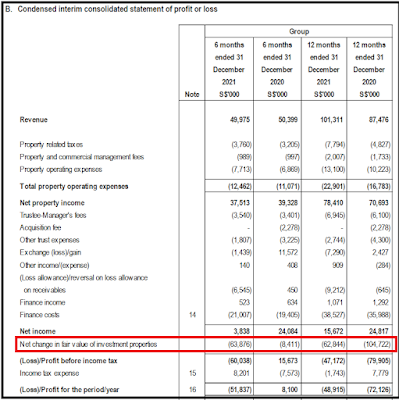
In FY2021, fair value of its shopping malls dropped by <S$62.8Mil>. In FY2020, this fair valuation was <S$105Mil>. Total fair valuation decline over the past 2 years combined is <S$167.8Mil>. Since the valuation methodology is based on discounted future cashflow by Jones Lang LaSalle, this means that expected future cashflow has plunged. This maybe attributable to higher interest rate and also lower occupancy rate [please see 1(b) below].

1(b) Occupancy rate of its mall has dropped further
As at 31 Dec 2021, occupancy rate of the shopping malls have dropped to 93.9% relative to 96.5% as at 31 Dec 2020. This is strange considering that by FY2021, the COVID situation I thought is already better managed in the whole of China. 

1(c) Is the free cashflow available for distribution sustainable on a longer term?
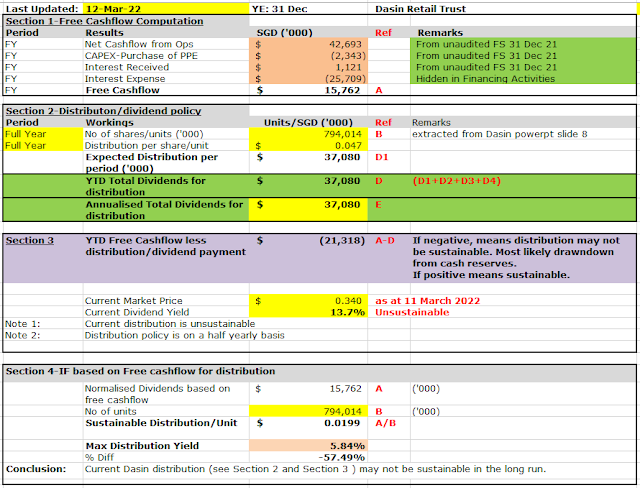
The free cashflow does not seemed sufficient at all and being financed from current pool of existing cash balances. This will dwindle over time. The current distribution by Dasin is unsustainable in the longer run. If based on free cashflow, the sustainable distribution yield will only be +5.84%.  This is where I find it extremely worrying. I will probably do a more in-depth analysis on this enigmatic issue if Dasin survived the upcoming bank loan default.  
 
1(d) Can't help but wonder whether the numbers reflected in its financials and presentation are reliable
In addition, I sometimes wonder whether the numbers presented in Dasin's financial are reliable. 

-Are there also as many tenants still operating in the different malls with good footfall from shoppers?

-Are there also huge unrecorded liabilities that is waiting to pounce on unsuspecting unit-holders? 

-Does the bankers have in possession certain unfavorable information that is why the refusal by some of them to to refinance the syndicated bank loan even after 2 extensions?

However, to be fair, not all signs are gloom and doom with regard to Dasin as I will further elaborate in Paragraph 2 and Paragraph 3 below.

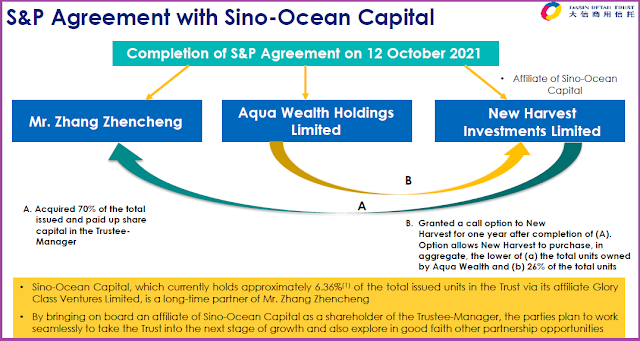
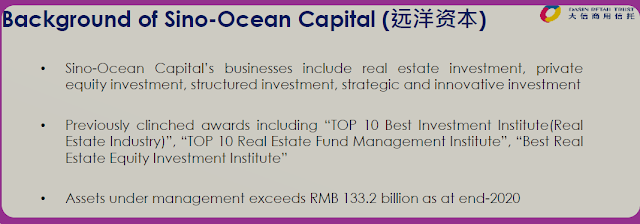
2. Reputable new trust manager and major shareholder-Sino Ocean


Sino-Ocean Capital is listed on the HKSE. So at least there is a glimmer of hope that the bankers will be willing to re-finance the loan given the better reputation and financial position of Sino-Ocean.

3. NAV of Dasin is at S$1.40 per unit- Market Price/NAV ratio of an incredulous 0.243
If one look out the latest China Retail Focused REIT/BizTrust Comparison by Vince on REIT-TIREMENT, we can do a rough comparative benchmark to similar retail REITs as follow: 
-BHG Retail- 0.59 
-Sasseur REIT- 0.88

If we are conservative, we can just use the lower BHG Retail REIT's ratio of 0.59 as reference benchmark. So, if Dasin managed to survive the bank loan renewal crisis, then its fair market value may have a potential upside of recovering to S$0.826 per unit. This is a whopping 147% potential upside in capital appreciation. Of course, this is just a speculation as I am somehow unable to figure out the root cause of the low free cashflow for Dasin as alluded to paragraph 1(c) as aforesaid mentioned.  This is also subject to the reliability of the financial figures being provided by Dasin with no hidden surprises.
Parting thoughts
The free cashflow evaluation seems to be pointing to a future cut in distribution to unit-holders as it is not sustainable in the longer run since it is being drawn down from available cash and leverage.  Anyway, this intriguing issue is not important right now. The upcoming deadline for renewal of the bank loan is perhaps the crux issue for Dasin now as it will determine whether there will be an immediate rights issue to repay the syndicated bank loan or a forced liquidation of investment properties. Saying that, there is also the possibility that the end of Dasin is once again postponed by the bankers should they choose to kick the can down the road for another 3 months extension on 19th March 2022.

Thursday, 10 March 2022

Lendlease REIT Plunged 11.6% Since Beginning Of The Year-Curse of the JEM Acquisition.

Ever since the announcement by Lendlease Global Commercial REIT ("LREIT") on 14 February 2022 (Valentine's Day coincident release?) that it will be acquiring the remaining stakes in JEM, its unit price has taken a wallop. No, this is not just the impact of the Ukrainian Russo war or global interest rate hikes, but some investors seems to be upset at certain aspects of the deal such as the upcoming issuance of so many new units which reduces the NAV of LREIT to a mere S$0.80 per unit. For most companies, if they announced a mega deal, prices theoretically should go up but LREIT went all the way down from its S$0.90 per unit at beginning of the year till it hits an all time FY2022 low of S$0.795 per unit on 8th March 2022 a day after the EGM. So what exactly happened to LREIT? A mega-deal now became its Achilles heel and curse? 
1. Main query by some unhappy unitholders to directors of LREIT-NAV  decline to S$0.80 per unit
NAV per share declined to S$0.80, which is not better for unitholders as it means that that acquisition price is too high. The drop is due to the high number of new units to be issued. However, considering the fact that NAV per unit before the acquisition for FY2021 is only S$0.81 per unit, I think one can actually live with this slight drop. It is strange that after the EGM on 7th March 2022, the price did not even bounced up. 

Personally, I thought that the Profit Before Tax is the most important as it will determine the ultimate distribution payout (DPU) to unit-holders-please see paragraph 2 below.


2. Distribution Yield improves by 1% point from 5.2% to 6.22%
This is where it gets very interesting. Price per unit of LREIT is around S$0.90 at the beginning of the year. At a pre-acquisition DPU of S$0.0468, this represented a yield of only +5.2%. However, prices after the EGM hovers around S$0.800- S$0.805 per unit. If we further add in the impact of GEM acquisition, this will boost the DPU to S$0.0501 per unit. This is a yield of +6.22%. For passive income investors, LREIT suddenly seems to be a better deal considering other REITs such as Capitaland Integrated Commercial Trust distribution yield is only around 5%. 

In addition, the GEM acquisition adds much needed diversification into LREIT's only 2 properties of Sky Complex and Somerset 313 @ Orchard. LREIT's new offices of Sky Complex in Italy and GEM Offices now consists of 2 extremely resilient recurring rental income streams from Sky Italia, a subsidiary of Comcast Corporation (one of the world's largest broadcasting and cable television company) and also the Ministry of National Development of Singapore respectively. 
However, there are some some worrying points to take note of- please see paragraph 3 below. 

3. Issuance price and sufficient cash on hand to avoid dilution 
(i) One unknown factor of concern to me is how low the rights issue of units will get priced. The illustrative example used  in the presentation materials states that this is S$0.82 per unit. Obviously, if one is going to issue at S$0.82 per unit when the market price is only S$0.805, this rights issue will never work. Why would one subscribe to a higher priced rights issue when one can get it from the market at a lower price?
Extracted from "Reponses to Questions from Unit-holders" by LREIT Management-1st March 2022

(ii) The other worrying part is that to acquire the remaining 68.2% in JEM, LREIT will need to raise financing of S$1,790Mil. This is an enormous eye popping sum. The elephant in the room is how much is the share of contribution for retail investors like us who do not have deep pockets. From the above extract, it seems that 40% (S$718Mil) of the required funds will need contribution from all unitholders (excluding the Sponsor). If including the sponsor's share and the recent approval to issue up to 1,265 Mil units, price of new units can go down to S$0.752 per unit.

(iii) Last but not least, for retail investors who entered at S$0.90 per unit at the beginning of the year and no longer has any spare cash, it will not be fair if latter institutional investors or existing investors managed to get new units at say S$0.752 per unit. Retail investors thus need to commence raising cash on hand position to prepare and participate in the upcoming preferential retail tranche rights issue. 
 
Parting Thoughts
Based on the above, the JEM acquisition can be either a curse or a blessing in disguise depending on when one bought into LREIT. Personally, I think that the current price of S$0.805 per unit seems to be relatively more attractive to some of the other retail & office REITs out there on SGX. There will also be recurring tax savings of S$5.6 million per annum due to the restructuring of the fully acquired GEM into the REIT structure. I do not mind earning a 6.2% distribution yield annually while waiting for capital appreciation upsides. 

Monday, 7 March 2022

Investment Portfolios Updates- S$613k (4 Mar'22)- Impact of Ukraine and Russia War

The net assets value went down overall due to the invasion of Ukraine by Russia. Oil prices soared to USD129 per barrel on fear that the United States and its European allies will be banning imports of Russian oil. As energy prices went out of control, this will impact all aspects of products and services hence stock markets continued to react adversely to the ongoing Russo-Ukrainian war. 

1. Portfolio 1- Stocks held in SGX Central Depository
I have sold off my units in Mapletree NAC Trust and bought additional units in United Hampshire US REIT and Lendlease REIT from the sales proceeds.

Lendlease REIT has just announced the remaining acquisition of JEM shopping mall. I am rather intrigued by this additional acquisition of a suburban shopping mall along with its office property signed on a 30 year tenure with the Ministry of National Development. This new additional acquisition of the remaining stakes will improve the defensiveness of the earnings of Lendlease.

United Hampshire US REIT offers a very extremely attractive distribution payout of 10% per annum as its market price keep dropping despite good earning results.

2. Portfolio 2- Margin purchased securities
OCBC is interesting. Despite missing their Q4 2021 results against expectations of market analysts, it is still at an overall improvement of 35% net profit for FY2021 relative to FY2020. What's more, the reason for missing target is due more to conservative allowances being made. Personally, I felt that the market seems to have overreacted with a 5.8% drop in OCBC from S$13.16 to S$12.40 on 23 February 2022. Then as at 25 Feburary 2022, it further slumped to S$11.85 per share following Russia's invasion of Ukraine. I have started accumulating additional OCBC shares during this period.

3. Portfolio 3 (with Tiger Brokers)- Venture into higher risk as well as capital growth stocks here
Alibaba continued its downward plunge. Terrible performance so far as the growth rate no longer meets market expectations. I have sold off part of my Alibaba holdings to take on higher risk in Dasin Retail Trust by placing a bigger stake here. Will Dasin Retail Trust enter into bank loan default in mid March 2022?

United Hampshire US REIT announced a very good set of 2nd half and full year 2021 results. It has consistently performed well with an extremely attractive distribution yield of 10.0%. United Hamsphire has delivered resilient results throughout this COVID crisis. However, its unit price is currently at a miserable US$0.610 as at 25 February 2022.  Hence I have continued additional bite size investments into this US REIT.

Parting Thoughts
Despite the huge drop in valuation of the investments under my portfolio, I expect the dividends payout for this year to remain consistent. I am currently expecting S$13K of dividends distribution payout in March 2022. This period of gloomy sentiment represents a good time to continue to add on to more banking stocks or REITs to improve on the dividends receipt. I am currently looking forward to the rights issue of Lendlease REIT as well as the listing of Mapletree student accommodation REIT.

Sunday, 27 February 2022

United Hampshire US REIT Super Attractive 10% Distribution Yield Per Annum- Cash Cow Too Good To Be True?

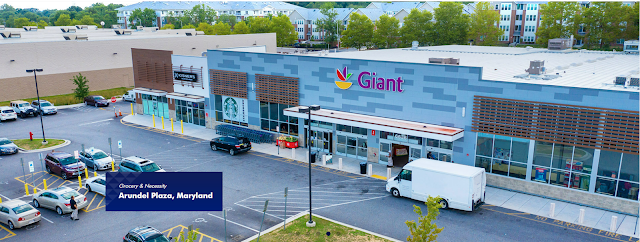
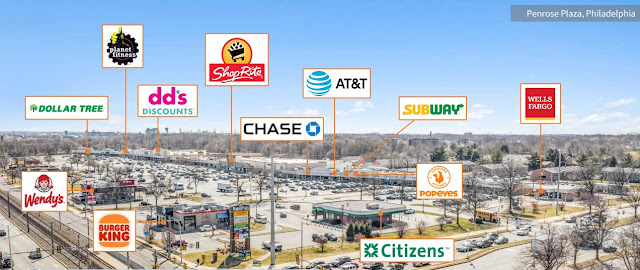
With the invasion of Ukraine by Russia, United Hampshire US REIT ("UH REIT") was not spared the carnage on world-wide stock markets with the already low trading price being further hammered till US$0.61 per unit as at 25 February 2022 (Friday) closing despite the relatively good results just being announced. Given the total DPU for the full FY2021 is US$0.061, this means an extremely attractive distribution yield of exactly +10.0% per annum, not withstanding the fact that the latest acquired properties contribution only came into effect on 14th October 2021. This also means that for FY2022, UH REIT stands to enjoy another upside of 9.5 months of additional rental contribution coming from Penrose Plaza Philadelphia and Colonial Square Shopping Centre Virginia. I will also attempt to elaborate a bit later on why the current ongoing war in Ukraine actually benefits REITs based in US. 

1. 2nd half 2021 results highlight
Financial highlights comparison to forecast and historical results

Operating metrics appear healthy

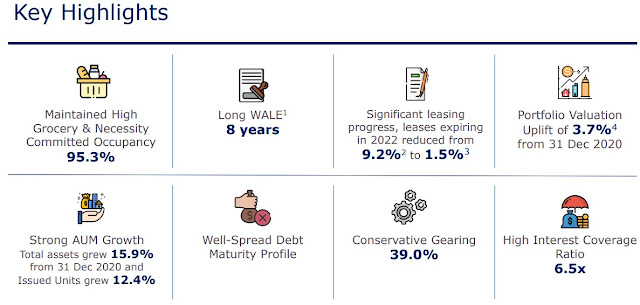
As we can see, UH REIT financial results remain well within expectation. Its performance has also improved a lot if compared to historical 2nd half numbers. Operating metrics such as leases expiring in 2022 has been reduced from 9.2% (as at 31 Dec 2020 )t o only 1.5% (as at 31 Dec 2021) with good work by their business development team on renewal. In addition, its WALE is relatively high at 7.9 years which gives much stability to recurring rental income. 

2. Sales of self storage facilities and income support complaint by retail investors
I am glad that UH REIT has entered into a conditional sales of their self storage properties Elizabeth and Perth Amboy for a sales consideration of US$49 Mil (before transaction costs). Taking into account the purchase price of US$43.4Mil inclusive of income top-ups, this represented a +12.9% sales premium. 

Whenever UHREIT is mentioned, there will be retail investors bringing up the topic of income support of these facilities and associated grievances about the "artificial" rental income. It is thus good to realise the associated profits with these self-storage to lock the profits and then recycle the capital. 

3. Effect of ongoing war in Ukraine by Russia on US.
The ultimate winner of the current Ukraine war will be USA. US will be selling more weapons to its European allies in view of the "belligerent" Russia Federation. The shale oil industry in US will also benefit from the upcoming sharp increase in oil & gas prices not to mention the possibility of exporting oil to European allies should Russia stop the shipment of oil & gas to Europe in view of the SWIFT ban being imposed on Russian banks. 

During world war 1, the US economy was in recession. But a 44 month economic boom ensued from 1914 to 1918 as Europeans begin purchasing US goods for the war. Such is the economic reality of war. So, I expect the economy of US to be doing very well in the near future albeit the ongoing smaller scale war. This should continue to support grocery and necessity properties from the trickle down effect. 

4. Main key risks for investors of UH REIT
Retail investors need to also consider risk factors associated with holding on to UH REIT and not get overly excited with the incredulous 10% distribution yield annually.

a. Rental rates cannot catch up with the rapid inflation. 
While there are rental escalation clauses, the rate of inflation spike may be a lot higher and faster than the allowed rental escalation.

b. US withholding tax changes.
We need to be careful of US tax authority IRS changes in tax rules. Currently, the US REITs listed on SGX are using special vehicles in US and sending back dividends to Singapore via a capital distribution model in order to get past the withholding tax requirement (tax shield). Note that US authorities may pass legislation to change this and having withholding tax being levied will reduce a substantial part of the dividends derived from US properties. 

For those interested on the technicality of the US tax shield employed by US REITs listed on SGX, I have previously done up a short write-up on the background and origin of "capital distribution" of US REITs in my Manulife US REIT posting here.

c. Low trading volume on SGX.
Personally, I find the daily trading volume of UH REIT to be on the low side. It is not very liquid. If one is in urgent need of cash and needs to sell, you may have to drop the price a lot in order to liquidate your holdings fast.

d. Loss of economic moat due to e-commerce
What if online fulfilment became cheap and efficient enough to deliver groceries directly from vendor's warehouse to the consumer at their own home? Will renting physical property still be necessary? Retail investors will need to keep a close watch on the market trend and sell immediately if this model of ownership is no longer relevant. The issue of being geographically far from the actual location of the properties to have adequate and timely visibility is another physical challenge in monitoring. 
Parting thoughts on UH REIT being a cash cow with super attractive yield of 10%
Notwithstanding the key risks as discussed above, FY2022 looks set to be another good year for UH REIT with the upcoming sales of the self-storage properties at a premium of 12.9% to cost as well as the additional rental contribution from Penrose Plaza and Colonial Square Shopping Centre. If UH REIT can re-deploy the sales proceeds fast enough for additional yield accretive acquisition towards the end of FY2022, this could be another price catalyst. I do hope that the sales of the self-storage properties would at least unlock part of the hidden value trapped within the current US$0.61 per unit which is grossly undervaluing the REIT from its IPO price of US$0.80 per unit in March 2020. UH REIT has so far produced a good track record of its resilient earnings throughout this COVID pandemic since IPO.  

Friday, 25 February 2022

War in Eastern Europe- Time to Sell Off All Stock Investments or Investment Opportunities Arise Again?

I will start off this blog post with some personal updates about myself. The past 2 weeks has been a real struggle for me. Last Monday, while preparing to go back to office, I performed my ART routine as usual and this time round, I was shocked to see a double line. I did not feel unwell except for feeling a bit of itchiness in my throat at that time only. I also became the pioneer employee who became the first staff to contract COVID in my company. Thereafter, all hell broke lose and COVID became rampant in Singapore with daily cases over 15K to 16K. Good news is that it feels like getting the normal flu with a bit of blocked nose and sore throat similar to what the MOH website published 99.7% statistics of people who got COVID will experience mild symptoms. But well, you never know whether you will end up as the 0.3% statistics of severe case that need hospitalization treatment for oxygen or other medical treatments if we take this too lightly.
1. War in Eastern Europe by Russia against Ukraine- Time to sell off investments or Investment Opportunities?
Just coming off the worldwide interest rate hike crisis which hits stocks badly, we now have another crisis coming out of Eastern Europe. Russia has decided to invade Ukraine. The Singapore Stock market plunged on 24 February 2022 (Thursday) with the short announcement by Putin (who increasingly seems to be behaving a lot like the previous dictator Joseph Stalin of the Soviet Union) that Russia will be launching a "military operations" against Ukraine. I think that this is just playing with words. An invasion and war is what it is. Let's call a spade a spade. 

It is interesting to see their ally China being placed in an awkward position with their foreign affairs ministry also trying to label this invasion as a "military operations" instead of an ongoing war in order to show solidarity behind Russia.

So is it now the time to sell off all stocks to avert the current market instability and further downsides?

2. Time to sell off all stock investments?
My usual thoughts are that it is very difficult to time the market. While the initial shock will typically cause the stock markets to sink into the red, the stock markets will eventually recover. I only did some minor sell off during the past few days to capitalize on stocks which have dropped significantly. No point trying to do mass selling and then trying time a market low to re-enter as one may miss out on the recovery surge. Anyone who tells you that they can accurately predict high point to sell and low point to re-enter the market from their crystal ball is just nonsense.

My own personal thoughts are that the end game is near. Without US and NATO support, Ukraine is doomed from the start against a more advanced and bigger armed forces of Russia. It also does not help that by end of Day 1 of the invasion, Russia has won air supremacy over the whole of Ukraine. 

I do not think that this will be a long drawn out war that will affect oil and gas supplies for too long.  While Ukraine history with Russia is complicated and both of its people are vastly different, there are many with families with ties in both countries. Hence I do not think Putin is out to totally destroy the people of Ukraine. Rather, Russia is trying to control the government of Ukraine to turn it into a puppet state in order to secure its own dominance in Eastern Europe.

3. Investment opportunities and my watchlist
There are many good bargains from the recent decline in stock prices on SGX. USA stock market still appear very high to me. China stock market is worrying due to the near collapse of their property sector which made up a huge proportion of GDP. As alluded to point 2 above, I do not think the current fear of sanctions and oil supplies disruption will spill over excessively on a long term basis to cause irreparable damages to global economies.
OCBC is interesting. Despite missing their Q4 2021 results against expectations of market analysts, it is still at an overall improvement of 35% net profit for FY2021 relative to FY2020. What's more, the reason for missing target is due more to conservative allowances being made. Personally, I felt that the market seems to have overreacted with a 5.8% drop in OCBC from S$13.16 to S$12.40 on 23 February 2022. Then as at 25 Feburary 2022, it further slumped to S$11.85 per share following Russia's invasion of Ukraine. I have started accumulating additional OCBC shares during this period. 
Another fascinating one would be United Hamsphire US REIT. It has consistently performed well with an extremely attractive distribution yield of 10.0%. United Hamsphire has delivered resilient results throughout this COVID crisis. However, its unit price is currently at a miserable US$0.610 as at 25 February 2022. 

Parting thoughts:
For every crisis, there will also be an opportunity. 2022 seems to have kicked off with a big bang.  I look forward to deploying my upcoming dividends receipt of S$12K in March 2022 back into the market. 

Last but not least, I wish everyone good health and all the best to you folks in your 2022 investment!