Monday, 28 November 2022

Manulife US REIT Upcoming Strategic Review- Will Unit Price Shoot Up Substantially Like Singapore Press Holdings Post Its Review?

Great news! Manulife US REIT ("MUST") just announced on 25th Nov 2022 (Friday) that Citigroup Global Market Singapore has been appointed as its financial advisor to conduct the much anticipated strategic review of its business. Please also refer to my previous post:  "Is Manulife US REIT A Good Buy at over 14% Distribution Yield Or A Dividend Trap?". I am pleasantly surprised that the CEO of MUST's Manager, Mr Tripp Gantt,  took such rapid action coming off the 2nd Nov 2022 announcement that MUST will be launching self-introspection on its mandate as an only office REIT. Based on the current unit price, MUST is giving out a high distribution yield of around 13%-14%. I will further elaborate on 3 major implications of this upcoming strategic review exercise as well as touch on the possibility of the worst case scenario (as well as other possibilities) that will leave existing unitholders in a lurch.    

MUST unit prices has been pulverised by almost 50% over the past 12mths due to weak structural demand  issues post COVID lockdown & rising interest rates

1. Signs that the drop in US physical office demand maybe perpetual in nature hence the strategic review.
The extremely low physical occupancy rate actually indicate that demand may never return to pre-COVID levels. Currently 33.33% to 50% in different states are back to office. The only question now is how much is the magnitude of this permanent drop. 

2. What other sector for its new business to venture into given the expertise among current management team?
Will MUST acquire warehouses or industrial buildings like Frasers Logistics & Commercial Trust ("FLCT") ? Or will it be venturing into Data Centres? If so, does its senior management team have the right expertise and proficiency given they have been managing only office buildings ? This bold move thus embolden certain business risk.

3. Even if the REIT ventured into other sectors, how would it finance and execute this transformation?
Now, this is the million dollar question. Will MUST start to sell off some of its freehold office buildings and then switch to acquiring new properties in other sector? Or will it spell a rights issue at the current pathetic unit price of US$0.385 and dilute all existing unitholders?
4. What are the other types of possibilities from this Strategic Review?
Due to the drastic sell-down, MUST unit price of US$0.385 as at 25 Nov 2022 is at a ridiculously low level compared to its net asset value of US$0.70 per unit as at 30 June 2022 (Mid year financial announcement). Besides the option of change in mandate to diversify into other sectors, there can also be 2 other options/scenarios:

4.1- Sell off some office buildings to realise its fair value of US$0.70
MUST can simply choose to sell off some of its freehold office buildings to realise its fair value. Since this is not a fire-sales, MUST will be in a strong position to negotiate with prospective buyers on a package deal. This has the potential to unlock value up to 82% with such realised sales. This can then be distributed out to unit-holders as a return of capital and an immediate catalyst to support the ridiculously current low unit price.

4.2- Buyout existing unit-holders at 20%-30% premium to current market price with investment firms and privatise immediately and subsequently seek to re-list at US$0.70 in another 2-3 years with some changes to assets mix.
Now, MUST can play punk and use a notorious method to take advantage of the current low unit price by offering a 20%-30% premium price to unit holders (by working with a few well-heeled partners) for them to privatize the REIT.  They could offer US$0.462 per unit to US$0.501 per unit to rally enough support from existing disgruntled investors waiting for a quick bailout.

After fine-tuning the properties mix with some add on, they can relist the REIT publicly at its fair value to earn big bucks for its partners.  However, many unit-holders will most probably be cursing and swearing at MUST management for short-changing them as many would have invested when price were hovering between US$0.70 to US$1.00 range 2-3 years back.

Parting thoughts
Personally, I thought that the conclusion of the strategic review would most likely lead to a huge rally in unit price of the currently badly battered MUST. The former Singapore Press Holdings share price is a good example of the eventual sharp rebound from its strategic review exercise. I have invested another 18,000 units of MUST (@US$0.385) per unit over the past week upon the appointment of the financial advisor. 

(Note: There is no guarantee that MUST will implement any of the options identified through the strategic review. Also, MUST management reminded unitholders to exercise caution when dealing in the units of Manulife US REIT and to refrain from taking any action in respect of their investments which may be prejudicial to their interests. In the event unitholders wish to deal in the units of Manulife US REIT, they are advised to seek their own professional advice and consult with their stockbrokers, bank managers, solicitors, accountants and other professional advisers if they are in doubt as to the actions they should take.)

Saturday, 26 November 2022

PSLE Results Does Not Determine Our Kids Future- look beyond that!

I am sure by now many parents of their primary 6 kids would have "chilled down" after the Primary School leaving Examination (PSLE) results were released on 23rd November 2022 (Wednesday). Like most parents, my wife and I have butterflies in our stomach while the school principle was addressing the school on overall results. The 98.4% news header of PSLE students progressing to secondary school looks impressive but underneath this glamorous front, there is a big can of worms festering in our education system. 

1. How the new Achievement Level System Works?
The Ministry of Education made a deliberate shift away from the old T-score system in 2021 so that students do not chase the last mark. An obsessive overemphasis on examination results is not healthy for the development of our children. 2022 is the second batch of kids sent to the butcher embarking on this fantastic new grading system.

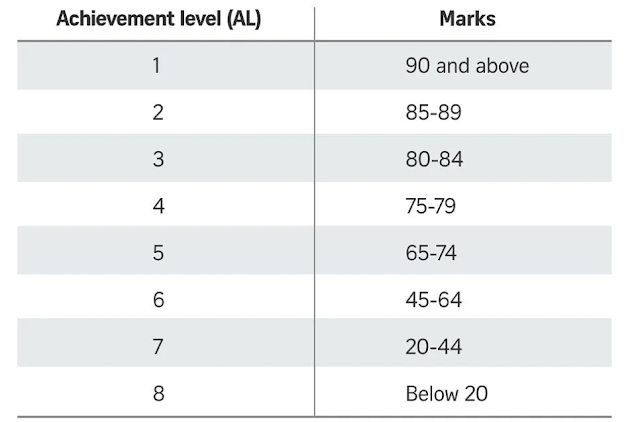
Under the new scoring system, each standard-level PSLE subject is scored using eight bands known as Achievement Levels ("ALs").

Each pupil is given AL scores from one to eight for each subject, instead of grades like A* to E.

Instead of the previous T-scores, a pupil's total PSLE score is now the sum of the AL of each of the four subjects, with the best possible total score being 4 points.


A key feature of this new system, first announced in 2016, is that pupils will be graded based on their individual performance in the subjects, regardless of how their peers have done.

2. Why it still sucks?
Basically, this new scoring system sucks big time still and I don't see how it reduces the stress level. In fact, it worsen the situation in particularly if a student is weak in Mother tongue and keeps failing it but excel in English, Maths or Science. No longer can he or she rely on the total score to plug the deficit in one subject. 90 for Maths or 100 marks for Maths still constitute an AL1 score only.   

The numerous tuition and book mugging continues under the new AL system.

3. Failure of the primary school system
I was shocked beyond words that only 51% of students scored 65 marks and above for English and Maths respectively for my kid's primary school. This means that the rest of the 49% of student population will score below 65 marks and I thought Singapore pride itself on its maths programme. When I check with my friends/colleagues with kids in other school, I was told that the statistics is almost the same. I think that our MOE need to seriously re-look at improving these numbers to help more students. 

4. Does PSLE results really show your child's aptitude?
I was speaking to other parents whose child has been doing well for say Maths or their Mother tongue consistently (AL1 to AL2) for past 2-3 years but screwed up in PSLE and their grade dropped 2 bands lower. So does this mean that the child cannot make it in these subject? Unfortunately, exam stress does happen.

For my own kid, the school principal exerted considerable influence on my kid who has a flair for his mother tongue to drop his Higher Mother Tongue subject as he did not do as well for other subjects during Primary 5 final exam (so that have more time to concentrate on scoring better for other subjects in following year PSLE). It is sad that our education system is no longer geared towards developing what the child excels in but instead became a tool for the school to look better statistically for the PSLE.  

Parting thoughts
If we want to really stop the current PSLE madness and stress, I have this extreme thought that perhaps we need to stop having PSLE at the young age of 12 years old and focus more on delivering a more holistic education and with more resources and time devoted to kids who are weaker in a particular subject. Why waste so much time on PSLE preparation? I have seen and heard of major disappointments and kids breaking down in tears over their PSLE results. Is it really worth it to put our kids through this? Anyway, above are just my personal thoughts. Wishing fellow parents in the same predicament all the best in their school open houses visit to finalize the secondary school application exercise. 

Tuesday, 22 November 2022

Digicore REIT Self Implosion- 58% Plunge In Market Valuation Within 1 Year And Is It A Star Buy Now?

Digicore REIT is one of the worst performing SREITs over the past 1 year. From its peak of US$1.20 per unit during Jan 2022, its unit price dropped to US$0.50 as at 31 October 2022. This is a shocking plunge of <58%> of its market valuation, all in less than 1 year. If one had subscribed to its IPO in December 2021 at US$0.88 per unit, the loss would still have been a mind-boggling  <43%> decline in original investment cost. Current market price of Digicore REIT is languishing between US$0.50 to US$0.60 per unit. As at 22 November 2022, its unit price of S$0.555 means that it is at an annualised distribution yield of 7.42% which is way higher than what Mapletree Industrial Trust (6% yield) and Keppel DC REIT (5.6% yield) are offering. In addition, its future distribution is expected to grow 2% with the upcoming partial acquisition of Frankfurt data centre. So whatever happened to Digicore REIT for the market to punish it so severely? Is Digicore REIT a starbuy currently or is it a dividend value trap? 

1. Investors are very worried that the Tech Industry woes will spill over to Data Centres.
The main concern for investors seems to be that the current crisis faced by the Tech Industry will lead to many default in rental as well as lowered demand for data centres. It probably does not help that Digicore REIT had earlier announced that one of its major tenants, Sungard Availability Services, had filed for bankruptcy protection. 

In response to questions from unitholders, Digicore REIT disclosed on 17 November 2022 that it has reached an agreement with Sungard to amend the lease to allow for an orderly exit of the premises by 31 December 2022.

Digicore REIT also have in hand a surety bond or essentially a security deposit for two months rent. Moreover, the space in question is only 37,000 sqft and the REIT is confident of backfilling this space quickly. 

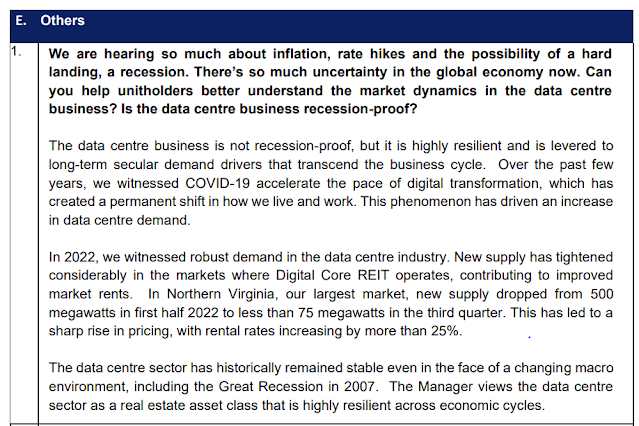
2. Interesting potential upsides of 25% increase in rental rate due to high demand for data centres and low supply.
Based on the heads up provided by the Senior Management of Digicore REIT on 17 November 2022, I thought that it is interesting that rental rates in future maybe renewed at a double digit rental reversion. Moreover, the data centre sector has historically remained stable even in the face of a changing macro environment, including the 2007/2008 Global Financial Crisis.   

Parting thoughts
Personally, I think that Digicore REIT is a starbuy at the incredulous 7.4% distribution yield on offer given the market expectation of an eventual 5% terminal borrowing rates by the US Federal Reserve. The huge decline in its price does offer one a relatively safer margin of error and to wait out the catch up in its market valuation.  I reckon that a 20% increase in future market valuation is certainly possible and will collect the high distribution yield while waiting. I have slowly been accumulating additional units of Digicore REIT during this down period. Saying that, I plan to keep my investment cost in Digicore REIT to less than S$50K.   

Tuesday, 15 November 2022

FTX Crypto Collapse A Good Parallel On How To Make Up Stories and Shift Blame At Workplace.

FTX's founder Sam Bankman-Fried is a genius. He has mentioned that for the billions of dollars being transferred from customer accounts at FTX to his own trading firm Alameda Research, is actually a "margin loan". Hence indirectly saying that it is not an illegal fund transfer. It is really amazing how FTX financial controls and internal governance actually allows a margin loan to single party to grow till so large. Even more puzzling is the fact that stakeholders such as customers, investors, employees and auditors themselves were not aware that the deposits in custody at FTX were being used for trading at Alameda Research. Who dare wins indeed! 

Maybe Bankman-Fried is now busy preparing a lot of documents to backdate them to cover his backside. We can probably employ the same tactic as Bankman-Fried in the real commercial workplace to make up story to cover up screw ups (this will make us similarly deplorable). 

The FTX crypto implosion is unfortunate and reflects the dark side of the promise of "decentralization" governance away from central authorities. I feel sorry for investors who were caught under the latest FTX collapse and I say this without any trace of schadenfreude. The inherent peril in investing in any assets is always there. It is just not possible to easily predict and prevent such collapse. Even Temasek Holdings poured US$200Mil of investments into funding FTX along with Blackrock. 

(Note: I lament at the complete loss of US$200Mil- imagine if the government had given out this to all Singaporeans instead and we can have $40 to S$50 per person to spend on an awesome meal at Din Tai Fung).     

Saturday, 12 November 2022

Is Manulife US REIT A Good Buy at over 14% Distribution Yield Or A Dividend Trap?

Manulife US REIT ("MUST") has seen its unit price diving from US$0.708 to US$0.375 in over a year. This is a whopping <47%> slump in its market price. US office REITS (MUST, Keppel Pacific Oak & Prime REIT) had all previously held up extremely well during the COVID 2020-2021 lock-down crisis but lately, their unit price had all plummeted and is offering an enticing 14% high distribution yield (as per StocksCafe). What is happening to US commercial office sector? While today's higher interest rate environment as well as concerns over implication of new withholding tax rule played a part in contributing to its downfall, there is another critical unresolved issue on hand which I should elaborate further below. 
1. Physical occupancy is well below 50% and at some US offices, just 33% had returned to office
While MUST reported that its overall occupancy for the recent period is 88.1% (down from 90% recorded as at end of 1H 2022), another more interesting indicator is the "physical office occupancy". The office scene in US is in stark contrast to the state in Singapore-it was reported that in some states, only 33%+ workers are physically back office with most still working remotely from home. In Singapore, most workers are already back office and you can tell from the many folks squeezing onto our MRT and buses rushing to work in the morning and the large crowd making their way home after work on public transport in the evening.

Just to side track, I saw that a number of folks use positive rental reversion as an indicator to justify that things are still looking well for US office REITs. I am skeptical on this as the positive rental reversion seems more of to do with inflation rather than directly linking to improved take up rate of office space hence not a direct reflection of the dire state of office rental market.

As at 12 October 2022, it seems that this number has gone up to 47.8 percent in places like New York. The numbers would probably go up further as CEOs of US companies are increasing their mandatory return to office mandate. Nonetheless, it appears that some form of hybrid working arrangement is here to stay post-covid lockdowns in US hence the demand for working space will no longer be as robust as 3-4 years ago. Apparently, this is a permanent shift in US office usage trending.

2. MUST launching hotelisation initiative of their office
Tripp Gantt, CEO of MUST’s manager, had announced in Aug 2022 that MUST will join the bandwagon of "hotelisation" of some of its office assets to adapt to the new realities that have arisen at the workplace, especially post COVID-19. What this means is that MUST will give options for more flexible use of its office space as well as provide curated experiences like having gyms for office tenants.

Personally, I am not sure how this hotelisation strategy will turn out. I can only conclude that in US, there is a drop in physical office space required and this trend seems permanent in nature, hence MUST and other US office REITs are definitely fighting headwinds. 

3.  MUST launches self introspection over its mandate as an office only REIT
In November 2022, Mr Tripp Gantt disclosed that MUST has commenced an introspection process within MUST as part of its efforts to rejuvenate its business operations. This provides strong hint that MUST management may soon diversify into other asset types besides office buildings acquisition. 
Parting thoughts
With over 14% high distribution yield at its current market pricing, I am wondering how MUST is going to do any yield accretive M&A deals. It maybe a good idea to sell off some of its office buildings and diversify into other asset classes in order to unlock intrinsic value for unit-holders. Despite the prevailing headwinds from market conditions as well as the high gearing ratio (over 40%), I think that MUST maybe in a better state than the other 2 US office REITs (Keppel Pacific Oak & Prime REIT) by virtue that their management team, led by Mr Tripp Gantt, have already kicked off an introspection process as alluded to point 3 above to rejuvenate their business and to re-position it for future growth.   

Please also see latest update announced by MUST on its strategic review on 25th November 2022:

Saturday, 29 October 2022

Investment Portfolios Updates- S$522k (28 Oct'22)- Investing During Bear Market Turmoil.

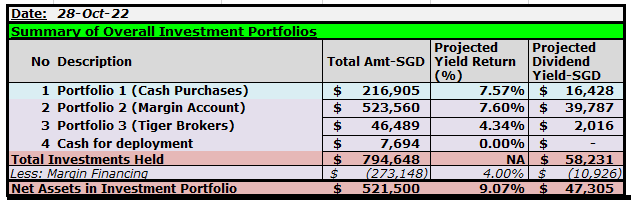
My net investments market value plummeted dramatically from S$613K to S$522K (a loss of S$91k) within a short span of 2 months. Gross investment before margin financing went down S$918K to S$795K (a decline of S$123K). I still vividly recalled being made "famous" by some retail investors during the March 2020 COVID crisis (whereby I faced an even worst decline) when my blog was published by those individuals on Hardware Zone forum as a good lesson to all on the danger of using margin financing despite them not knowing anything about my overall financial position and contingency plan in place. In addition, as an income focused investor, I am more concerned with the resiliency of dividend/distributions in my portfolios during bear market rather than the market value. I only have this to say about the use of margin financing: if one does not have any strategy, self-discipline or contingency plans in terms of managing leverage in different scenarios, then it is best to stay far away from it.

Anyway, the various global stock markets performance have been going up and down as if they are playing a game of Yoyo. The last 2 weeks has been extraordinary volatile with ferocious & rapid sell off in SREITs to 52 weeks record low- I was simply stunned by the brutalities of investors who kept dumping their units as if there is no tomorrow. For this round of market turmoil, I am glad that my SREIT holdings such as Capitaland Integrated Commercial Trust and Keppel DC REIT continued to report good results despite the great fear instilled by the relentless increase in borrowing rates. In spite of the volatility, I have continued investing during this dark period and also make some minor changes to my portfolio which I should elaborate further below.

1. Portfolio 1- Stocks held in SGX Central Depository 
(Note: This portfolio is designed to provide immediate dividends for use (if required) as it is under my own CDP account and the dividends credited goes directly to my bank account.)
2 main updates here:
(i) I have purchased Digicore REIT. Personally, I find that its price has fallen till a very ridiculous level with distribution yield of over 6.5%.

(ii) Selling off 10,000 units of Keppel Data Centre ("KDC") REIT and switching to another badly beaten down REIT- pls refer to "Keppel DC REIT Unit Price Dropping Like Flies- 43% Decline From S$3 Per Unit To S$1.70 Per Unit". A number of folks have requested me to reveal the identity of the "badly beaten" down REIT: I have actually used the proceeds from KDC to buy into United Hampshire US REIT which has declined sharply but with a higher distribution yield.

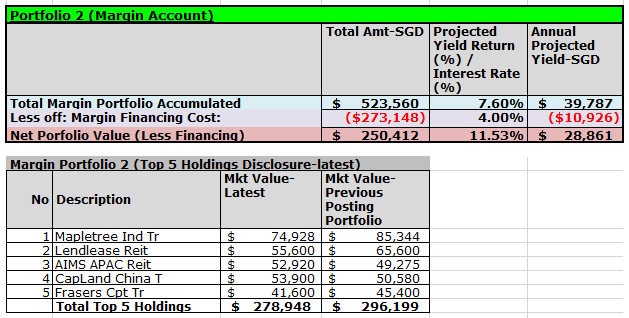
2. Portfolio 2- Margin purchased securities
(Note: My margin purchased securities has grown to a sufficient scale to sustain itself and also to repay annual financing charges as well as to gradually pay down the margin loan through dividends generated.) 
I have taken profits by selling down the bulk of my banking stocks OCBC and UOB (while retaining some small stakes in my margin portfolio) and reducing my margin borrowing by S$31K (from S$304K to S$273K). While it is true that rising interest rate does benefit banks but the problem here is that if a severe recession with numerous job losses (we already seen the radical 900,000 job retrenchment exercise being announced by Credit Suisse), default of banks loans as well as decrease in loans granted will mean worsening results for the bankers. I decided not to take the risk and to lock into the profits. 

In addition, I have made further investments into Capitaland China Trust and also AIMS APAC REIT.

3. Portfolio 3 (with Tiger Brokers)- Venture into higher risk as well as capital growth stocks here
Main updates here:
(i) I continued to accumulate some Alibaba stocks (where many expert investors are cursing & swearing at it and showing off that they are right in predicting its dismal performance) as its price keep dropping. I will be holding on to it for now despite the higher political & economic risks associated with a pivot towards a socialism economic model. Please see "Alibaba Plunged 12% And Hit All Time Low of HKD61 Per Share- Time To Sell Off And Exit Alibaba Mayhem?"

(ii) sold off SingMedical whereby its directors made a privatization offer. I am lamenting at the low ball offer being made and have sold off my stakes directly. Please see "Singapore Medical Group-Directors Made Low Ball General Offer For Privatisation At Only 37 Cents Per Share".

(iii) I have also ventured into investments into S&P 500 initially here but have since sold it off to raise the level of cash to wait for good opportunities during this market turmoil.

Summary
Given the recent good results announced by the various SREITs (except for US office REITs), I expect dividends to continue rolling in over the next few months.

Wednesday, 26 October 2022

Application for Singapore Government Treasury Bills- Decent Discount Rate Expected.

A few days ago, my wife suddenly asked me a question on how to apply for MAS Treasury bills. I was rather stunned by her query as she is normally very conservative and the most complicated "investment" she is willing to go into on her own initiative is fixed deposit. Her forage into equities came only after very extensive persuasion and efforts from me. Anyway, turns out that her colleagues were all obsessed with placing money into fixed deposits and subscribing for Treasury bills these days. The 6 month Treasury bill for this upcoming 2nd half October 2022 tranche is expected to be approximately 4% financing rate which is a far cry from the pathetic low rates in the previous years.

1. What are Treasury bills?
Treasury bills (T-bills) are short-term Singapore Government Securities (SGS) issued at a discount to their face value. Investors receive the full face value at maturity. The Government issues 6-month and 1-year T-bills. 
Application highlights for Singapore Government Securities (using DBS platform as an example)

2. How to apply for Singapore Government Securities?

I think that Kyith (Investment Moat) has a very good and useful write-up on the intricacies including using different banking platform aside from DBS. Please refer to "How to Buy Singapore 6-Month Treasury Bills (T-Bills) or 1-Year SGS Bonds"

3. What is the cut off timing to subscribe for the latest tranche?
Unfortunately, the latest tranche application has closed. DBS closed it at 9pm, 26 October 2022, 1 business day before the auction date of 27 October 2022. Interested folks can wait for the upcoming November 2022 tranche and possibility higher interest rates.

Parting thoughts
I thought that the Singapore Government Securities (Singapore Savings Bonds, Treasury Bills & Government Bonds), offer quite a decent return for risk adverse investors as an alternative to letting cash remain in bank account. Nevertheless, for myself, I will rather put extra cash into local banking stocks or SREITs to take advantage of the huge decline in market price and higher distribution yield. 


Updated 27 Oct 2022-Results of Auction:
Cut off yield is 4.19% for this issuance! Much higher than what I expected....OMG....those who put in $200K gets S$4,190 immediately refunded. This marks the highest ever yield on a 6 mth T-bill since more than 30 years ago (September 1988) where it peaked at 4.73%.