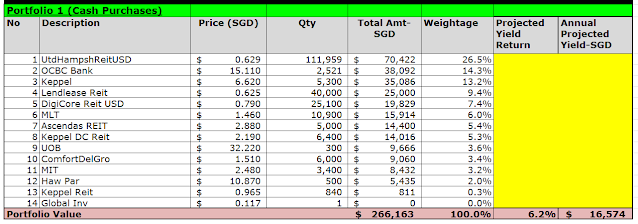
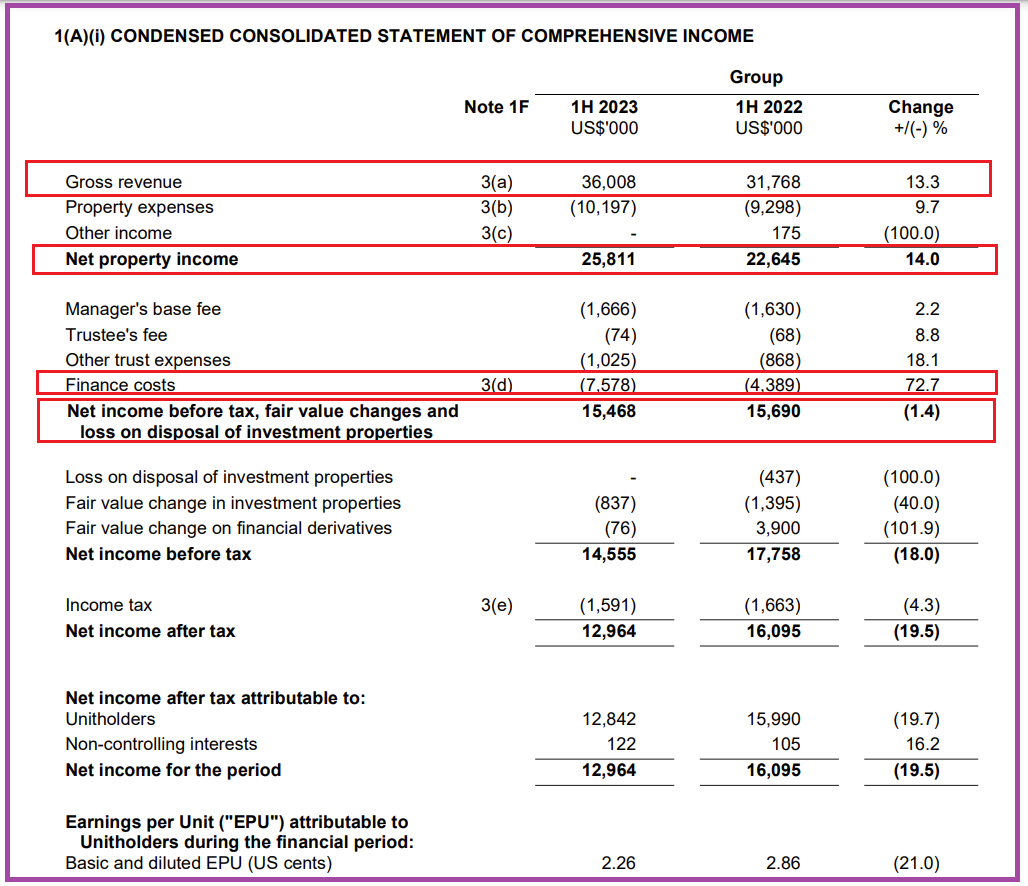
Hi Folks, this is to follow up on my
last United Hampshire US REIT ("UHREIT") post on whether rights issuance to all local unit-holders of US REITs- as a last resort to raise funds- is actually feasible in the event of a financial crisis faced by the REIT. According to the Investor Relation team of Manulife US REIT, this rescue option cannot work as each unit-holder can only hold up to 9.8% of units in such a setup and the sponsor are thus unable to step in. This is the one critical piece of information that no one thought is important for many years until the recent US Office REIT crisis exposed this aspect as the weakest link in the chain which can lead to devastating consequences for US REITs listed on SGX. What it means is that even if a sponsor (referring to US properties REIT) is financially strong, it throws a spanner into the works for the last available rescue option on the table- which is the equity fund raising exercise.

I have sent in an email query to UHREIT Investor Relation last week as well as attended the SIAS UHREIT Webinar session just now (22 Aug 2023; 7pm). The response has been quite general FAQ kind of answers which I do not blame them as UHREIT team can only work with disclosure that have already been made known to the general public. Mr Gerard Yuen (CEO of UHREIT) also kicked the can further down the road when rights issue question was raised citing it is in a very different asset class relative to what happened to the commercial office sector. I have pieced together some of the key points from what UHREIT is able to disclose as well as general information that are available online.
1. What exactly is this 9.8% unit-holding limit and the implications?
This is the maximum unit-holding that an individual can hold in the US REIT and is crafted into the Trust Deed as the foundation that is cleared and permitted by Uncle Sam. Any breach of this 9.8% limit will mean an immediate withholding tax being levied for distributions. To be more exact, a breach of this will not just mean an immediate withholding tax being levied on that particular unit-holder- it
will apply to all local unit-holders. Since the general
Withholding Tax Rate in US is 30%, so we can assume that the amount of distributions received will dive by a whopping 30%.
2. Any other consequences of a breach of this 9.8% unit-holding?
Using what happened to Manulife US REIT recently due to the breach of bank covenant and consequently no distribution being made, there will be additional corporate tax exposure once the REIT structure is being punctured.
3. Breach of this 9.8% will mean a breach of MAS requirement and be suspended from trading?
Nope, apparently this is more of a tax efficient vehicle issue. But the grave financial implication is that it will lead to further downward spiral in its pricing given the additional tax expenses and risk premium demanded by unit-holders.
Hence based on the above mentioned adverse consequences in Pt 1 and Pt 2, any recuse by the Sponsor via a rights issue that leads to excess subscription support will breach the 9.8% limit and lead to the unravelling of the structure being put in place. This is also why the sponsor of Manulife US REIT has not been keen to do a rights issue since commencement of the November 2022 Strategic Review.
4. Does that mean rights issue will not work for these US REIT during a financial crisis?
Not exactly. Let me try to explain 3 scenarios:
4(a) Scenario 1: Rights issue exercise with bankers stepping in to undertake excess unsubscribed rights
In a normal case, an US REIT will be able to get investment bankers to undertake any unsubscribed rights by paying an additional professional fees for stepping in to mop up the excesses. But for very risky cases like the structural demand challenges in US Office sector and the out of the world high interest rate environment, I don't think any sane bankers will dare to underwrite the rights issue for such REITs lest they get stuck in REIT equities that need to be written down to zero in a few months if things deteroiate further.
4(b) Scenario 2: All existing unit-holders are willing to subscribe to their entitlement hence 9.8% for sponsor remain intact
This scenario is an ideal scenario where the World as we know is PERFECT- every unit-holder do their part and their percentage unit-holdings remains the same after the rights issuance exercise. Unfortunately, we all know that this will never happen in real life. There will be unit-holders that will not subscribe due to individual unique circumstances as well as reasons.
4(c) Scenario 3: Rights issue exercise with existing unit-holders (besides the sponsor which is already at 9.8% max limit holding) willing to take up any unsubscribed excesses.
This is again another theoretical ideal case scenario whereby we are assuming other existing unit-holders are willing to pick up the slack for the Sponsor. These "other" unit-holders must also have deep pocket to be able to do this. Practically, this is very tough to execute with lots of coordination, unknowns and the rights exercise might fail to raise the required amount of funds.
Parting thoughts
I can only say that holding on to US REIT is extremely risky as having a good sponsor has limited value add point during crunch time. Once the management missed the opportune time to do a rights exercise, the REIT will most likely end up in a death spiral or take a long time to climb out of its woes. The 9.8% max limit imposed on the sponsor is the Achille's heel of holding US REITs. The one thing that is exceptional about United Hampshire US REIT relative to Manulife US REIT is that its strip centre properties are a very resilient asset class thus far which have performed extremely well over the past few years.