Showing posts with label Asian Pay TV Trust. Show all posts

Saturday, 20 August 2022

Asian Pay TV Trust Broadband Rises From The Ash With 5G Adoption and 8.5% Distribution Yield- Undervalued Or Value Trap Again?


Asian Pay TV Trust  ("APTT") used to be the market darling for income investing investors which pays over 8% in dividend yield from IPO. However, APTT has since dropped from its IPO price of S$0.97 (in 2013) per unit to the current S$0.116 per unit as at 19 August 2022. This is a whopping 88% plunge in market valuation for investors did not bail out and are still holding on to APTT. In short, the high dividends then were not sustainable. I have made close to 46% return from capital gain and dividends back in its more glorious days under the Macquarie Infrastructure Fund. But have since lost most of it after accumulating new units from the IPO spin off. I even accumulated more units when its price drop after IPO. But eventually, I was forced to cut loss and sell off at various prices ranging from S$0.60 to S$0.80 due to its worsening cashflow position and declining earnings. But I count myself fortunate that I sold off the bulk of the holdings before its price collapsed further from May 2018 onwards.

1. Is APTT at S$0.116 per unit and 8.5% distribution yield now a STAR buy?
The previous strategy of APPT senior management is to use borrowings to finance CAPEX. This means that its free cashflow actually cannot finance the dividends paid out with massive debt incurred. At one point, the debt issue will explode in particularly if the underlying business decline and can no longer generate sufficient cashflow. Due to its current low price and current free cashflow of up to S$80Mil, the question is whether it is a good to time to accumulate units  of APTT now.

2. Current high gearing ratio despite cutting dividends by 80% since 2018 and 2020 rights issue to repay colossal debt of over S$1.4 billion.
In 2018, borrowings of APTT was at round S$1.4 billion. As at 30 June 2022, its borrowings is still at approximately S$1.4 billion despite cutting dividends by 80% in Nov 2018 and launching a rights issue in 2020. It looks like APPT network CAPEX over the years have been rather intensive. Its current gearing ratio stands at an eye popping 48.8% notwithstanding cutting dividends by 80% in 2018 and rights issue in 2020 to cut down on bank borrowings.

3. Broadband is growing with 5G adoption but Cable TV decline remains worrying
Broadband is growing as APTT partnered with mobile operators to drive fixed-line broadband segment and higher speed plans. However basic cable TV remains in doldrums. For its half year revenue, Cable TV makes up 74% of its overall revenue which implies that it remains an extremely heavily weighted segment in terms of the business performance of APTT. Hence any upsides contribution from its Broadband segment will still be outweighed by the declining basic cable TV segment.

Parting thoughts
As alluded to the above points, I am rather surprised that an analyst from Phillip Capital recently upgraded APTT to "buy" due to recent share price weakness and has a target price of S$0.150 per unit. Personally, I will still be staying far away from APTT. Its core cable TV business is a sunset business segment in view of intense competition from IPTV service providers that will continue to wilt away its core earnings.

Saturday, 17 November 2018

Asian Pay TV Trust Meltdown- Is It A Good Buy At Current Price And Is It A Good Business?

Asian Pay TV Trust (APTT) unit price plummeted this week upon the announcement by their management team that they will be cutting dividends by 80%. This was a rude shock to many of their investors who were anticipating the dividend to be cut by half only. As a result, the unit price had a meltdown and dropped to S$0.15 during an all-time low on 14 November 2018 from the previous day closing price of S$0.315. Obviously, a lot of dividend yield-seeking investors are cursing and swearing at APTT. I also know of a case of an investor who bought 100,000 shares of APTT at around $0.47 a few months back and in total held over 300,000 shares of APTT. This represented a loss of at least S$100K in the capital value of the stocks on hand due to higher acquisition price over the prior years.

Why Do Some Investors Use Net Asset Per Unit To State That APTT Is Undervalued hence keep buying non-stop?
I would also like to add on that using purely Net Asset per unit to value APTT is not a good yardstick which some investors had relied on. This is because a huge chunk of the "asset" is tied up with an intangible asset in the form of a license to operate its business in Taiwan. The valuation of an intangible asset is fraught with lots of subjectivity depending on your beliefs. For my own sensitivity analysis, I would have impaired and discounted it severely based on the ever-weakening future cash flow generation from the entire business.

Is The Worst Over For APTT?
The million dollar question that everyone keeps asking now is whether the worst is over. Most importantly, is it a good time to buy undervalued units for APTT and also whether it is still a good business to invest in?
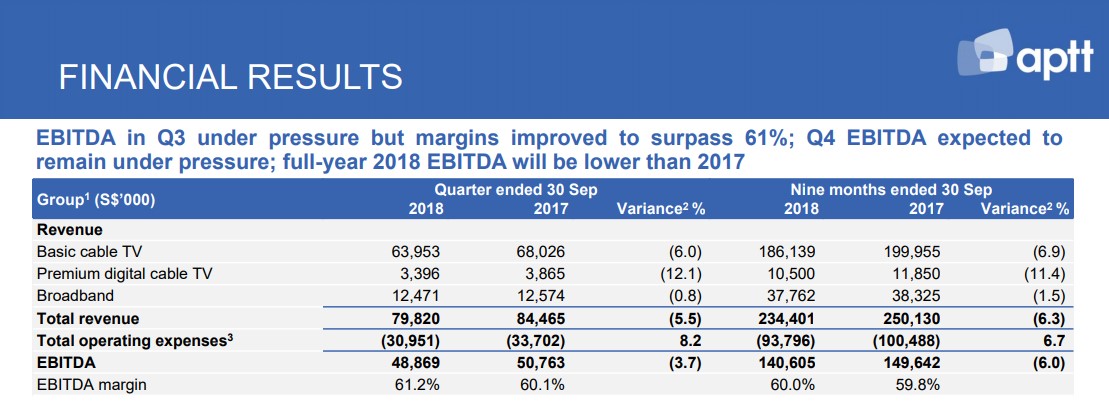
First and foremost, my personal view is that APTT has been massively oversold. There are no significant changes in the current business environment. The results show 9mths ended 30 September 2018 revenue declining by <6.3%> and EBITDA decreasing by <6%> whereas unit prices had plunged by 50%.  I think that the fair value should be a lot higher. Also, the dividend payout after the cut is actually more sustainable. For those who dare goes in now will definitely have a higher probability of making profits. Generally, it is the entry price relative to the fair value of any type of business that determines whether the investment will turn out to be profitable.

Also, the extremely low price is actually making it an attractive offer for buy-out by existing shareholders such as Terry Gou (Hon Hai Group Chairman) or other big corporations. 

BUT personally, I need to point out that while the unit prices are currently undervalued, there are unstable elements that are shaking the fundamentals of APTT and one may not be able to sleep well at night holding on to this counter.

3 Reasons Why Low Risk Tolerance Investor Should Stay FAR Far Away From APTT:

(1) Intense Competition from Pirates and Mobile unlimited Data Plans from Taiwanese Telecoms.
Consumers today are buying lots of TV boxes with free pirated TV shows. OTT such as Netflix, Viu, Youtube Premium etc are rising in popularity. Pay TV services is a declining market. For fibre broadband, they are also facing intense competition from Taiwanese Telecom companies which are offering unlimited Data Plans on the mobile network for connection. While the services are not obsolete, the revenue APTT can generate will continue to decline gradually due to a change in consumer demand. 

(2) APTT Management Team is either exhibiting excessive optimism from previously announced results or they are unsure of their own business and industry outlook. 
I have previously pointed out in my other posts that the management keeps repeating that the ARPU decline is stabilizing. Apparently, their perception and definition of stabilization are very different from my own definition. Quarter by quarter it has been declining. I do not see anything stabilising about that aspect. 
Extract from previous QFY2018 Q2 Results Presentation
In addition, during the 2nd quarter announcement, the APTT management team mentioned that they believed the unit prices are undervalued and that they are contemplating a share-buy back. But for the recent 3rd quarter announcement, it turns out that they have cashflow issue to fund future CAPEX without incurring more debts. Hence why talk about share-buy back when they do not even have sufficient funds to maintain the previous dividends and future CAPEX? I personally find such presentation contradictory to the ground situation and have sold off all my APTT units immediately after my last post in September'18 and hence was lucky to have avoided the recent crash in the unit price.

I hope that the major institutional investors will demand for at least 1 new senior management personnel to join the current APTT management team. It is time to do a global search or look in Taiwan for someone who can effect change by bringing in new perspective to the current business. Look at Starhub Singapore, it has done well with a new CEO who has brilliantly executed a cost-cutting exercise and a joint venture for cybersecurity.

I hold a view that a solid management team is a core to sustaining and developing a business and to continue to make it relevant.

(3) Massive Debts and Rising Interest Rate Environment
S$1.4 billion debt is actually a high risk to APTT as alluded to Reason 1 above. The old perception by everybody that APTT is a defensive stock and has stable cashfllow is actually no longer valid due to the declining customer demand. Banks are known to be fair weather friends. Once the marco economic environment sours or there are further decline in operating results that lead to banker's re-assessment, there is no guarantee in the loan agreements that the bankers are obligated to continue extending the borrowings indefinitely. The billion dollar debt is not a small amount.

I am also not confident that APTT will be able to get a lower financing charge upon renewal in the face of a rising interest environment and also declining business albeit gradually, that leads to worsening risk profile. Again, I do not share the same excessive optimism of the management team of APTT. Leverage is always a double-edged sword that cuts both ways.

Parting Thoughts
The current price of S$0.167 per unit includes dividend declared. Stripped off the Q3 dividend of S$0.016 per unit and ex-dividend effect will be S$ 0.151 per unit. From the revised dividends projection of S$0.012 per unit for FY2019 and FY2020, the dividend yield thus becomes 7.95% which is fairly decent as historical excessive dividends payout will be re-deployed back into the business as CAPEX investment.

For more conservative and low-risk tolerance investors, it may be better to give APTT a miss in order to sleep better at night.  

Thursday, 13 September 2018

Asian Pay TV Trust Review for Q2 2018-Plummeting Unit Price And Goodbye To 2019 Dividends


Frankly speaking, I am extremely disappointed with the financial performance of Asian Pay TV Trust (“APTT”) for Q2. Disappointing as in the ARPU has not stabilized at all as per asserted by APTT management for many prior quarters. Q2 2018 saw further decline instead of “stability” in the key performance indicator of all its business segments. I have previously posted that in the absence of visibility of earnings upgrade from the ARPU, I will not put in more investment into APTT due to the intense competition disrupting its business.

Basic Cable and Premium Digital Cable TV Q2 2018 Performance
APTT is clearly facing tremendous competition from pirated Android TV boxes, Netflix and other online video streaming medium-IPTV. The piracy issue is not just a Taiwanese issue. This is a global problem. In Singapore, Starhub is a very good example of another pay TV business that is seeing declining subscription from the rampant piracy issues. I am sure many of you all know of some colleagues/friends or relatives who have purchased those “TV boxes” from Sim Lim Square and then decided to cancel the monthly subscription to Singtel and Starhub pay TV services due to the super cheap cost. So far, the content pirates are still outwitting authorities & pay TV companies and proved almost impossible to shut them down. 

Broadband Q2 2018 Performance
In addition, APTT is also besieged by unlimited wireless data packages from mobile operators on the Broadband front. The availability of low cost unlimited data offerings from top Taiwanese mobile operators means that APTT is forced to offer higher speeds at competitive prices to acquire new RGUs and re-contracting existing RGUs. The CAPEX invested over the past few years for growth purpose turns out to be more of a defensive CAPEX nature in order to address the decline in broadband subscription over the past few years.
 
Management assertion on share buyback due to undervaluation of share prices
APTT senior management gave reassurance to all investors during the Q2 results presentation by pointing to the assertion that “With a stable and resilient cashflow, APTT is a defensive business that is positioned to grow in a measured way”.

The 4 main growth drivers are as follow:
(1)         Up sell and cross sell across TBC’s subscriber base for future growth;
(2)         Scalable and efficient cost structure. There is headroom in network capacity to allow provision of additional services at limited incremental cost to support future inorganic growth;
(3)         Broadband Growth intact from opportunity to gain more market share. Moreover, there is rising demand for higher speed broadband due to rapidly growing demand for data AND
(4)         Premium Digitial TV. Room for growth as digital cable TV penetration in Taiwan is still lower than that of Korea, Singapore and Hong Kong.

The management team has mentioned that APTT is exploring potential unit buybacks as the current unit price of APTT is undervalued. At the same time, it wanted to strengthen its balance sheet hence as a result, the Board of directors is of the view that the distribution per unit in 2019 is likely to be lowered to support the initiatives.

My thoughts before final parting for Q2 2018 review
I find it incredulous that at this juncture, the management team feels strongly that APTT is undervalued by the market. A declining service pricing and uncertain future market outlook (declining historical track record since IPO) can also mean that the business activities will continue to worsen. I will not be surprised given the upcoming super fast 5G mobile network roll out and also unresolved rampant piracy issues. APTT is already warning investors that the overall performance of FY2018 will be worse off than FY2017. The cutting of future 2019 dividends in a way seems to be an admittance that the historical business model of leveraging heavily from bank borrowings is no longer sustainable in view of the competitive operating environment.

Using the dividend discount model and assuming dividend is cut by 50% due to lower cashflow and to fund CAPEX, the price may drop to S$0.216 per unit once it is announced officially in Q4 with regard to the slashing of dividends. I do not think investors will accept a cost of equity lower than 15% for holding on to APTT unless the business outlook and revenue generation improved drastically.

I am thus unsure why the management choose to want to cut dividends instead of continuing to utilize cheaper bank borrowing at effective interest rate of a mere 3.4%…..unless despite all the positives painted in the presentations, they have no confidence and are in fact very worried over the declining APTT business and worsening cash flow generation. But I reckon that APTT management team is probably really just being prudent in its new approach and I am just thinking too much?     

Saturday, 26 May 2018

Asian Pay TV Trust keeps spiralling downwards after Q1 2018 results. How low could it go?

Asian Pay TV Trust ("APTT") closed off Friday (24 May 2018) at a 52 weeks low of SGD 0.440. Based on the re-affirmed SGD 0.065 per unit of dividend guidance for FY2018 by the Management of APTT after the Q1 2018 results announcement, this represented a dividend yield of 14.77% (please see the previous post here with regard to analysis on whether the cashflow for dividend is sustainable) Is this a value trap? How low will APTT goes? When will the dumping of its units in open market stop?

Why did APTT plummet recently since the release of its Q1 2018 financial results?
I rationalised that the reasons for the free-fall are as follow: 

1. The market  getting jittery based on the continued erosion in its core business earnings amidst the competition. 

2. There is also the announced increase in corporate tax rate from 17% to 20% in Taiwan. I reckon that due to the pursue of populist policy by the government to reduce personal income tax,  the authority have no choice but to balance the books by milking corporations. This will make the government look good for the upcoming year end election. However, this is contradictory to the overall reduction in corporate tax rates going on in the world to boost business growth and also attracting foreign investments. 

3. Market interest rates are expected to keep going upwards. There is again some uncertainty by the market over the interest expenses on huge loans taken out and its financial impact on APTT. Just to add on, the interest rates on the bank loans used to be over 8.5% during the Macquarie Infrastructure days. Since then, APTT has restructured the bank loan with a drastically lowered interest rates. The interest rate is based on interbank offer rate plus 2.3%. The latest loan of NT$29 billion taken in Oct 2016 will only be due in Oct 2023. Out of these, NT$16 billion has been hedged using interest rate swaps from floating rate to a fixed rate.
4. Losses in Q1 2018. This was actually due to the one off deferred taxation charge of S$11Mil taken into the books from the increase in corporate tax rates from 17% to 20%. I have mentioned in my previous post (pls see here) that there is no cashflow impact on the application of deferred taxation in FY2018. The tax view and accounting accrual view overcomplicated the situation and may have casted an aspersion on the future financial performance on top of the worsening key business indicators in pt 1.

5. Cancellation of Korean America Summit in Singapore on 12th June 2018 by US President Donald Trump? The Business Times mentioned that Asian stocks were jittery over the uncertainty of the Summit in Singapore. 

Review of key Business Metrics of APTT
The 2 key operational metrics of APTT are namely, (i) Revenue Generating Units (RGU) and (ii) Average Revenue Per User (ARPU). In its presentation deck to shareholders, the management of APTT often put down ARPU as "stabilising".  

For example, for previous year Q1 2017, APTT reported ARPU stabilising. 
Then again in the recent Q1 2018 presentation to investors, APTT again used the term "ARPU stabilising". 

The ARPU is thus actually far from being "stable". The blood bath have not halted. ARPU is still sliding downwards almost every quarter. The Premium digital cable TV business segment is suffering from pricing challenges due to competitive pressures from the unlimited wireless data offerings from mobile operators. ARPU had lowered due to promotions and discounted bundled packages being offered to generate new RGUs and to retain existing RGUs.

The only good news is that the RGU are indeed stable and the blood letting in terms of decline financial performance is really due to unfavourable pricing that is adversely affecting their profit margin.


As to how serious is the declining ARPU or whether it will indeed eventually reached "stabilisation", investor will have to make up their mind on the future outlook. One will have to wait for the upcoming Q2 2018 results to have better visibility since the ARPU in Q1 2018 is still declining.  

Valuation using the Dividend Discount Model
The Dividend Discount Model is a method of valuing a company's stock price based on the theory that its stock is worth the sum of all of its future dividend payments, discounted back to their present value. Since many investors seems to treat this as a high yield stock, I reasoned that the DDM will be a useful tool for us to do some mathematical valuation to see the fair value per unit expected.
P = D1 / (r -g)
P= Current Price based on summation of the infinite series;
D1= Dividend Payment per unit (S$0.065)
r= Cost of Equity (assume 14.77% based on 25th May 2018 closing price)
g= Dividend Growth Rate (assume zero in APTT's case) in perpetuity.

Based on the above, we have P = S$0.440 if the Cost of Equity is 14.77%

Now, if we assume that the Cost of Equity, based on the previous  month of around 12.26%, then P = S$0.530. The risk premium and expected return from investors have increased further ever since the release of the Q1 2018 results.

If we assume that the dividends going forward to be cut by 25% due to one's view that APTT will cut price further or lose more subscribers while maintaining 14.77% as Cost of Equity, P= S$0.35.

Hence based on one's outlook, we see that the price range can be from S$0.35 to S$0.53. Analyst target price based on the discounted cashflow projection (another valuation methodology) priced APTT at S$0.52. Based on the slowing quarterly losses in ARPU, I will say the fair value should be around S$0.40 and with probability of favourable upsides or stabilisation in view soon. Loan facility due in 2023 means that short term continuity of the business is not likely to be a major issue as the ability of the business to service its debt is not an immediate issue yet but there is a risk by assuming no major surprises in its current revenue generating abilities.

Please do share your views and outlook for APTT. Will it drop below S$0.40 or is it already oversold and represents a good opportunity right now to invest in APTT?

Tuesday, 22 May 2018

The increase in tax rate to 20% led to HUGE LOSSES in Q1 2018 for Asian Pay TV Trust? Myth or Fact?

With the release of Q1 results by Asian Pay TV Trust ("APTT"), I begin to see a lot of weird comments on investment forum from how they interpret the results. Some of the folks on the forum frantically advocated an immediate sell off due to the huge loss incurred for Q1 2018 by APTT. Some remarked that "Taiwan tax is so scary that it makes a profitable company into a loss making company overnight". Others were skeptical on why APTT management only focuses on EBITDA and did not place emphasis on the net losses incurred. 

Myth: The increase in tax rate to 20% led to huge losses in Q1 2018 for APTT. Taiwan tax is so scary that it makes a profitable company into a loss making company.

This is not true. The main reason for the turning of results to loss is due to a one time <S$11Mil> deferred taxation charge to the Profit and Loss statement. Note that a deferred taxation charge represents only a timing difference to smoothen out the accounting profit and loss else it will lead to a skewing of year by year financial results. There is no cashflow impact. Neither does it represents an increase in actual tax expenses to the Taiwanese Tax Authority with the one time deferred taxation charge. The effect gets reversed out over subsequent financial years and is a creature that exists due to the prescription under the International Accounting Standard.  

To better illustrate how this works, let's look at the following simplified scenario. Assuming S$100K of Computer Equipment were purchased and under tax law, it allows for accelerated tax depreciation of 100% within the first year, all S$100K will thus be eligible for tax deduction filing. 

From the accounting perspective, the Computer Equipment purchased has a useful live for 3 years. Hence the annual depreciation rate booked into the Profit and Loss statement will be S$33.3k on a straight line method. 

Next, we assume a business can generate S$150K of revenue every year and the only expenses for the purpose of this theoretical exercise is the depreciation charges for Computer Equipment. Also prevalent income tax rate let's assume is 17%.  


As you all can see, without the Deferred Tax adjustment, the current tax for the first year is only S$8,500 whereas for Yr 2 and Yr 3, the current tax expense payable to the Tax Authority increased significantly to S$25,500 respectively. This will lead to drastic differences in the Net Profit and Loss for Yr 1 relative to Yr 2 and Yr 3. It is only with this creature known as "Deferred Taxation" being created that leads to the same Profit and Loss over the years from the accounting perspective to resolve the timing differences between tax and accounting view.  

There is thus no direct cashflow impact from the application of deferred taxation. Hence one should only consider the impact of the revised increment in current taxation payable to the Taiwan Tax Authority and exclude the impact of the deferred taxation with regard to the assessment of Q1 2018 performance of APTT.

In my next post, I shall do a quick review of the Q1 2018 APTT business results as well as a valuation of the business to compare against the market unit price.  

Wednesday, 25 April 2018

Will Asian Paid TV Trust tumble further downwards to less than 40 cents again?

Things are not good with Asian Paid TV Trust ("APTT") market price again. It tumbled down below the 50 cents support level this week. Strange thing is that there were no major news announced by APTT and there were huge volume that involved millions of units being sold off. This probably represented some selling by institutional investors.


I have previously mentioned in my other post that APTT is a risky stock due to its current business fundamentals. The share drop this week is a reflection of the volatility and investor risk perspective of this business trust. Please see Asian Pay TV Trust Review (Part 2) -Future Business Outlook  

Monday, 16 April 2018

Asian Pay TV Trust Review (Part 2) -Future Business Outlook


I actually have a love and hate relationship with Asian Pay TV Trust (“APTT”).
For those of you who have been with this business before its maiden spin off from the Macquire Infrastructure Fund days, you will know that this has long been a cash cow that has over the years been delivering and bringing in lots of cash for the unit holders as well as the banks which provided the financial leverages via borrowings.

I have made close to 46% return from capital gain and dividends back in 2012. But have since lost most of it after accumulating new units from the spin off. Its IPO price debuted at S$0.97. I even accumulated more units when its price drop after IPO. But eventually, I was forced to cut loss and sell off at various prices ranging from S$0.60 to S$0.80 due to the worsening cashflow position and declining earnings with the exception of 20,000 units. I figured out that as long as the business does not collapsed within 10 years, the high dividend yield will still compensate for any further decline in unit price and also to retain the opportunity to participate in any business development upsides in future. Ok, enough said, let’s go back to do some financial assessment based on the latest published 2017 Annual Report.   

Before we dwell into mental acrobatics on the financial statements interpretations, let us recap on key developments for previous financial year 2017:
  • TBC first large cable TV Operator in Taiwan to complete the digitalization of its subscriber base and switch off analogue TV broadcasting in 2017.
  • Management of APTT did mention that for 2018, they will be offering discount TV packages to grab market shares as well as to  continue to build on the business strategy of up-sell and cross sell of services across Taiwan Broadband Communication’s (“TBC”)  subscriber base to drive growth in future cash flows.
  • Management has re-affirmed in February 2018 that the distribution guidance remains at 6.5cents per unit for the year ending 31 December 2018, unchanged from 2017, subject to no material changes in planning assumptions.
Key questions that we need to ask ourselves will be:
1    1. Can the dividend going forward be maintained?

2. What are the risks associated with holding units in this Business Trust? Is it not a stable business that will continue to generate stable cashflow for unit holders?

3. Is the current price of S$0.510 (after the plunge over last 2 weeks) the right time to go in? Will it go down even further?

Key Financial Concepts- Why APTT management keep using EBITDA instead of Net Income when reporting on its financial performance?
EBITDA refers to the Earning Before Interest, Tax, Depreciation and Amortisation. The cash generation prowess is what APTT business represents due to the nature of its business.

Taxation refers to corporate taxation as well as the accounting concept of deferred taxation which is a very abstract concept. I do agree that taxation is irrelevant in measuring the performance of the management. Hence when the Taiwanese government announced that going forward, they are going to increase Corporate Tax Rate from 17% to 20%, the EBITA if ceteris paribus, will mean that nothing in terms of the business has changed fundamentally albeit the drop in distributable free cash flow.

Interest refers to financing cost of borrowings. This is arguably not within the management control as rates can fluctuate even if the borrowing quantum remain the same. However, there is still a cashflow impact for this item similar to Corporate Taxation.

Depreciation and Amortisation represents cash paid up-front for acquisition of Property, Plant and Equipment and Intangible assets. Intangible assets here refer to Cable TV Licenses, Software, Programming rights and goodwill from acquisition of an acquiree’s business. Out of S$2,391Mil, Cable TV licenses to operate in Taiwan from government forms the bulk of this item with value of S$2,372 Mil. Interesting thing is that this license does not have any expiry hence the cost will never be amortized as it grants APTT perpetual rights to be in the business in Taiwan. Rest of the items such as Programming rights will be amortized according to their useful lives.  There is no cashflow impact from effect of depreciation and amortization.
 
Extraction of the breakdown of Intangibles that made up the bulk of the Assets of APTT
Borrowings Risk to finance CAPEX
A key point to take note of over here is that the management team is relying heavily on bank borrowings to finance any major CAPEX such as the rolling out of digital TV broadcast. Since equipment do get worn out eventually, there should by right, be cash set aside yearly for future CAPEX. Hence a significant problem resulted from the current business operations is that it will run out of cash at one point in time when such need arises.

A business cannot be borrowing indefinitely and then just keep paying financing cost. This unplanned CAPEX depending on its urgency and also quantum will eat into the distributable free cashflow or even worse, it can lead to rights issue if the quantum is significant.

The second point is that the management team has always been using leverage on bank loans to pay out high dividends to unit holders. Also, the banks do not grant indefinite borrowing. Business is all about sentiment. If market condition worsen, there is risk that APTT cannot get the S$1.4 billion of onshore loan facility renewed. Good thing is that APTT had concluded a re-financing agreement with its banker in October 2016 which extend the loan facility for 7 years expiring on 26 October 2023. But do take note that the loan taken from this facility needs to be repaid in various tranches over the years and not just at the end of the facility term.

There is still another S$125Mil offshore multi-currency term loan facility due in 2019. However, APTT as of 31 December 2017 only have S$80 Mil of cash and trade receivables. Since it paid out most of its free cashflow as dividends, it will run the risk of default should the bank decided not to renew this facility. Even if it does not pay out any dividend for 2018 and reserve the cash for the off shore loan repayment, this may still not be adequate in view of uncertainty over the ability to sustain the current level of cashflow in view of competition. Of course, APTT can still tap on its other onshore loan facility to draw down more cash to tide them over but you folks get the gist of what I am saying here: APTT is running heavily on leverages for its survival.  It has a very weak statement of financial position in terms of actual cash on hand.

But it does have cashflow to pay out dividends if management is successful in the execution of the strategy to at least stabilize the current level of earnings coupled with the assumption that there are no future change in Macroeconomics conditions that will force bankers to withdraw and stop debt renewal. Although past financial performance does not equate to future performance, it does give us some insights into the state of the Paid TV business in Taiwan.
Note that Net Income has been decreasing over the past 5 years. This is a worrisome trend.


Is the dividend sustainable? Earnings per share significantly less than the dividend per share declared.
The cashflow from the APTT business model is actually more substantial than what a lot of people think. The reason being that the net income number already includes a high CAPEX upfront depreciation as well as deferred taxation which has no cashflow impact immediately. I did a very high level adjustment to illustrate why the operating cashflow is actually a lot higher than the net income as per below:  

Hence to look just at the net earnings per unit, many analysts concluded that the dividends are not sustainable. This is not true unless there are drastic changes to the way APTT operates through the financing leverage model or the business conditions worsen as per mentioned above. 

Conclusion:
I view the APTT business as a high risk model with high leverage. In addition, there is market disruption arising from the popularity of illegal android TV boxes, legal content provider Netflix, Viu etc. I do like the high dividend yield based on the current unit price for compensation of high risk undertaken by investor to provide equity funding. 

There is no net tangible asset value left from the statement of financial position in the APTT business. The guide to its perceived survival depends on the outlook of its future cash generation ability. Since investment is also about capital preservation, in the absence of earnings upgrade visibility, I will not suggest anyone putting all their eggs in one basket. The high dividend yield is really to cater for the high risk premium for this business. Probably, investors should make it just a small percentage of one's overall stock portfolio until things become clearer that the business strategies can bear fruits for FY2018.

Wednesday, 11 April 2018

Asian Pay TV Trust Review (Part 1) -3 Myths to Debunk.


The Asian Pay TV Trust is a business that seems to have created a sense of confusion among various investors on investment forum. Without scrutinizing the financial statements, it would be hard to assess the future and the risks associated with this business. Let me start with debunking some of the assertions made by some forummers.

Myth 1: “Target: $0.595 soon!!!  Good investment for income by collecting dividends!!! 12.7% Dividend Yield at current price of S$0.510…Hurray!”
Blade Knight: The revenue and distributable income may go down based on historical trending due to more competitive pricing to retain existing TV subscribers. This decrease coupled with the financing cost for unplanned CAPEX for digitalization of TV upgrade led to repeated revision downwards of the dividends over the last few years.

There is always the downside risk that the net income will be insufficient to cover for operating expenses and to also pay off the mammoth financing cost from the S$1.5 billion debt. Unit holders may even have to play the White Knight in such scenario by subscribing to rights issue to raise cash to ensure business continuity and to stave off immediate liquidation law suits by creditors.

Myth 2: “The unbelievably high yield sounds too good to be true, which prob isn' t, if you know what' s really underneath the hood. Might work for a short punt though”.

Blade Knight: But management of APTT did mention that for 2018, they will be offering discount TV packages to grab market shares as well as to  continue to build on the business strategy of up-sell and cross sell of services across Taiwan Broadband Communication’s (“TBC”)  subscriber base to drive growth in future cash flows.

Depending on your outlook, if one thinks that TBC is a stable business that is well positioned for future growth and one likes the business strategies, then this is a sound business well worth the risk undertaken by investor.

Myth 3: “No more CAPEX. So cash paid out reduced and dividend increase.”
Blade Knight: This is not true. The financing or the CAPEX was mainly through additional borrowings. Hence a reduction in project CAPEX will not lead to an increase in dividends available for distribution. It does however stabilize the pool of distributable income as financing cost will not increase from additional drawing down of credit line. For 2018, there will be an overall decrease in financing cost due to 0.3% decline in interest rate payable from the Onshore Facilities followed by the completion of the sale of the Trustee-Manager.

So is Asian Pay TV Trust an up and coming rising Star? Is the current share price excessively discounted right now such that there will be inevitable favourable upside gain? Or the current price has not hit rock bottom and will slide down even further?


P.S: Please stay tune and go on to the analytics on the latest 2017 financial statements as illustrated in the Part 2 Review for Asian Pay TV Trust once it is out.

Sunday, 17 November 2013

Asian Pay TV Trust- Updates on Results release

Results for APTT announced on 12th Nov'13. Results and dividends distribution as per original IPO forecast. In addition, APTT also going ahead with network expansion across greater Tai Chung area in Taiwan. This expansion drive will give it access to an additional 400,000 household.

In view of it's recent price drop, APTT has declined to an extremely attractive price of S$0.77 per unit which translates to an annual dividend yield of 10.71% yield. Also, there is even more room for distribution to improve due to new potential customers which will widen it's subscriber base. 

Saturday, 2 November 2013

Asian Pay TV Trust- Why its price keep dropping?

Over the past 1 week, I observed that Asian Pay TV Trust ("APTT") dropped below the resistance level of $0.80. It declined to an all time low of $0.775 by end of 1 Nov'13. APPT IPO debut in May'13 at $0.97. Based on the current price, it represents a shocking plunge of approximately $0.20 drop per unit or 20% decline in its market value within half a year. Another peculiar point is that the Sep'13 results will only be announced on 12th Nov'13....but there were sudden sell off by current investors. Is it insider trading and the results from APPT is going to be a major disappointment? 

Well, my own analysis is that APTT is a very much misunderstood stock. The market is pricing risk and reward at 10.6% yield based on $0.775 per unit.....this is crazy. I have been holding on to APTT since its Macquarie International Infrastructure Funds days which was 5 years ago. APTT had performed magnificently in terms of capital growth and dividend income (I entered into the market during the Global Financial Crisis in 2008).....for me, this has always been an excellent cash cow and I believe it will continue its stellar performance for the following reasons:

(1) There is no major change in the management of APTT. It is a team which has a consistent track record of delivering results and executing strategic plans in business development in Taiwan.

(2) Potential competitors will have a tough time competing with APTT which already has the basic infrastructures in place. It will be tough for any competitors to try to sustain operations till they achieved the same economy of scale.

(3) Content on offer by Taiwan Broadband Communications such as HBO, National Geographic, Discovery Channel etc. are solid. There are over 105 TV channels in the basic package alone. Internet download of programs are currently still somewhat lacking in content. I foresee consumers still onto paid TV for many many years. Anyway, if technology and lifestyle change, there will still be ample time to get out before it truly became a sunset industry.

(4) My valuation using the discounted dividend model arrived at close to $1 per unit. Also, net asset per unit is around $0.92. Hence based on current pricing, there is a significant margin of safety in mopping up more shares in APTT. Over the past few days, I have acquired another 10,000 units, taking advantage of the declining pricing.

(5) The cash flow is sustainable bearing any major mishap. APTT management has reduced leverage significantly over the years. They have learnt many invaluable lessons during the last 2008 recession. 10.6% yield means one will be able to recoup one's investment in less than 10 years. The current yield is very much worth the risk taking.

Of course, the main concern will be whether APTT can get their broadcast license renewed in another 5 years. Based on what APTT has built up, this should not be a major hurdle.

The financial results to be announced soon will indicate whether my analysis are on the right track. As the saying goes, no risk no gain.