Review of latest announcement in Oct 2026.
Showing posts with label Mapletree Ind Trust. Show all posts
Showing posts with label Mapletree Ind Trust. Show all posts
Sunday, 8 November 2026
Mapletree Industrial Trust: DPU Falling Again. Buy, Hold or Run?
Review of latest announcement in Oct 2026.


Saturday, 17 October 2026
SGX REIT Data- As at 16 October 2026 Closing- Quick Reflection.

Hi Folks, welcome back
to Investment Income for Life. This week I did
something a little different. I got AI to help me compute a forward
distribution yield for every SGX-listed REIT and stapled trust, all 39 of them,
using closing prices as at Friday, 16 October 2026. The method is simple: take
the latest routine distribution, annualise it (x2 for half-yearly payers, x4
for quarterly payers), and divide by the unit price. The key tweak: I told
it to ignore any advanced distributions paid out before a rights issue or
preferential offering for an acquisition, as well as one-off gains. Those
payouts tend to distort the numbers, so stripping them out normalises the yield for sanity. Let's dive in.
 |
| Part 1-Click Picture to Enlarge for Viewing |
 |
| Part 2-Click Picture to Enlarge for Viewing |
1. The Big Picture
Across the 39 counters (excluding those not paying distributions), the average forward yield works out to 7.37% and the median to 6.92%. That is a very decent income stream for a basket of hard assets.
Across the 39 counters (excluding those not paying distributions), the average forward yield works out to 7.37% and the median to 6.92%. That is a very decent income stream for a basket of hard assets.
But the average hides a very wide spread. At
one end, leaving aside BHG Retail REIT's token 0.52%, Parkway Life REIT yields
just 4.37%. At the other, Sasseur REIT and ESR REIT are both above 11%. As
always, the yield tells you as much about the market's fears as it does about
the income.
2. The "Quality Premium" Club
Only six REITs are trading above their NAV and the notable ones as follow:
Only six REITs are trading above their NAV and the notable ones as follow:
- Parkway Life REIT: +56.0% premium, 4.37%
yield
- Keppel DC REIT: +19.7% premium, 5.52% yield
- Mapletree Industrial Trust: +9.8% premium, 6.95% yield (Note: MIT is in trouble over its North America data centres that are old school kind and unable to support the current in demand hyperscaler type)
- CapitaLand Integrated Commercial Trust: +3.7%
premium, 5.40% yield
These are the names the market trusts: strong
sponsors, resilient sectors (healthcare, data centres, Singapore industrial and
retail) and a track record of steady DPU. You pay up for that peace of mind,
and the yield is lower as a result. The other 32 counters with a stated NAV are
all trading at a discount.
3. The Double-Digit Yielders
Five REITs are offering 10% or more on a forward basis:
Five REITs are offering 10% or more on a forward basis:
- Sasseur REIT: 11.22% (Retail, China outlet
malls)
- ESR REIT: 11.14% (Industrial, based on core
DPU)
- First REIT: 10.65% (Healthcare, Indonesia
hospitals)
- United Hampshire US REIT: 10.16% (Retail, US
grocery-anchored)
- Elite UK REIT: 10.00% (Commercial, UK
government-leased offices)
Hot on their heels are Daiwa House Logistics
Trust (9.33%), CapitaLand India Trust (9.09%) and NTT DC REIT (9.04%). Most of
these carry some form of currency, geographic or tenant concentration risk,
which is why the market demands a higher yield to hold them.
4. The 70%+ Discount Graveyard: KORE, MUST and
Prime
Now for the most interesting part of the table. The three US office REITs are trading at eye-watering discounts to book value:
Now for the most interesting part of the table. The three US office REITs are trading at eye-watering discounts to book value:
- Manulife US REIT (MUST): -83.2% discount,
distributions still suspended
- KORE US REIT: -79.1% discount, 5.48% yield
- Prime US REIT: -78.5% discount, 8.77% yield
These REITs imploded post COVID as work from
home hollowed out demand for US offices. Occupancy fell, valuations got
slashed, gearing went up and distributions were cut or suspended to preserve
cash. I lost 1 arm and 2 legs holding all 3 of them previously as they held up well during COVID period...but thereafter, everyone knows what happened. When the market prices a REIT at 20 cents on the dollar of NAV, it is
basically saying it does not believe the NAV.
I am not sure whether there are still many
"value hunters" investing and holding them. Their unit prices have been in the
doldrums for many years already, and every "this is the bottom" call
so far has been premature. A deep discount on its own is not a margin of safety
if the NAV keeps getting written down. For me, these remain a
watch-from-the-sidelines group until there is clear evidence that office
leasing in the US markets has turned.
5. United Hampshire US REIT: The One That
Caught My Eye
United Hampshire US REIT ("UHREIT") looks very interesting. At US$0.425, it trades at a 41.8% discount to its NAV of US$0.73, and its 1H26 DPU of 2.16 US cents annualises to 4.32 US cents, a forward yield of 10.16% per annum.
United Hampshire US REIT ("UHREIT") looks very interesting. At US$0.425, it trades at a 41.8% discount to its NAV of US$0.73, and its 1H26 DPU of 2.16 US cents annualises to 4.32 US cents, a forward yield of 10.16% per annum.
Unlike the US office trio, UHREIT's
grocery-anchored and necessity-based retail centres have held up far better.
But as usual, the high yield reflects real uncertainty over the distributions,
including:
- US interest rates staying higher for longer,
which pushes up borrowing costs and weighs on valuations
- A depreciating USD against the SGD, which
erodes returns for Singapore-based investors
- Potential changes to US withholding tax rules
in an unpredictable policy environment under the current US administration
- Sponsors being unable to come to the rescue during REIT financial crisis,
as the Trust Deed places constraints on how much they can increase their
unitholdings before the REIT-Taxation vehicle breakdowns.
Maybe I will do a deeper review of UHREIT in
another post when I have the time.
6. Parting Thoughts
- Yield is the price of uncertainty. The higher it goes, the harder you need to look at gearing, interest cover, currency and refinancing risk.
- Yield is the price of uncertainty. The higher it goes, the harder you need to look at gearing, interest cover, currency and refinancing risk.
- A big discount to NAV is only cheap if the
NAV is real. The US office REITs are the clearest reminder of that.
- The blue-chip S-REITs (CICT, CLAR, MIT, MLT, FCT) are yielding roughly 5.4% to 7.0%. Not spectacular, but steady, and they form the core of an income portfolio for many of us.
Anyway, personally for me, I am not in a hurry to go down big on SREITs, as I think more rate hikes are coming which should keep SREITs price depressed for a long time.
Ok folks, that's all from me today. Have a great weekend ahead!
Disclaimer:
The forward yields above are my own simple computations based on the latest routine distribution and the closing price on 16 October 2026. Actual future distributions may be higher or lower. This post is for information and sharing only and is not investment advice. Please do your own due diligence before investing.
Wednesday, 10 June 2026
The AI Paradox: Why Mapletree Industrial Trust’s US Data Centres Are Struggling.

Let's deep dive into exactly how this portfolio is structured, and why its biggest segment is now facing an unexpected uphill battle.

Section 1: Types of Data Centres in MIT's Portfolio
MIT holds 55 data centres across North America (spanning major tech hubs like Northern Virginia, California, and North Carolina), alongside data centre assets in Singapore and Japan (such as its newly fitted Osaka Data Centre).
To serve a diverse client base, MIT categorizes its data centre assets into three primary physical and operational structures:
- Hyperscale Data Centres: These are massive, high-capacity facilities designed to support large-scale computer applications. MIT structures these as fully fitted facilities.
- Target Customers: Large cloud service providers and massive technology giants (colloquially known as "Hyperscalers" like AWS, Microsoft, or Google) who require immense scalability and computing infrastructure.
- Powered Shell Data Centres: These are buildings that are physically constructed with robust utility connections, fiber optic infrastructure, and power capacity routed to the property line, but the internal fit-outs (such as cooling units and server racks) are left blank.
- Target Customers: Established data centre operators and large enterprise tenants who prefer to install their own custom technology stacks, hardware, and operational designs while letting the REIT handle the physical real estate.
- Colocation & Mixed-Use Data Centres: Multi-tenanted facilities where space, power, and cooling infrastructure are shared among smaller users.
- Target Customers: Corporate enterprise clients, healthcare providers, financial institutions, and telecommunications firms that need reliable data hosting but do not operate at the scale of a tech giant.

Section 2: Why MIT's North America Data Centres Are Becoming Its Achilles Heel
If you read the news, artificial intelligence is driving an insatiable global appetite for server space. Yet despite this undeniable tailwind, MIT’s North American portfolio has paradoxically turned into its primary operational drag, causing its overall Distribution per Unit (DPU) to slide by 6.3% year-on-year to 12.71 cents for the latest fiscal year.
The issues come down to specific property dynamics and a structural mismatch between older assets and new AI requirements:
1. The Power Bottleneck and Smaller, Legacy Footprints
AI training workloads require massive, highly advanced data centres with specialized cooling systems and unprecedented power allocations. Many of MIT’s North American facilities are smaller, legacy enterprise spaces or powered shells. When major leases expire, backfilling or converting these properties is incredibly difficult because upgrading power networks involves massive construction risks and years of grid approval lead times. For instance, following the departure of a major tenant (Vanguard) at its Philadelphia facility, MIT faced minimal leasing interest due to these exact power and execution limitations, ultimately choosing to divest the asset.
2. Confirmed Tenant Non-Renewals and Downsizing
The portfolio is wrestling with major tenancy transitions. Secular shifts have led to corporate downsizing and lease terminations. Most recently, a major tenant downsized its footprint at 250 Williams Street in Atlanta, and the trust faces a succession of upcoming non-renewals across secondary clusters. Because finding new, niche tenants takes months of downtime, these vacancies hit the bottom line immediately.
Key Portfolio Metrics to Note:
- Occupancy Rate: Driven by these lease expiries and space downsizing, the average occupancy rate for the North American portfolio has fallen to 86.1%. This stands in stark contrast to its highly resilient Singapore portfolio (93.4% occupancy) and its Japan data centres (100% occupancy).
- Revenue Contribution: The North American portfolio represents a massive chunk of MIT's business, making up approximately 46.5% of its total geographic AUM. Because it commands nearly half of the trust's structural asset value, the lower occupancy and weaker rental reversions in the US exert outsized downward pressure on total rental performance.
Section 3: Pure MIT Bad Luck?
Sadly, MIT finds itself in a classic real estate conundrum: being in the right sector, but caught with some of the wrong property types for the current technological shift. While the boom in AI is very real, it is highly selective—favouring newer, massive, power-optimized hyperscale facilities over older legacy layouts.
Nevertheless, all is not lost. The good news here is that the management of MIT isn't sitting on its hands. They are actively recycling capital—selling underperforming US sites at premiums to valuation and pivoting towards modern data centre growth in Japan and Europe. Combined with a robust, highly stable industrial portfolio back home in Singapore, MIT has the financial buffer to navigate this bumpy patch.
Parting Thoughts
Personally, my thoughts are that for long-term income investors, the key will be watching how fast MIT can plug the vacancy leaks in North America and shift capital into high-power digital real estate.
Of course, the key risk here is that by the time MIT fixed its North America data centre portfolios, the AI boom would have already gone to bust. I am currently still holding on to my MIT units and observing the execution by MIT.
Ok folks, that's all from me today. Have a great week ahead!
Monday, 16 March 2026
Purchases During Recent Market Turmoil in Midst Of Donald Trump's War Against Iran.

Hi Folks, this post is more for my personal update & tracking of my own investment during the recent oil crisis sparked off by Donald Trump's war against Iran. Some said that Trump's war against Iran is more of a diversion tactic from his own domestic home base away from the Epstein fiasco and his involvement. From Trump's perspective, he is waging a righteous war to prevent Iran from further enrichment of uranium for building a nuclear bomb that will mean the end of the world. Nevertheless, no matter what is the rationale for igniting the fire of war, it has lead to global devastating consequences with oil price shooting through the roof by almost 100% relative to pre-war oil prices.
1. Investments and Accumulation (Cash + CPF deployment)
During the past week of market turmoil, I have executed the following purchases:
(i) Alibaba (HK 9988)- AI fallout and also fear of intensifying e-Commerce competition led to Alibaba stocks falling from over HKD185 per share in October 2025 to under HKD130 per share which is a close to 30% decline in its share price. I remain optimistic in Alibaba's fast growing cloud business. Bought more Alibaba shares at HKD130 per share and around S$6.5K;
(ii) Lendlease Global Commercial REIT (SGX-JYEU)- Unfortunately, prices did not drop further with substantial discount price to its rights issuance exercise of S$0.558 per unit. It continued to hover around S$0.555 to S$0.560 per unit. Since most of my investments are not held under discount broker like Tiger/Moo Moo, I decided to just save on the brokerage cost by subscribing for the rights under my Maybank Margin account. Have cut down on the excess subscription for sake of rounding up the numbers to at least 100 tranche. Around S$7K for S$0.0558 per unit of Lendlease Global Commercial REIT ("LREIT"). Additionally, end of today I will further subscribe to another S$3.3K worth of LREIT @S$0.558 under my CDP account. I believe that the transformation to Singapore focused retail REIT model and the better aggregate leverage ratio has completed and LREIT's financial performance should stabilise going forward (provided its Management does not do anymore hostile & anti-shareholders stance such as massive diluting existing unit-holders from capital raising exercise via offering rights issuance to only new external shareholders).
(iii) Amova STC Asia REIT ETF (SGX-CFA)- Decided to pump in from my CPF OA account amount of S$10K at price of S$0.801 per unit during the REIT pricing correction and fear of inflation coming back with financing cost spiralling upwards again.
(iv) Mapletree Industrial Trust (SGX-MIT)- Interestingly, price of MIT has slid to below S$2.00 per unit level again and this represented a high dividend yield of more than 6.5%. From my CPF OA investment account, went on to accumulate another 2,000 units of MIT at price of S$1.97 per unit for S$3,940.
Total accumulation over the past week: S$16.8K in cash top up and another S$14K from CPF OA.
2. Parting Thoughts
At this juncture, I don't think anyone is certain of when exactly the war waged by US and the closure of the Straits of Hormuz by Iran will end. So take note that the stock markets might crash even further. Hang in there folks and hope that the senseless war will end soon and the global stock markets will eventually recover. Who dares wins!
Sunday, 27 July 2025
How to Invest Into Singapore Real Estate Investment Trusts? My Personal Approaches to REITS.
How to Invest Into Singapore Real Estate Investment Trusts? My Personal Approaches to REITS- Please refer to below video:
Saturday, 26 July 2025
Keppel Data Centre REIT Remarkable Boost in H1 2025 Earnings and Distributions- Things to Watch Out For Before Jumping In.

Keppel Data Centre REIT ("KDC") just released a remarkable 1H FY2025 results with distribution income surging 57.2% year on year and delivering a super impressive 12.8% growth in distribution per unit ("DPU") of 5.133 cents. Annualised this and the current yield will be 4.43% per annum based on the S$2.32 per unit as at 25 July 2025. Market price of KDC has rallied 5.9% within 2 short weeks as many investors were awed by the spectualar results from KDC. Still, there may be a few potential downsides that retail investors need to be mindful on, especially for those who suddenly find KDC full of prospects, and want to ride the data centre AI wave.

1. Investing in KDC Is Not As a REIT But a Growth Stock.
Then again, if we look back at the announced acquistion of the Singapore data centres by KDC in November 2024, it is already clear that DPU will increase by around 8%. Also, the newly acquired Singapore data centres have very short tenure of 25 years and I thought that even with a 4.31% distribution yield, the current market price of KDC seems very much overvalued if we benchmark to the current risk free government bonds. The distribution yield of 4.31% is thus still extremely low as unit-holders need to prepare to plough back capital into KDC at the end of 25 years for additional extension. The only pausible explantion here is that many investors are treating KDC as a "growth" stock.
2. Overhanging Issue at Guangdong Data Centres.
There has been no news suggesting that the tenant (Bluesea Data Development) has resumed rental payments or that it has settled its arrears. So question remains whether its Guangdong data centres are now white elephants.
The only reference I found was the AGM minutes on 15 May 2025 which only mention that 100% quarterly allowances has been made to zerorise income contributions from Guandgong DCs. Also, KDC management are adopting investment assets at fair value for its accounting treatment based on independt valuation reports. So, in event that the situation worsen, investors may have to repay loans relating to those China investments at a loss which will hit future distributions.
 |
| Extract of AGM Minutes on Guangdong troubled DCs. |
Parting Thoughts and Personal Thoughts
I am not sure whether one should keep chasing and accumlating KDC at its current sky high market valuation. Its market price is currently S$2.32 per unit as at 25 July 2025 while its NTA is only S$1.53 per unit (as at 31 December 2024) and this means that one is paying a jaw dropping premium of +51.2% over its NTA. Nevertheless, if I want to increase my investments into REITs with data centres exposure, I will probably choose Mapletree Industrial Trust followed by KDC rather than DigiCore REIT or the recently listed NTT Data Centre REIT.
Saturday, 24 May 2025
Living on the Knife’s Edge These Days- Investment Portfolios Heavy Losses and Personal Wealth Maybe Already Destined at Birth

Just when everyone thought that the China-US trade war has simmered down, the King of Mayhem, Donald Trump, unleashed another round of turmoil to the global stock markets by threatening a 50% tariff on the European Union (“EU”) and a 25% import tariff on Apple iPhones not made in US. This is hundred of billions in trade with EU. Retaliatory actions-which we are sure of-by the EU will basically mean the end of trade between US and the EU. It does not matter whether this is another brilliant negotiation tactic out of the “Art of the Deal” book by Trump as he has succeed in damaging trade and bilateral ties with EU even if he were to change his mind later on.
1. Local bread and butter- potential loss of jobs in upcoming market slowdown.
There has been a slow down in business in retail definitely. I have been living on the knife’s edge (刀口上舔血) for the past 2 years. Despite my company making record profits in 2024, the senior management at HQ has not approved any salary increment again. I guess the uncertain economic outlook contributes to the current predicament. Maybe should have applied to be a civil servant in government for stability instead of taking a private commercial career path. Now too old to change with a short runway once you hit middle age.
2. REIT heavy portfolio going lower.
Wow, the recent see-saw up down up down for REITs is never ending. With bond price crashing due to higher yield demand for the supposingly risk free US Treasuries, this mean that REITs must also produce a higher income yield which puts tremendous downward pressure on REITs. We can see the Mapletree family of REITs crashing to near recent low again. Will it go down further? Yup, this is definitely possible given the antics of the King of Mayhem.
3. Transferring CPF Ordinary Account to CPF Special Account for higher 1.5% more interest income.
When we talk about the strategy of transferring CPF OA to CPF special to get the higher 1.5% more interest income, the property guru and YouTuber Eric Chiew always come to my mind. This is because Eric will mock folks who do this as it means not much money left in the CPF OA to upgrade to bigger private condominium to make tons of money.
Sometimes, one has to accept one’s wealth destiny. My ex-colleague (68 years old) who has retired told me that in everyone’s life, how much money one can made in this lifetime is more or less already decided at birth. Haha….so not everyone can expect to be like Eric who keep flipping properties to get wealthy and then get to live in landed property. If your destined life is like salted vegetable, chances are when you try to buy a second property to Huat big big, you may end up like in 2008 or 1990s where the property market crash over 20% and get very stressed up for 4-5 years trying to pay off the mortgage like a slave to the bank and your work place boss.
Or to share another tragic story, I had another colleague who suddenly got into a car accident (you can’t control other drivers from recklessly driving into you) with multiple fractures and also pain medication withdrawal side effects that effectively diminish your ability permanently to function effectively as an employee and business owner. Then how to pay for huge monthly mortgages?
Parting thoughts
The only light at the end of the tunnel is that Donald Trump only has 4 years tenure as president of the United States. Making America Great Again (“MAGA”) seems to be destroying everyone including US itself with the high prices for daily necessities and other imported products.
Monday, 3 March 2025
Upcoming US Recession and SREIT Rally From Lower Interest Rate Fallacy.

Wow, this is really bad news! Early US economic data for the first quarter of 2025 is pointing towards negative growth, according to the Federal Reserve Bank of Atlanta. If we have 2 consecutive quarters of negative growth, then techincally, the US would be in an economic recession. What this means is that the probability of two or even more Federal Reserve rate cuts has just increased drastically.
1. The Call to Buy REITs as Interest Rate Cuts Will Mean Huge Savings in Financing Cost is a Fallacy.
Interestingly, a number of folks on social media have mentioned that now maybe the best time to buy into REITs which have been performing badly and in the doldrums. Nevertheless, it is important to note that a financing cut may not lead to a rally in SREIT market price because the main factor is still whether the REIT can continue to generate sustainable rental income. Many businesses will be severely impacted and there will be increased in bankruptcy from firms and consumers. There will also be widespread retrenchment of staff (which we are already seeing for a number of years).
Not suprisingly, during past recessions, most of the REITs will have substantial drop in their market price (along with the broad market sentiment) despite a lower interest rate environment. So far, I have not seen REITs price rally in past recessions. Do remember that REITs are still equities afterall and underlying business fundamentals are still the essential determinant of its market price. This is unlike bonds instrument whereby their market price soar when interest rate is being cut- this is the basic 101 inverse relationship of bond price vs the market financing rate.
2. REITS I Will Try Avoiding During Recession
Personally, I will be avoiding the following REITs sector:
(1) Hospitality REITs- if everyone is struggling with bread and butter, no one will be in the mood for travelling; demand will thus plunge.
(2) Office Commercial REITs- Too cyclical and unpredictable.
Instead, I think that shopping mall REITs (Frasers Centrepoint Trust and Lendlease REIT) as well as Industrial REITs (backed by Temasek Holdings) will be a safer buy while waiting for the market to recover. Special theme REIT like strip malls with grocery focused business (United Hampshire US REIT) should also be a safer place to ride out the recession.
Parting Thoughts
With a narrowing net interest margin spread, bank stocks like DBS, UOB & OCBC will find their earnings dipping soon as they have peaked. SREITs will also be in the doldrum for at least another year or two. So will you folks be making any adjustment to your current portfolios?
Saturday, 1 March 2025
Investment Portfolios Updates (28 February 2025) - Net Investment of S$722K and Projected Annualised Passive Income of S$47K.


My total gross investment rebounded back to over S$1Mil while net investment after margin loan hovers around S$722K. While SREITs continue to perform miserably with a steep drop again recently, the overall portfolio was propped up by a sudden +S$30K rally in my China stock holdings of Alibaba, Ping An, Link REIT, Bank of China ("BOC") and Industrial & Commercial Bank of China ("ICBC").
1. Portfolio 1- Stocks held in SGX Central Depository

2. Portfolio 2- Margin purchased securities
(Note: My margin purchased securities has grown to a sufficient scale to sustain itself and can pay off annual financing charges as well as to gradually pay down the margin loan through dividends generated.)

3. Portfolio 3 (with Tiger Brokers and MooMoo)
(Venture into higher risk as well as capital growth stocks here)

4. Portfolio 4 (Endowus Unit Trusts & Other Investments)

Parting Thoughts
I have approximately S$13.2K of dividends payment for re-deployment in March 2025. Out of these, I intend to utilise S$6.7K to pay down the margin loan. Another S$6.5K will be used for either reinvesting into SREITs which are at rock bottom or buying into Endowus bond funds.
Sunday, 17 November 2024
SREITS Crashed Again- REITS Or SG Banks More Attractive?

SREIT tumbled down again over the past 2 weeks. Interestingly, I see a number of folks like Josh Tan buying into Mapletree Industrial Trust (“MIT”) or Master Leong strong preference for Mapletree PanAsia Commercial Trust (“MPACT”) to take advantage of the recent “crash” while others like the famous AK71 preferred the local trio of DBS, OCBC and UOB banking stocks as better buy than REITs. For the latter, the local banks are only paying out 50%-60% of their earnings as dividends to shareholders while ploughing back 40%-50% of their earnings into the business which should theoretically keep building up their Net Assets Value and eventually their market price should gradually increase. So it gets kinda of confusing on whether one should buy more REITs during the current downturn for the REITS sector or accumulate more local SG bank stocks given the different opinions of their preferences.
1. Time to Chiong/Accumulate more SREITs while prices crash and interest rate being slashed gradually into 2025?
Personally, I have mentioned before my thoughts in September 2024 that most of our SREITs are now priced fairly given that we should not expect future interest rate to be near the previous decade of zero interest rate environment. Distribution yield of 5.5% to 6.0% for blue-chips SREITs should be the norm now. Anything that is lower will not compensate for the additional risk premium one undertakes relative to the local risk-free rate.

MIT’s distribution yield of 5.96% at unit price of S$2.27 per unit is decent. But I would not say super attractive given that its market value per unit is at a huge premium over its NTA per unit. Since MIT is my second largest holdings already, I did not add on any further.

As for MPACT, while its distribution yield is now at an attractive 6.9% (@ S$1.23 per unit) and its market value per unit is at a large discount over its NTA per unit, the stock market maybe pricing in substantial worsening in distributions from its Hong Kong, China and Japan exposure. Also, its crown jewel of Mapletree Business City seems to be losing its luster. So I guess the usual high risk high reward adage will apply here. It thus depends on which crystal ball you are gleaning into for whether the foray here will reap handsome return or just a lackluster one.
2. Local Banks With Splendid Results Expected Into 2025.
There is no doubt that DBS, UOB and OCBC trio have been having a good run since last year due to the sudden spike in interest rate on their net interest margin and also wealth management business. But if recession comes, bank stocks will also crash and risk of bad debts increase exponentially. I will be staying away from banks for now unless there is a substantial correction in their prices.
Parting Thoughts and My Watchlist.
Given the recent developments as aforesaid mentioned, I have been focusing my monthly nibble size investments into Endowus bond funds and Keppel Ltd. I thought that overseas REIT such as Link REIT looks more attractive given its market price is almost 40% off its net book value per unit and giving a distribution yield of 7.6% with 21% leverage ratio.
Wednesday, 9 October 2024
My Stock Pick- Should One Still Invest in REITs and Other Dividend Stocks in Current Market Climate?

Hi Folks, it has been a crazy past 2 weeks with the weakening of the US Market and also our local SREITs. Back on 19th September 2024, I have discussed in my previous post that despite the jumbo 0.5% rate cut by Powell, the strong rally in SREITs maybe overdone as the distribution yield of blue chips like Mapletree Industrial Trust ("MIT") dropping to close to only 5% yield at its highest point during the REIT rally. Stronger than expected US payroll statistics also led to various market concern that inflationary pressure will be back and it is still too early to step off the accelerator for rate hikes. Even with the slight correction yesterday, I think that most SREITs are still over-valued as we cannot expect interest rates to be at near zero like the past decade.
1. SREITs That I Will Still Buy
Seriously, I really cannot find any good buys for the top blue-chip REITs from the trio Mapletree, CapitaLand and Keppel families. Look at MIT or Keppel DC REIT, will you still dare to go in to accumulate additional units at the current pricing?
If I have any additional resources and forced to buy something, I will probably add on to United Hampshire US REIT ("UHREIT") as its price has once again tapered off and giving out a 8.8% distribution yield as at 8th October 2024. However, since this is one of my top holdings, I am already overly-concentrated in UHREIT and will have to give this very attractive SREIT a miss.
2. Overseas REITs That Is Still Worth Buying.
I thought that Link REIT ("LREIT") listed on the Hong Kong Stock Exchange ("HKEX") is a very undervalued counter. LREIT used to be linked to the Hong Kong Government and has interesting properties mainly based in Hong Kong and China. My Hong Kong work colleagues have been mentioning this to me. Same for Master Leong YouTube channel which he has also shared as a value for money buy. Its leverage ratio is at an enviable 20% resulting from a rights issue at HKD 44 per unit in March 2023.
I accumulated around 6,200 units of LREIT from May 2024 to July 2024 at an average price of HKD 32.2 per unit since I am getting these units at a big discount to what those rights issue holder paid in 2023. For me, any purchase that is below HKD 44 per unit is not a bad deal. It is currently giving out a distribution yield of 6.96% along with potential for capital growth.
3. Other Interesting Dividend Counters
I thought that Ping An is an interesting recommendation on various media such as Master Leong as aforesaid mentioned. Ping An price has dropped from HKD70+ to a pathetic HKD30 range due to the belief that the China Communist Party will force Ping An to do national service and recuse one of the Property Development firm. I have been adding Ping An (5,000 shares) from Jan 2024 to Sep 2024 at an average price of HKD 34 per share. Its distribution yield was previously hovering near 8% which was too attractive for me. However, with the current market pricing which lowers the yield to only 5.25%, I maybe selling it off to accumulate other investments if suitable opportunities such as if our local SREITs underwent further price correction.
Parting thoughts
I do hope that the China and HK markets continue with their revival as they have been in a bear territory for many years and hopefully produce outstanding capital growth on top of dividends distribution. Strangely, picking undervalued good dividend paying companies in China/HK has turned up to be a good decision with a stroke of good luck in recent week- I certainly did not expect the sudden capital appreciation in just one week.
Friday, 27 September 2024
Investment Portfolios Updates (27 September 2024) - Net Investment of S$732K and Projected Annualised Passive Income of S$42K.


A rising tide lifts all boats indeed! Just 2 months back during my last portfolio review, it was still doom and gloom for our SREIT sector spiralling into a bottomless blackhole. Then suddenly, with the much anticipated rate cut by the US Feds finally materialising, all the SREITs counters started soaring. Considering that my REIT heavy overall portfolios makes up 66% of the entire investment, it contributed to a strong recovery. Coupled with the sudden China stimulus measures announced over the past few days, my China centric investments (Alibaba, Ping An, Link REIT and Capitaland China Trust) shot up by close to 25% which help rallied the overall gross investment value and investable cash balances to above the S$1 Million mark. Net investments after netting off margin loan stands at a record high of S$732K.
1. Portfolio 1- Stocks held in SGX Central Depository
(Note: This portfolio is designed to provide immediate dividends for use as it is under my own CDP account and the dividends credited goes directly to my bank account.)
(Note: This portfolio is designed to provide immediate dividends for use as it is under my own CDP account and the dividends credited goes directly to my bank account.)
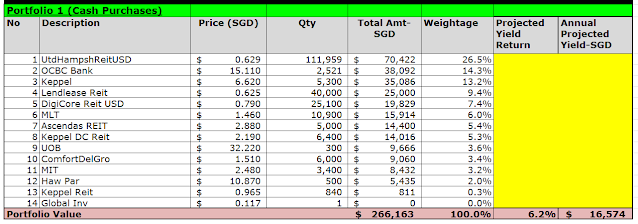
2. Portfolio 2- Margin purchased securities
(Note: My margin purchased securities has grown to a sufficient scale to sustain itself and can pay off annual financing charges as well as to gradually pay down the margin loan through dividends generated.)

For Keppel Pacific Oak REIT, I think that if interest rate continue to trend downwards, there will be a higher probability that the REIT Manager may resume distribution payout as soon as the 2nd half of 2025 instead of 2026.
3. Portfolio 3 (with Tiger Brokers and MooMoo)
(Venture into higher risk as well as capital growth stocks here)
4. Portfolio 4 (Endowus Unit Trusts & Other Investments)

Summary
While the investment value of my underlying portfolios have went up significantly, the sad fact is that my projected annual passive income still remain the same as 2 months back which is a tad disappointment. I do look forward to exiting my stakes in Alibaba once it hits over HKD160 per share and then convert them into higher yielding income producing assets.
Thursday, 19 September 2024
SREITs Maybe Overvalued Despite Jumbo Size Interest Rate Cut of 0.5% By Powell.
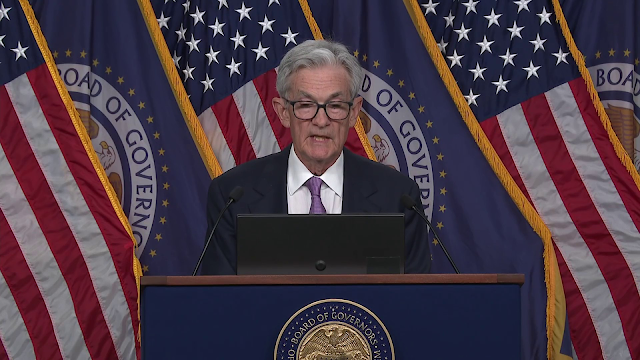
Wow, what a BIG surprise! The conservative Uncle Powell has finally announced not just a cut in US Federal Reserve rate but a giant size 0.5%. Current US rates now hovers at 4.75% to 5.0%. This is higher than what I was expecting. But still, the recent SREIT price rally maybe overdone. US interest rates will not fall back to the close to 0% in the past unless the US economy crash due to a severe recession.
Assuming an eventual near term US Fed rate of 3.5% at equilibrium to fight against inflation and also to ensure adequate economy growth stimulation, returns from REITs required for most folks should be at least another 2.5% to compensate for equity risk of holding onto financially strong ones like Mapletree Industrial Trust ("MIT") and Capitaland Ascendas that are linked to Temasek. This will translate to an expected yield of 6.0%. MIT is now trading at 5.3% distribution yield as at 18 September 2024.
While I am still holding on to the SREITs in my current cash and margin portfolios, I have began selling off part of my CPF OA investments in MIT to lock in the recovery and the resultant capital gains at the S$2.50+ range.
Monday, 29 July 2024
Investment Portfolios Updates (26 July 2024) - Net S$620K and Projected Annualised Passive Income of S$42K.


The recent SREIT rally has finally put a brake on the non-stop downward spiralling in market prices. There is a much anticipated worldwide expectation of a US rate cut in September 2024. Based on US inflation reports and moderate job growth data, it seems chances of a rate cut is indeed high. Keeping my fingers crossed that the recent rally in price is permanent with more to come. However, Geopolitics such as the upcoming US Presidential Election (Trump appears to be the favourite to win now after his assassination) and also escalating Middle East conflicts between Israel and Iran back military groups are causing much uncertainty in global economies. There is also the very controversial Allianz offer that affects my current share-holdings in Income Insurance Ltd- please see further remarks under Portfolio 4 section below.
(Note: This portfolio is designed to provide immediate dividends for use as it is under my own CDP account and the dividends credited goes directly to my bank account.)

2. Portfolio 2- Margin purchased securities
(Note: My margin purchased securities has grown to a sufficient scale to sustain itself and can pay off annual financing charges as well as to gradually pay down the margin loan through dividends generated.)

I have took profit and sold off all my Ping An Insurance shares. Have used the proceeds to purchase Link REIT as well as to pare down on expensive margin loan. Margin loan thus went down from S$291K to S$281K.
Also took a small speculative 5000 units trade in Mapletree Industrial Trust when its price plummeted to S$2.10 per unit and took profit 2 weeks later @S$2.29 per unit after the SREIT rally.
3. Portfolio 3 (with Tiger Brokers and MooMoo)
(Venture into higher risk as well as capital growth stocks here)
I have took profit and sold off all my Ping An Insurance shares. The proceeds were used to purchase additional Link REIT units when its price plunged to below HK$30 range (HK$29.80) per unit. Also opened up a small position in a penny stock, Oceanus, which had seen continued strong growth in its food distribution business in China.
4. Portfolio 4 (Endowus Unit Trusts & Other Investments)
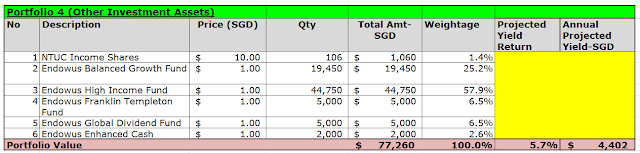
I have continued to build up my bond funds investment via Endowus platform.
Guess the only news-worthy update here is that my NTUC Income shares market value will go up from S$1,060 to S$4,300 if the controversial Allianz offer gets approved by local regulator and shareholders. The 2 formers CEOs of NTUC Income Co-operative have come out to speak out against the deal as they do not want the insurance group to lose track of its social goal to provide cheap insurance to the lower income of Singapore society.
Thursday, 11 July 2024
SREITS and Banks Strong Rally Today (11 July 2024) After Powell Show Power!

I thought my eyes were playing tricks on me when I checked on the SREITs market today. Not just SREITs but local bank stocks also went up. Looks like the market like Jerome Powell's message on potential interest rate cut which may happen earlier rather than sinking into recession: “You don't want to wait until inflation gets all the way down to 2%, because inflation has a certain momentum,” Powell said. “If you waited that long, you’ve probably waited too long, because inflation will be moving downward and will go well below 2%, which we don't want.”
I am surprised but delighted to see the surge of 2.86% to 4.76% today for Mapletree Industrial Trust and Mapletree Logistics Trust respectively. I am heavily vested in the Mapletree family of REITs. Let's hope that there will be a sustained rally in price after the long drought.
Monday, 24 June 2024
Invest SREITs at all-time low or better to go into Bond Investment Instead?

I am having a headache recently with regard to my upcoming regular month end of additional capital injection into the investment portfolios. On one hand, SREITs have tanked again to near their 52 weeks low and now seems the best time to invest. Saying that, in particularly for the past few months, whenever I thought that the SREITs prices have bottomed and accumulated more units, their price just dropped further. On the other hand, my investment forage into bond unit trusts over the past 1 year has been stable thus far especially with global inflation under control- interest income which I had received is around 6% return per annum and capital price of the bond fund held their ground well. Moreover, there is also potential further capital appreciation once interest rate cuts by the US Federal Reserve is announced.
1. Invest SREITs at all-time low or better to go into Bond Investment Instead?
I think that I will probably add on to the bond unit trusts for June 2024 month end as I have previously in May 2024 already invested approximately S$10K into both United Hampshire US REIT and Frasers Logistics & Commercial Trust (unfortunately, both SREIT's unit price declined further after my respective purchases).
2. A close friend asked me whether Equities or Money Market Funds is the best investment in view of current market?
I thought that my friend asked me a very interesting question. My personal thoughts are that for risk averse folks who find equities and bonds extremely risky, then maybe buying into the Money Market Funds is well worth it. Singapore Saving Bonds or T-bills are also good options.
The thing is that over the years, I have decided to just keep my real thoughts to myself whenever risk averse close friends asked me such question. I will at most just share my thoughts on the above financial instruments since their risk profile is extreme prudence and they generally ask for the sake of affirming their own beliefs (if you say something else, then it gets into a heated debate). However, the fact remains that returns from such investments will barely keep up with inflation. I think that some risks need to be undertaken in order to exit the rat race earlier.
Ok, that's all for today's post, have a great week ahead folks!
Friday, 19 April 2024
Mapletree Industrial Trust Rapid Plunge in Valuation- Opportunity in Current Crisis or Value Trap?
Mapletree Industrial Trust ("MIT") recent market price has declined rapidly amidst the higher financing cost environment and Middle East troubles. Today, I will touch on whether the current crisis presents a good entry point for MIT and my recent additional investment this week.
Please see below for my latest video on YouTube channel. Going forward, I will be posting various exclusive investment contents onto my YouTube channel only. Please subscribe to my YouTube channel also to get the latest content for sharing.
Tuesday, 2 January 2024
Central Provident Fund Personal Updates- Moving Towards Enhanced Retirement Sum Using Special Account.

As at 31 December 2023, the much anticipated interest of S$13.6k was credited by the CPF Board. My special account is now at S$247.6k which is S$15k higher than last year. The S$10k of recurring interest income from the special account should be enough to catch up to the yearly increase in ceiling for enhanced retirement sum. For my CPF special balances, I do not intend to risk investing any of it albeit tempted at various times to try to beat the 4.08% interest income rate using unit-trusts. This is my final line of defense in the event of a black-swan event that may wipe out my cash investment portfolios.

As for my CPF ordinary account, I have set aside S$76K in my CPF Ordinary investment into the following assets as at 31 December 2023:
1. S$36K invested into SGX- Mapletree Industrial Trust;
2. S$30K invested into MSCI Equity Index (50%) and MSCI Bond Index (50%) via Endowus &
3. S$10K invested into Endowus Core Flagship (80%/20% Equity/Bond mix).
I have also taken profit of S$5.6K realized from Endowus MSCI indexes during the recent rally in global equities and bond prices and returned these balances to my CPF account. I will redeploy another S$5k to S$10K if the stock market corrected in early 2024.
As for my Medisave account, these will be eventually depleted as my parents do not have critical illness insurances. For H&S, managed to get some for my Dad with certain exemptions. I am thankful that our Singapore government has rolled out the Pioneer and Merdeka Generation medical packages for the elderly Singaporeans. These initiatives have thus far saved me and my sibling from incurring huge medical expenses.
Saturday, 28 January 2023
United Hampshire US REIT Finally Having Some Signs of Life?
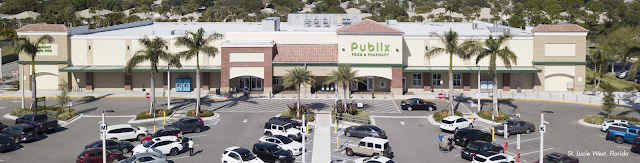
United Hampshire US REIT ("UHREIT") has been one of my lacklustre US REIT investment holdings inside my portfolios despite no apparent bad news like those facing US Manulife REIT. While most REITs such as Keppel DC REIT, DigiCore REIT and Mapletree Industrial Trust sprang back to life and shot up vivaciously over the past few days, UHREIT just went up a tiny bit and laggard far behind. It has tumbled 28% from US$0.625 per unit as at 31 August 2022 to US$0.45 per unit at one point in time during early January 2023. I was beginning to get worried that there maybe some extreme bad news like fraud that has not been officially released.
1.What happened to UHREIT?
I thought that there maybe certain news that I have missed out on UHREIT. So I reached out to a fellow investment blogger, Happy REIT Investor, whom I recalled is similarly vested in UHREIT. For those interested, please refer to the comments section for the insights shared by Happy REIT Investor in his recent portfolio posting. You can see our discussion there on UHREIT.
(Fyi: Happy REIT Investor is one of the few bloggers who has already attained the sacred financial independence with a sizeable investment portfolio built up through his astute investment skills).
2.UHREIT Distribution Yield
The current distribution yield of UHREIT is 11.75% based on its unit price of US$0.495 per unit and annualised 5.82 cents of payout. Its upcoming year end results will be released on 22 February 2023.

For those like me who pursues an income investing strategy, the ups and downs in terms of the pricing of a stock does not really matter if one adopts a long term view. As long as there are no frauds or major bankruptcy of the major tenants, I think that one can always wait it out while collecting the dividend payout.
Parting thoughts
I am actually thinking of whether to add on to UHREIT. However, it is currently already taking up 10% of my overall equity portfolios and thus will increase my concentration risk. For 2023, I intend to diversify and build up more investment holdings in non-REITs sector assets.
For those vested in UHREIT, will you still be holding on to it despite the lackluster price performance since IPO? What are your thoughts?
Subscribe to:
Posts (Atom)