Showing posts with label Global Investment Ltd. Show all posts

Sunday, 26 March 2023

SGX listed Global investment Limited Loss Of S$6.08Mil Due to Investments in Credit Suisse CoCos.

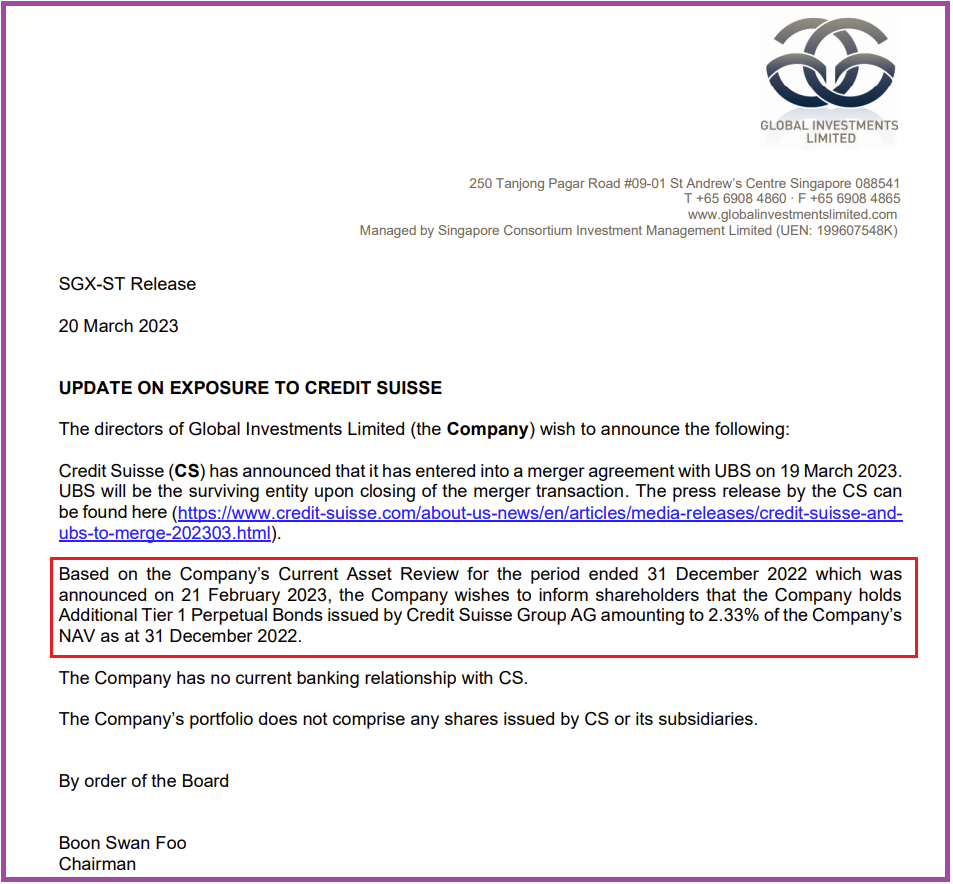
I thought that it is rather interesting to see marketing and mass communication techniques being employed into the SGX announcement by the management of Global Investment Limited ("GIL") to confirm that they have taken a hit in their CoCo with Credit Suisse and then express it in a nonchalant manner since it is only a "mere 2.33%" impact on its Net Asset Value of S$0.1682 as at 31 December 2023. The announcement has cleverly avoided mention of a full write-down by only inserting a URL for shareholders to read for themselves the other announcement coming out from Credit Suisse as well as astutely avoiding the quantification of the absolute quantum that is now worthless by only referencing to 2.33% of net assets.
1.Quantification of absolute amount lost in the Credit Suisse banking crisis- S$6.08Mil
SGX announcement by GIL

Source: https://www.credit-suisse.com/about-us-news/en/articles/media-releases/credit-suisse-and-ubs-to-merge-202303.html
The financial impact of the CoCos that the Swiss government has announced as a full write-down amounted to S$6.08 Million. This is actually an extremely high amount that is nearly half of the annual dividends income and interest income received by the GIL from its investments. 
Total Revenue from main investments of GIL
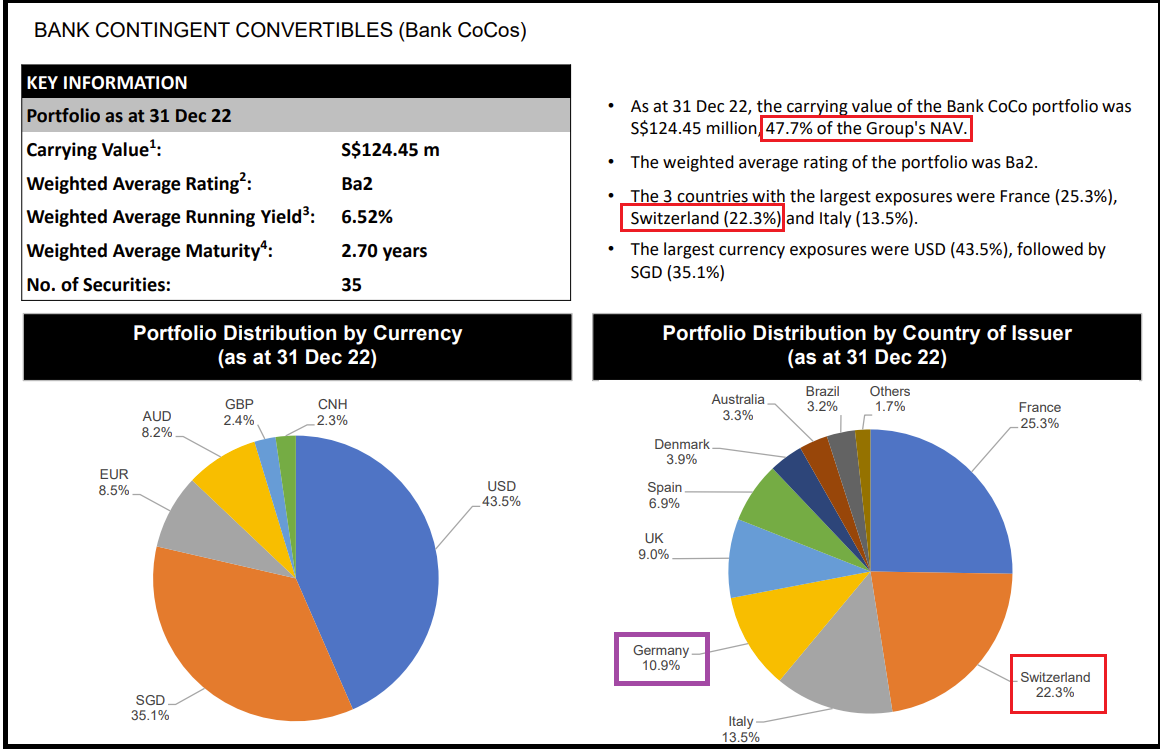
The worst aspect is that the banking crisis continues to spread with Deutsch bank, one of Europe's largest bank, also appearing to be in trouble from a lack of confidence- GIL has 10% exposure to Germany out of its total S$124.45 Million in bank CoCos.
Another 10% potential exposure in CoCos coming up from Germany bank in trouble

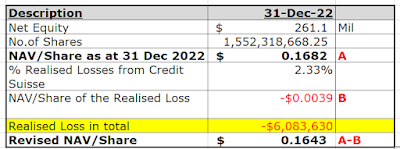
2. Net Asset Value after taking out Credit Suisse CoCos exposure
As aforesaid mentioned, there maybe another S$12.4Mil of potential exposure coming out from Germany CoCos and this may even be higher if the banking contagion starts spreading again in Europe.

Parting thoughts
As at 24 March 2023, GIL is languishing at S$0.105 per share which is one of the lowest ever over the past 5 years. Tier 1 banking capital has become extremely risky in the prevalent market conditions and 47% of its net asset are stuck in CoCos. Personally, I am staying away from GIL for now until the banking crisis stabilized. 

Monday, 20 March 2023

Global Investment Limited In Crisis Mode- 48% of Its Net Assets Are In Bank Contingent Convertibles (CoCos).

It has been a long time since I last write-up on Global Investment Limited ("GIL"). GIL used to be one of my favourite counters as I find its market trading price to be grossly undervalued to its net asset value (which is mostly reflecting fair value accounting). Anyway, I have sold off most of my shares in GIL during September 2021 to October 2021 when it last traded at a high of S$0.154 to S$0.155 per share- my current residual shareholding is only 1 share which is an odd lot leftover from one of the shares for scrip dividends exercise.  Given that its price has slumped  by <27.1%> to S$0.113 per share and offering up till 6.7% dividend yield, is it a good buy now?

1. Banking sector crisis
Given the cracks appearing in the international banking systems, holders of Bank Contingent Convertibles (CoCos) are now being exposed to an all time high risk. CoCos are the lowest rung of bank debt created during the European debt crisis to buffer banking capital. CoCo bonds is structured around a loss absorption mechanism, so it is a product with extremely high risk.  When the regulatory authority makes a judgement that a bank is unable to continue its operation, it will reach the trigger point. This will force the conversion of CoCo bonds into ordinary shares or writing down of the principal of the bonds in accordance with the terms of its loss absorption mechanism. Holders of CoCo bonds might need to bear part of the loss or a total loss of their investment.

In short, the US$17 billion of CoCos held by bondholders of Credit Suisse are now worthless overnight with the takeover by UBS. The Swiss lender had 13CoCos outstanding issued in Swiss francs, US dollars and Singapore dollars.

2. GIL's exposure to CoCos
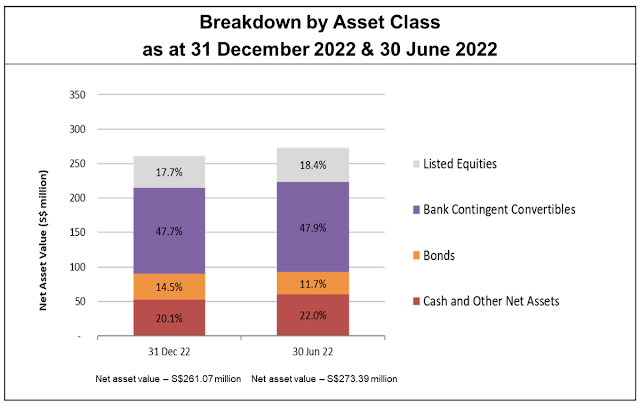
GIL has a whopping 47.7% of its net assets in CoCos. How much was its exposure to Credit Suisse is the big question mark here?
Parting thoughts
Personally, I think that this might be one of the worst time to be invested in GIL given the loss of confidence in the international banking systems. The demise of 3 US banks and 1 major European bank in a short span of just 1 week underlines how bad is the global economic climate.  I thought that GIL should actually reduces its holdings in risky CoCos and instead allocate more of its funds into global listed equities while waiting for the economies to rebound and the bull market to return.  

Monday, 2 January 2023

Investment Portfolios Updates- S$536k (30 Dec'22)- Investing During Bear Market Turmoil.

While the stock market conditions have improved slightly, December 2022 remains in the doldrum and the expected year-end huge rally mentioned by many analysts did not materialize at all. Based on StocksCafe, my year to date unrealised losses (including historical dividends received) is <-7.17%> as at 30 December 2022. The income investing strategy is still working well for me and getting realised investments in the form of recurring dividends helps to cushion against economic turmoil and mitigate the vagaries of exploiting the most opportune market timing to take profits.

1. Portfolio 1- Stocks held in SGX Central Depository 
(Note: This portfolio is designed to provide immediate dividends for use (if required) as it is under my own CDP account and the dividends credited goes directly to my bank account.)
I have invested my excess fund of approximately SGD10K over 2 tranches of 7,000 units each at prices of US$0.540 and US$0.520 respectively during the last week of December 2022 into DigiCore REIT. In fact, I have been gradually building back my stakes in DigiCore REIT since I sold off all my DigiCore REIT units at US$0.865 per unit to take profit during the mini-rally in August 2022. Please see "Is DigiCore REIT a Good Buy Now Since its 41% Decline in Unit Price From IPO?".

2. Portfolio 2- Margin purchased securities
(Note: My margin purchased securities has grown to a sufficient scale to sustain itself and also to repay annual financing charges as well as to gradually pay down the margin loan through dividends generated.) 
2.1 Additional investments were made into Capitaland China Trust. The devastating frequent shut down and rental rebate to its retail shopping malls will soon be a thing of the past going forward into 2023. China has done a sudden reversal of its zero COVID strategy. 

2.2 Manulife US REIT is in trouble as its fair valuation has dropped substantially which caused its leverage ratio to hit 49% (1% short of Monetary Authority of Singapore maximum ceiling of 50%). There is a high probability that Manulife US REIT may be blacklisted by Maybank Securities in its allowable margin programme. Nevertheless, Manulife US REIT has now dwindle to become a small part of my entire margin portfolio such that even if it became non-marginable or zero in value, I will not be caught in a margin call. I have also applied the stress test on my Portfolio 2 in the event that the other 2 US office REITs (Keppel Pacific Oak and Prime) also ended up in the same predicament and overall, I would still be able to escape unscathed. 

2.3 If push comes to shove and the recession worsen, I still have an alternative backup plan in place to ensure my margin portfolio held up for the longer term. 


3. Portfolio 3 (with Tiger Brokers)- Venture into higher risk as well as capital growth stocks here

3.1 I have increased my stake in DigiCore REIT for capital growth as its price has declined 41% to its IPO debut which I personally think is being oversold. 

3.2 I have also took profit on my short term investment into Global Investment Limited with a small 7.1% capital gain within 2 months. 

4. Portfolio 4 (Other Investments)- Non-listed equities and DBS DigiPortfolio

I have invested S$1K into DBS DigiPortfolio to test out their new category of digital portfolio. This product is an income focused portfolio which has 55% in equities, 40% in bonds and 5% in cash holdings and seeks to pay out 4% dividends per annum. So far, I do not really like it as visibility to its components needs quite a bit of mental acrobatics. 

In future, I will also be opening up a pre-funded brokerage accounts with DBS Vickers for investing in index ETF that has a focus on income distribution. The brokerage fees starts from a minimum of S$10 per trade (or up to 0.12% of any transaction) for such an account. Portfolio 4 is being opened also to diversify away from the use of Tiger Brokers. 

Thursday, 24 June 2021

Undervalued Gem- Global Investment Limited Huge Discount Gap to Fair Valuation Narrowing

It is interesting to note that despite the almost daily share buy-back by management, Global Investment Limited ("GIL") remains at a huge discount to its fair valuation. The good news here is that the prior to the commencement of the share buyback exercise in early January 2019, the Company's shares were trading at a discount of 39% relative to its NAV per share as at 31 December 2018. Following the implementation of share-buyback, the fair valuation gap has narrowed slightly. Based on current market price of S$0.151 as at 23 June 2021 relative to Q1FY2021 announced NAV of S$0.1977, this represented a discount of 30.9% to fair valuation (since investible assets marked up to fair value, NAV here will approximate fair valuation). 

1. Recap of Addition Asset Purchased During 2020 COVID Induced Economic Downturn
One of the key investment by GIL was to exploit the opportunity to invest in more bank contingent convertibles (CoCo) when markets fell drastically due to COVID-19 in 2020. Hence CoCo percentage concentration increased to 58% in 2020 relative to 43.4% in 2019. This turned out to be a brilliant move as the risk of holding CoCo reduces with various European markets gradually recovering from COVID due to higher vaccination rate.    

2. Key Management lead by Mr Boon Swan Foo and team still going strong
Mr Boon Swan Foo who has extensive experience continued to be on the board of directors of GIL. 

Mr Ronald Seah, Lead Independent Director, who has served for over 10 years will be stepping down at the end of the 2021.

Mr Tan Wee Peng, has also stepped down at the AGM to make way for election of new directors as part of the board renewal process. 

Mr Lay Charlie Nhuc Hiang has joined the BOD in June 2020. He is an economist of an International Investment Bank (Commerzbank) who understands the investment business well. 

Rest of the BOD remains intact. Mr Boon Swan Foo and Mr Ronald Seah also continue to increase their shareholdings in GIL through the Scrip Dividend Scheme. Interest with shareholders are thus aligned.

3. Parting Thoughts
Despite the rally in share prices of GIL, the Company is still very much undervalued. At a discounted price of 30.9% to NAV, it offers a fair buffer margin of safety. The annualized dividend yield is currently at 5.29% (based on S$0.008 per share to market traded price of S$0.151 per share). I reckon that the cash dividend paid out has been conservative due to COVID as well as encountering good opportunity to invest into marketable securities. If it goes back to pre-COVID period, dividends payout has the potential to increase by another 20%. which will mean a 6.6% dividend yield.

Sunday, 15 November 2020

Undervalued Gem- Global Investments Limited Stable Valuation

Global Investments Limited ("GIL") has maintained its net asset valuation per share which hovers around S$0.1832 as at 30 September 2020. For October'20 and November'20, its stock price has also remained stable despite the recent market turmoil where most stocks plummeted, largely due to the daily share buy-back exercise.  The accounting for its investments are also marked to fair market value. Hence at market price of S$0.137-S$01.39 per share, this represented a discount of between 24% to 25% to its most recent fair valuation of S$0.1832. 
Based on total dividends of S$0.009 for this year, the dividend yield from holding GIL at S$0.138 (as at 13 Nov 2020 market price) is about 6.52% per annum with a potential capital upside of 24%-25%.

Risk Area to Note:
The bulk of the investment of GIL are held in the higher risk asset class of Bank Contingent Convertibles (CoCo). Coco is a fixed-income instrument that is convertible into equity if a pre-specified trigger event occurs. CoCo is actually a creature created to help under-capitalised banks and to prevent a similar global financial crisis in 2008-2009. Hence Coco is a high risk but high yield financial instrument. 

75% of GIL's CoCo are with banks in France, Switzerland, Germany and the United Kingdom. However, with the huge discount to Net Asset Value per share, it appeared that there is a compensatory margin of safety in event that the European banks sunk into bankruptcy should the COVID-19 2nd wave outbreak worsened the prevailing economic situation.

Summary
I believe that with the announcement of more and more successful phase 3 COVID vaccines being rolled out, the risk associated with holding some of GIL's financial instruments will be reduced going forward.

(P.S: Please also "Follow" me on Facebook-Investment Income For Life.)

Sunday, 12 July 2020

Global Investments Limited Still Way Below Its Net Asset Value- Unable To Unlock Intrinsic Value Despite Share Buy-Back

Global Investment Limited ("GIL") share price has surprisingly recovered back to its pre-March 2020 crash level. This means that its share price performance seems to have outshone the STI which is amazing. The Net Value Asset per share of GIL is around S$0.187 per share. Its latest share price of S$0.137 per share as at 9 July 2020 represented a discount of 26.7% given that most of its financial assets are already fair valued through profit and loss. 

1. Contingent convertibles (CoCo) made up the bulk of GIL's investment portfolio
The bulk of the investment of GIL are held in the higher risk asset class of Bank Contingent Convertibles (CoCo). Coco is a fixed-income instrument that is convertible into equity if a pre-specified trigger event occurs. CoCo is actually a creature created to help under-capitalised banks and to prevent a similar global financial crisis in 2008-2009. Hence Coco is a high risk but high yield financial instrument. 

As can be seen above, GIL has deployed a significant portion of its cash holdings into buying more CoCo during this period of market down-turn. The concentration of CoCo has increased from 43.4% in 31 Dec 2019  to 57.4% in 31 May 2020.

From the 2019 annual report, we can see that the weighted average coupon rate of return from CoCo is around 5.8% and the weighted average maturity is 5.09 years. 75% of GIL's CoCo are with banks in France, Switzerland, Germany and the United Kingdom. With the huge discount to Net Asset Value per share, it appeared that there is a compensatory margin of safety in event that the European banks sunk into bankruptcy should the COVID-19 2nd wave outbreak worsened the prevailing economic situation.

2. Daily share buy-back initiative still unable to unlock hidden intrinsic value 
I am not entirely convinced by the effectiveness of the share buyback initiative given the significant difference to its fair value. GIL is still severely undervalued by the market. In the longer term, the share buyback is no use as a tool to prop up share price as the mandate for purchase has a limit imposed on it.

The management of GIL should seriously conduct a strategic review as soon as possible and assess options such as selling off the entire company to other industry players such as banks, fund management companies or even government institutions (Temasek Holdings). This would then unlock the huge discount in its current languid share price. The market is apparently demanding a substantial risk premium for GIL over the meltdown of GIL during the previous Global Financial Crisis in 2008 that has scarred too many souls and did not re-price in the current restructured investment assets adequately. I would prefer the option of liquidating and walking off immediately and redeploying the returns to other investments. 

3. GIL and its relationship to the current scandal at Eagle Hospitality Trust ("EHT")
One important announcement by GIL caught my attention. One of its independent director, Mr Tan Wee Peng Kelvin, actually sat before on EHT's board of directors. The Authorities are conducting a joint investigation into current and former directors, and officers responsible for managing Eagle Hospitality Trust (EHT), in connection with suspected breaches of disclosure requirements under section 203 of the Securities and Futures Act (Cap. 289).

The thing about margin of safety is that this is assuming that the management's interest are aligned with shareholders and that they are discharging their duties faithfully. Else no matter how big is the magnitude of the margin of safety, the business is going to get into trouble sooner or later as apparent in the EHT case which is under investigation by the MAS and also the Singapore Police Force. 

Anyway, GIL clarified that the Board is of the opinion that Mr Tan is able to discharge his duties professionally as an independent director of the company. 


Summary
For the upcoming scrip dividend scheme, I will be participating in it. Pricing is attractively set at S$0.135 which is at slight discount to its latest market trading price of S$0.137 per share and a 27% discount to its fair value per share. In addition, the current dividend yield of 7.3% (S$0.01 per share) is attractive while awaiting for an eventual unlocking of its hidden value. Saying that, GIL's heavy vesting in CoCo makes this investment extremely risky.  Well, there is no such thing as a free lunch. 

Wednesday, 1 May 2019

Undervalued Stock- Global Investment Limited and Recent Share Buy-Back Activities

The share price of Global Investment Limited ("GIL") has risen over 30% to S$0.136 per share since its lowest point on 7th December 2018 of S$0.103 per share. The main reason was due to the January 2019 market rally against the bear market sentiment that plagued the market during the last quarter of 2018. The other reason for the strong showing was due to the management of GIL exercising the share buy-back mandate. Ever since 8th January 2019, GIL has been pretty busy buying back shares almost daily. The last share buyback announcement was just as recent as 26 April 2019. 


Nevertheless, I am not entirely convinced by the effectiveness of the share buyback initiative given the significant difference to its fair value. GIL is still severely undervalued by the market. In the longer term, the share buyback is no use as a tool to prop up share price as the mandate for purchase has a limit imposed on it. Using a quick and dirty method to derive the valuation, we can use the NAV to approximate the fair value given that most of its assets are repriced to the market during the book closing. The fair value per share thus worked out to be around S$0.187 per share (S$322Mil of Net Assets over S$1,723 Mil number of ordinary shares). The current share price of S$0.136 per share is still at a very steep discount of 37.4% discount to the estimated fair value. 

The management of GIL should seriously conduct a strategic review as soon as possible and assess options such as selling off the entire company to other industry players such as banks, fund management companies or even government institutions (Temasek Holdings). This would then unlock the huge discount in its current languid share price. The market is apparently demanding a substantial risk premium for GIL over the meltdown of GIL during the previous Global Financial Crisis in 2008 that has scarred too many souls and did not re-price in the current restructured investment assets adequately.  

For now, the good thing is that GIL is paying out dividends and not hoarding excessive cash, unlike other companies. The Company's mission statement is to invest in a socially responsible way to generate steady income and capital appreciation so as to deliver regular dividends and achieve capital growth for shareholders.

Note: Please refer to my other postings with regard to the assets held by GIL. 
1. Global Investment Limited- Financial review. Is it really a "Hidden Gem"?
2. Global Investment Limited- Excess cash from FY2017 deployed into China Domestic Bonds
3.Global Investment Limited (Attempt To Unlock Intrinsic Discounted Value)- Wiping off Accumulated Losses from the Global Financial Crisis

Monday, 1 October 2018

Global Investment Limited (Attempt To Unlock Intrinsic Discounted Value)- Wiping off Accumulated Losses from the Global Financial Crisis.


Global Investment Limited (“GIL”) has announced on 28 September 2018 that it intends to hold a Special General Meeting (“SGM”) to pursue a few ordinary resolutions. Most of the resolutions proposed are due to technicality issue when GIL transfer the domiciliation of the Company from Bermuda back to Singapore. Hence by virtue of the Singapore Companies Act and SGX Listing requirement, it required shareholders to give a new mandate such as on existing share buyback and Scrip Dividend Scheme that are already in existence under the law of Bermuda. I will give a quick highlight of the 2 ordinary resolutions that may have a greater impact on the financial and share price.


Extract of Proposed Resolutions at Special General Meeting

The first ordinary resolution is basically a capital reduction exercise proposed by GIL. There is actually no financial impact from this resolution being pursued. But I reckon that it is an attempt to remove the stigma of the huge losses incurred by the previous Asset Manager, Babcock & Brown. The stigma has long been associated with a huge discount off the book value of GIL.  

(1) Background and rationale of the 1st proposed resolution for capital reduction
GIL was incorporated in 2006 and run by Babcock & Brown from 2006 to 2009. It incurred astounding losses of S$236Mil up to 31 December 2009. The losses arose mainly from the impairment of the underlying investments made in 2008 and 2009 during the Global Financial Crisis.

ST Asset Management Ltd took over as the manager of the Company on 25 November 2009 followed by Singapore Consortium Investment Limited from 29 April 2016 till present. It is worthwhile to note that under the current management team from 1 January 2010 to 30 June 2018, GIL has generated a total profit of S$193Mil out of which S$127Mil has been distributed out as dividends.

In addition, there were also legacy issue with regard to the significant cumulative forex losses from the USD functional currency of S$66Mil prior to the effective change from USD to SGD as functional currency from 1 January 2012.

(1.1)Structure of the proposed 1st resolution for capital reduction
Extract of Statement of Financial Position as at 31 Dec 2017

This exercise undertaken is to better reflect the underlying assets of GIL’s balance sheet. This will remove the “Accumulated losses” that is so prominently being displayed as negative on its balance sheet. By flushing the losses against share capital, my guess is that the directors are trying to dis-associate GIL from its previous management during the Global Financial Crisis. This seems like a re-branding & marketing effort for investors to re-assess the Company based on the solid track record of the new management. Will have to give the management credit for this valiant attempt to try to close the gap between the net realizable values against current undervaluation by the market on SGX.

(2) Proposed re-domiciliation of the Company from Bermuda to the Republic of Singapore
GIL intends to seek shareholders’ approval for the transfer of the domicile of the Company from Bermuda to Singapore by way of a discontinuance out of Bermuda and continuation and registration in Singapore. The 2 main purposes are to (i) align GIL’s country of registration with its country of listing and where its main operations and business are situated (which is actually Singapore) and (ii) to enhance administrative and operational efficiency when the Company contemplates any corporate transactions or undertakes any fund raising exercise whereby GIL will need to ensure compliance with both Singapore listing rules, regulations and laws as well as Bermuda laws and regulations.

(2.1)Cost savings from the re-domiciliation of GIL from Bermuda to Singapore
Currently, for any corporate transactions and exercise undertaken by the Company would need to comply with both the rules and regulations of Singapore and Bermuda. There is thus a duplication of legal expenses for compliance. By switching the re-domiciliation of the Company from Bermuda to Singapore, there will be savings in the costly legal fees for compliance purpose. Hence overall, this initiative is an excellent move as it would result in faster execution and lower costs incurred by GIL.

Final thoughts on the Special General Meeting
I think that the management of GIL are awesome and pro-active in terms of doing their best for the Company and the assets under management. It is great to see that the management are making efforts to lessen the magnitude of the huge discount of the market value relative to the intrinsic value. I am keeping my fingers crossed that with the proposed resolution, there will be some short term improvement in the closing of the current gap. However, I am not sure how effective this move will be given that the undervaluation issue has been there for many years.

If this still does not work out, the management should probably up the ante and get some big investors to come in and buy out GIL closer to the fair value. Then inject new assets or business along with existing ones into a new Company and then do an IPO in future. This seems to be the only quick way to unlock the dormant value hidden in GIL.

Note: Please also refer to the following links for the previous reviews on GIL


Sunday, 1 July 2018

Global Investment Limited- Excess cash from FY2017 deployed into China Domestic Bonds

From my last review, Global Investment Limited ("GIL") had S$88Mil of cash on hand as at 31 December 2017. Total assets is S$337Mil. This represented a 26% of unproductive assets held as cash and cash equivalent at the end of the previous financial year.   

For Q1 2018, GIL had deployed S$59.11Mil into purchase of a basket of 21 China domestic bonds. These fixed income securities have a weighted average coupon of 4.28% and have a weighted short term maturity of 2.22 years. The invested fixed income securities are classified by management as held at fair value. This is a sound strategic decision to deploy the excess cash on hand to earn returns. At the same time, the 2.22 years holding duration minimizes the risk of further likely global interest rate hikes while leaving room for GIL investment team to maneuver if global recession indeed sets in. 

New investment into China Domestic Bonds-S$59.11Mil allocation by Sector

The China retail bonds may not be as low risk as one believes. There is no ratings by international rating agencies, instead, only the ratings from domestic rating agencies are available. There is also currency risk exposure as the bonds are all denominated in CNY whereas the functional currency of GIL is SGD.  However, I think that overall, the risk is manageable as the current market price of S$0.135 is at an almost 44% discount off the Net Assets per unit held by GIL (S$0.1945 as at 31 March 2018). Recently, the price of GIL declined further by 6.9% (from S$0.145 to S$0.135) hence further enhancing the margin of safety for investors who are accumulating GIL units during the recent market downturn.  

The other significant development announced in May 2018 is that GIL managed to get an amicable settlement from Babcock and Brown in respect of false and misleading representations made to GIL in respect of its previous investments in railcar portfolios. GIL will be receiving approximately S$6.8Mil from Babcock and Brown as the settlement sum. This is a positive development as that there is no long drawn litigation case from this saga which will drain financial resources as well as the focus of the management from running the Company and that GIL will be getting compensation of S$0.004 per unit. 

Amicable settlement of litigation with expected S$0.004 per unit of net proceeds for GIL

The only unfortunate event for Q1 2018 is that there is a net loss from fair valuation of assets classified as held for trading. This might have an impact on the upcoming interim dividend paid out. The management had informed shareholders that instead of economic profit, it will benchmark dividends payment against net profit to better relate the dividends payment to earnings. Management seems confident as of 10 May 2018 that they will be able to deliver dividends of S$0.005 per unit. This is a dividend yield of 3.7% for half year interim and if extrapolated, represents an expected 7.4% dividend yield for the whole of FY2018 based on market closing price of S$0.135 per unit for the 1st half of 2018. If we compare this to last year interim dividend of S$0.006 per unit, this is a decline of 16.7% in terms of dividends paid out.  
S$0.005 per unit of dividends expected for interim 2018- 16.7% decline from prior year.

It will be interesting as investors await the announcement of the results of GIL for its 1st half financial year performance in August 2018. 

Sunday, 29 April 2018

Global Investment Limited- Financial review. Is it really a "Hidden Gem"?

In the previous post, I have mentioned that Global Investment Limited ("GIL") was indeed giving out dividend yield of over 10% for FY2015 and FY2016. In FY2017, its yield was over 8.9% in view of the growth in market valuation from S$0.136 per share to S$0.146 per share as at 31 December 2017.

What are the principle activities of GIL?
GIL works something like a unit trust with a balanced fund portfolio that focuses on:
(i)   equity investment;
(ii)  fixed income component;
(iii) asset back securities;
(iv) collateralized loan obligation securities and
(v)  operating lease assets (currently not holding on to any).

According to its investment philosophy, GIL seeks to make investments through different means to achieve the desired economic exposure to the risks and rewards of the assets. GIL aims for assets that will generate steady income and appreciation in capital to deliver regular dividends and achieve capital growth.

In addition to direct asset ownership, such methods may include, but will not be limited to stapled securities consisting of debt and equity, guarantees of assets and performance, securities lending and participating loan agreements.

With regard to collateralized loan obligation securities, it refers to their investment in mezzanine and subordinated notes which are issued by secularization vehicles that hold collateral consisting of mainly senior secured corporate loans, while the CLN investments reference portfolios of trade finance obligations and corporate loans, with obligors mainly domiciled in Asia. 

I would also like to draw attention to GIL's dividend policy which is to pay out most of its profit after tax after taking into consideration GIL's requirements for future growth.

Key Personnel and management of the fund
The BOD of GIL metup 7 times in 2017. GIL is managed by Singapore Consortium Investment Management Limited (SICIM) which holds a Capital Markets Services License for fund management issued by the Monetary Authority of Singapore. GIL thus does not have any direct employees in its payroll. 

GIL is chaired by Mr Boon Swan Foo who is also the non-executive Director and Chairman of the Company. Mr Boon is the Chairman and Chief Executive Officer (CEO) of SICIM. He serves on the board of China National Offshore Oil Corporation. Swan Foo also served as CEO of ST Engineering from 1997 to 2001, was the Mananging Director of A*STAR from 2002 to 2006. He was also the Chairman and independent Director of Perennial China Retail Trust Management Pte Ltd from 2010 to 2013. 

Are the dividends sustainable?
GIL team has a very impressive record of delivering yearly profits for many years. Based on the financials dug out all the way back to 2012, it has been profitable in producing good returns to shareholders. The management fees paid to the Fund Manager is also structured in such a way that additional incentive payment (on top of base and fixed fees) is only paid out to the Fund Manager once they delivered 20% excess return over the bench-marked return. This aligned their interest to the shareholders.
P&L Trending
It is also interesting to note that in some years, the dividends paid out is higher than the earnings per share. But overall based on the stellar 2017 performance, the total dividends paid out so far are matched by YTD earnings. 


In the absence of major market turmoil, GIL should be able to produce another set of good returns in 2018 as the key management team remain intact to guide the deployment of cash and to evaluate market risks. 

Is GIL value for money at its current price and a hidden gem?
Well, the good news is that based on the net assets per share of S$0.206, the current pricing of S$0.145 as at 27 April 2018 means that we seems to be looking at a whopping 30% discount to NTA per share. 

Is GIL considered a safe stock as only a small percentage are in listed equities?
To answer this question, let's first take a look at the assets that GIL invested. It has over S$203Mil in Non-current assets and S$134Mil in current assets as as at 31 December 2017. Its debts is only a mere S$4.4Mil.

Statement of Financial Position as at 31 Dec 2017

It has a good spread of asset classes and is also well diversified in terms of geographical regions. 
As at 31 Dec 2017, total monetary amount of its asset is S$337 Mil and S$242 Mil are invested. The high cash position in 2017 was due to realization of investments and will be re-deployed out in 2018.

Saying that, my view of the asset classes held for Bank Contingent Convertibles (known popularly as "CoCo") and CLO notes are actually as risky as listed equities. The increasing global interest rates should improve yield of the assets deployed. However, the risk of losing the capital are actually high and not "minimal" risk. 

Conclusion:
In conclusion, I viewed GIL as a risky investment for investors. My risk tolerance are low and while the management for GIL are good, I will only at most hold a small portion of my overall holdings in this particular counter. After being through the Global Financial Crisis in 2008, we all already learnt that big financial institutions are not impervious to financial collapse. High returns and high risk have always been the adage of investment. 

Thursday, 26 April 2018

Super high yield SGX Dividend Stock-Global Investments Limited. STAR buy?

It seems that Global Investments Limited ("GIL") has been producing dividend yield of over 10% for the past few years. Now, this is where it becomes very interesting. Its principle activities  is actually an open ended balanced mutual fund launched and managed by Singapore Consortium Investment Management Limited. GIL invests in public equity and fixed income markets globally.

I first came across this "SUPER"" stock mentioned on some of the investment forums. Then recently, my curiosity was piqued when  a close friend told me that he had uncovered a "hidden gem" that had a track record of paying out over 10% in dividend yield and out of goodwill, revealed this secret to me. I found this claim incredulous as it means that GIL gross investment return on the assets purchased must be over 10% per annum in order to fund dividends to shareholders on top of paying remuneration and salaries for the Directors and permanent staff cost. The gross returns will also need to sufficiently cover administrative costs such as statutory compliance cost (Eg: Audit fees, Corp tax fees, Corp Sec fees).

Is this too good to be true? A secret stock with a double digit dividend yield per annum? 


Well, seems that the dividend yield part is true. But then the key questions that we need to ask ourselves are:

1. Are the super high dividends sustainable?

2. What is the risk profile and key business risks for this business?

3. Is GIL a value for money undervalued stock right now?

Will be digging up the financial statements and also glance into the annual reports of GIL to try to address the above mentioned questions in my next posting. GIL may in fact really be a star buy after-all. 
(Pls see published review of GIL- Global Investment Limited Financial Review)