Showing posts with label Prime US REIT. Show all posts
Showing posts with label Prime US REIT. Show all posts
Monday, 19 October 2026
This US Based SREIT Declined 23% Since July 2026 and Now Giving Out 10.2% Dividend Yield.


Sunday, 5 October 2025
Prime US REIT Short-Changed Existing Unit-Holders With Private Share Placement.

By now, everyone should be aware of the downside of investing in US Commercial REITs listed on SGX. Given the maximum rule of no individual unit-holders can hold more than 9.8% of total units without dismantling with special tax concession granted by Uncle Sam, existing unit-holders will not be able to participate in rights issue. Instead existing unit-holders have to watch their investment get diluted at the worst possible time.
 |
| Financial Highlights |
Prime US REIT remains in great peril with aggregate leverage level of 46.7% albeit the gradual but slow recovery in US Offices occupancy rate. While Manulife US REIT is in a far worse condition, this gives scant comfort to existing unit-holders of Prime US REIT. The current strategy of suspending bulk of the dividends distribution from Unit-holders to finance CAPEX seems not to be working well as on September 25, 2025, the management of Prime US REIT announced a private placement of 129.2Mil new units to raise approximately US$25Mil at a 10% discount of average market price of US$0.215 per unit. This led to an immediate dip in market price of Prime US REIT to US$0.199 per unit as at Oct 3, 2025.
Parting Thoughts
Existing loyal retail unit-holders remain adversely short-changed by the management of Prime US REIT with this dilutive move. I hope that the management of Keppel Pacific Oak US REIT does not get inspired by this terrible move while trading at a huge discount to NAV per unit.
Friday, 15 August 2025
US Office REITs Recovery Play (KORE focus) And Disappointing Projected Distribution Yield Even If Full Payout Resumes-Part 2

Hi Folks, today let's do some stress tests on the expected distribution yield of Keppel Pacific Oak REIT ("KORE") once it resumes its distribution in FY2026. I know that there are many folks who have been holding on to their US commercial office REITs units since the pre-COVID days which also coincided with the then super low interest rate environment. There are also folks who have accumulated additional units of Manulife US REIT ("MUST"), Prime US REIT and also KORE to take advantage of the implosion in unit pricing at rock bottom while waiting for capital appreciation and dividends post recovery phase. KORE seems to be in a better shape than Prime US REIT and MUST from the key metric of occupancy rate and also leverage ratio.
First and foremost, let's take a quick look at the recent announced cashflow of KORE 2nd half results before we annualised the numbers for analysis. The net operating cashflow from rental of offices has plunged from US$36.2Mil for 1H2024 to only US$29.8Mil for 1H2025. This is disastrous. This is a drop of <US$6.4Mil> rental income for half a year and if we annualised it, this will be precarious drop of <US$12.8Mil> in FY2025.
 |
| Extract of Cashflow Statement 1H FY2025 |
Next, we will proceed to examine 3 different scenarios by assuming different level of CAPEX spending and the free cashflow available for distributions.
1. Assuming CAPEX Required in 2nd Half 2025 is similar to 1st Half 2025

For this conservative scenario, the free cashflow is unable to sustain any payout unless KORE's management decided to go back to their own way of using borrowings to finance renovation to trigger off new leases or renewal of existing leases.
2. Assuming CAPEX Required in 2nd Half 2025 same as FY2024 Full Year as Benchmark

3. Assuming CAPEX to Trigger off New Leases Already Done by 1H FY2025 and ZERO for 2H FY2025


Parting Thoughts-Personal Thoughts
The expected sharp recovery in market price of KORE may not happen overnight albeit the 70% discount off its NTA per unit of US$0.70 as the probable distribution yield will be between 0% to 5.79% based on my projection if KORE decided to include in CAPEX and stop their unhealthy previous practice of paying for renovation using bank borrowings.
Thursday, 14 August 2025
US Office REITs Recovery Play And Disappointing Projected Distribution Yield Even If Full Payout Resumes.

Prime US REIT just released its first half results ending 30 June 2025. The results are a mixed bag of good news as well as some slight disappointment. Good news is that green shoots are indeed confirmed with the US office market making a painful but gradual slow recovery from both more favourable demand and supply side. The disappointing news is that distribution is still at only a fraction of the historical distribution. As for Keppel Pacific Oak REIT ("KORE"), its earlier announcement is also not too bad with occupancy maintained at the high end of 85%. I will run a financial projection later on for sharing also on the expect distribution using Prime US REIT to see the 2026 normalised distribution yield.
1. Current US Office Commercial Sector Updates
On the supply front, office ground breakings hit all-time lows, and the construction pipeline contracted to near historic levels, at a fraction of pre-pandemic levels. At the same time, inventory removals for conversions and demolitions outpaced new deliveries, resulting in a net decline of 700,000 square feet nationally in Q2. Scarcity of new, high-end supply is driving aggressive rent growth in the trophy segment and is expected to spur increased spillover demand in well-located, renovated assets as the pipeline dries up
 |
| Extract of Prime US REIT Occupancy |
2. Financial Projection of Distribution Yield in FY2026 Normalisation.
The numbers are looking really bad with cash balances still dwindling. Free cashflow also still in huge negative after paying for CAPEX and financing expenses. Please see below.

If we divide it by 1,308,259,000 units, then the sustainable distribution per unit will be US$0.0041 per unit. Based on market price of U$0.175 per unit as at 13 August 2025, the annualised yield will thus be 2.34% in FY2026 assuming 100% pay-out ratio is reinstated. (Let me know if there is anything incorrect in my maths or assumptions).
Retails investors need to take note that even if the management of Prime US REIT decided to reinstate the distributions, the payout will now need to factor in CAPEX requirement to cover for activating new leases. Unless operating rental income goes up further along with further cut in CAPEX and financing cost, there is not much left in terms of free cashflow for distribution to investors.
Tuesday, 1 July 2025
Manulife US REIT and Things To Take Note for US Office REITs listed on SGX.

I used to hold all the US office REITs of Manulife US REIT ("MUST"), Keppel Pacific Oak REIT ("KORE") and Prime US REIT ("PRIME") listed on SGX. Post COVID, all 3 REITS imploded in varying degree due to the work from home trend. I have then sold off the weakest 2 commercial REIT of MUST and PRIME and allocated the funds to KORE which I thought held the strongest balance sheet relative to the other 2 to mitigate the risk of bankruptcy while waiting for the US office market recovery. I thought that Dividend Uncle's recent interview with the new MUST CEO and his analysis on it are quite interesting, do take a look at his post here.
(Please click here for thos who preferred the You Tube version)
1. MUST Debt Restructuring On Track
Basically, MUST selling off of properties are on track to meet the debt restructuring plan imposed by the bankers. The only tragic part is that Donald Trump's import tariff imposition led to sudden uncertainty in the business environment and led to a 19% discount to net book value of Peachtree office building but nevertheless, this is still higher than the current market price of US$0.161 per unit of MUST which is just a fraction of its net asset value per unit.
Nevertheless, the same storyline of huge potential upside of 100% to 200% for the 3 US Office REITs which are trading at record low to their net asset value per unit hid a a major issue that has often been neglected and forgotten which I will elaborate below.
2. My Beef with US Commercial Office SREITS
The often forgotten issue is that during times of crisis, US Commercial Office SREITs are unable to tap onto its sponsors or existing unit-holders to raise much needed funds to survive the crisis.
The major hurdle is the problem of the complex holding structure designed to minimise withholding tax in the rental return to unit-holders. The sponsors are unable to underwrite the rights issue during crisis time as their own unit-holdings will exceed 9.8%- please see my previous post on the technicality here.
(i) So far, one of the solutions we seen during such crisis time is the selling off of office building at fire sales price for MUST and PRIME. KORE also announced in 2025 the sales of non-core assets. This is not exactly an ideal solution and as a matter of fact a really bad move.
(ii) The other solution is private placement to 3rd parties at extremely dilutive pricing. MUST tried that but failed in the face of institutional investors protest at the grave dilution for existing unit-holders.
(iii) A 3rd fund raising solution will be as per what KORE has done- it has suspended all distribution to unit-holders from 2023 to 2025 and only resume pay-out in 2026 subject to improvement in US commercial office space conditions. The retained distributions is akin to a forced rights issue where everyone will need to contribute thus circumventing the issue of non-subscription which will cause breach of the more than 9.8% individual threshold allowance.
Parting Thoughts:
While current US office REITs seemed very much undervalued, my personal thoughts are that retail investors may seriously need to consider whether it is worth holding on to a ticking-time bomb (due to market cycle) or to consider an exit strategy once the price recovery plays out.
Monday, 17 February 2025
US Office Commercial REITs Facing Bleak Future Outlook Despite Back To Office Mandate.

While many US Corporations have been increasingly forcing their workers back to office, it seems that the hope for US Office Commercial REIT to rally closer to their NTA value per unit relative to the current depressed market trading price maybe dashed soon. The upside factor of interest rate cut and back to office mandate by the US Federal government and CEOs of US global corporations are being offset by the termination of office leases from rapid downsizing of the Federal government.
1. Interest Rate Cut by the Fed in 2024 Reduces Financing Pressure on Commercial REITs
The 0.5% cut in September followed by subsequent cuts of 0.25% respectively in Nov 2024 and Dec 2024 brought down US financing rate by about 1% overall. This also makes it more conducive to borrow funds either for CAPEX or purchase of commercial building.]
2. Weaker Bargaining Chip of Workers Due to Increasing Signs of Softness in US Labour Market
US labour market have been showing signs of weakening. US workers thus does not have the same type of bargaining power that they once did. So, when the head of various US Corporations start to exert pressure for staff to be physically back office to work, workers have to suck thumb and follow the new guidance. JP Morgan and Amazon are leading examples of corporations clamping down harshly on remote work and expected their staff to be back in office 5 days a week. The era of remote working may soon be a thing of the past.
Also, Donald Trump has ordered US Fed workers to be back office. This lead by govrnment example also boosted the ground for the private sector bosses to recall back their remote working staff. Therotically, this should drive back up demand for office space.
3. DOGE Targets To Cut Federal Government Office Leases
Recently, there was a discussion based on report by Trepp Research and Insights which mentioned that a sizable user of office space is the federal government which leased almost 150 million square feet of office space across the US and contributed rental income of $5 billion to the office commercial sector. While Fed workers have been asked to go back office, DOGE seems to be right-sizing the number of Fed employees. In fact, the federal government has already started terminating short term office leases and is eyeing for bigger lease cut.
Summarising, the dark cloud surrounding US Office REITs will not be over soon. The drag on demand and occupancies for office commercial may last for 4-5 years.
Sunday, 12 January 2025
Is US Commercial Office Recovering Or Crashing in 2025? Hope or Depression for Manulife US REIT, Prime REIT and Keppel Pacific Oak REIT?

Is the US Commercial Office recovering or going to crash further in 2025? I guess the answer is it depends on who you are asking this question. Long suffering unit-holders of Manulife US REIT, Prime US REIT and Keppel Pacific Oak US REIT have seen their investments pummeled to just a tiny fraction of their original investments. Worst still, distributions have been cut or halted for a long time. On one hand, the higher interest rate environment effect is still ongoing even in 2025 as some office landlords need to refinance their previous locked in offices loans at the current higher rates. On the other hand, there are lesser office supply coming online as well as surge in conversion of office into residential uses which lead some to believe that 2025 will be the market bottom for the US Commercial Office sector hence a rebound is imminent going forward.
1. The case for market crash of US Office REIT in 2025 and recovery only from 2040.
The Straits Times on Nov 21, 2024 has published an article that has a forecast by Capital Economics that United States office buildings are unlikely to regain their peak pre-pandemic values until at least 2040 as demand for desk space weakens. It further mentioned that values of these offices are expected to plunge by 35 per cent from the peak by the end of 2025 and take an incredulous 15 years or more to recover! This seems to be an extremely pessimistic view. This is also in total contradiction to the view of CBRE and Jones Lang Lasallee.
2. The case for belief that the US commercial office market has bottomed in Q4 2024.
I thought that the global real estate and investment managmeent group of Jones Lang LaSallee USA ("JLL") has gathered pretty interesting hardcore statistics to back up the case that US office market has bottomed in Q4 of 2024 and that 2025 may see the start of recovery of the office market. One can read more of it here for their report.
<Quote from JLL>:
The culmination of 2024 marked another key development in the recovery of the U.S. office market—as leasing activity has accelerated over the course of the year, Q4 was the first quarter of positive net absorption since Q4 2021, and just the second quarter of occupancy gain since the onset of the pandemic in 2020. Leasing activity has established post-pandemic highs for the past three consecutive quarters, and Q4 volume reflected more than 92% of pre-pandemic averages.
</Quote from JLL>
 |
| Demand has returned to pre-COVID with Net absorption positive in Q4 2024. |
 |
| Supply Reduction & Employer Pressure Return to Office |
 |
| US Office Supply Reduction via Conversion of office to residential, revedopment and Demolition |
Parting Thoughts
Personally, I though that the US Office market has bottomed given that Q4 2024 positive net absorption confirmed the Q3 2024 signs of rebound with the shifting patterns of office attendance and US Fed interest rate cuts in September 2024 and November 2024 driving slightly more favourable conditions for US office landlords. Nevertheless, I do not think it will be an instant recovery in 2025 and may take a few years for recovery. So US office REITs are not out of the wood yet. I have continued to hold my stakes in Keppel Pacific Oak REIT but will not be adding more units. I do hope that once Elon Musk and his Department of Government Efficiency start axing many US government employees that are stubbornly still working from home albeit the lack of productivity, it will send a message to the private sector employees to get back to office to work- the US office market may recover strongly in 2025 onwards if this is the case.
Friday, 23 February 2024
Prime US REIT On Survival Mode And Signs of Green Shoots For Entire US Office Segment.
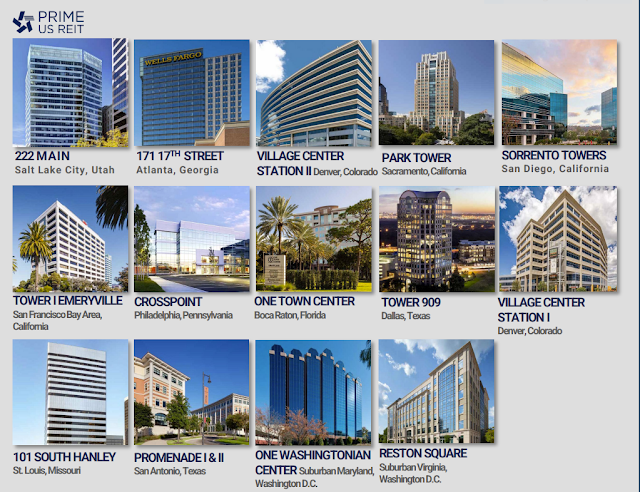
Prime US REIT ("Prime") has amazingly announced a better than expected results. I was expecting it to have breached its banking covenants after valuation decline. However, its aggregate leverage ratio is still within 50% and that it is giving out bonus units and 10% of its distributable income as dividends while retaining the rest for CAPEX and refinancing. Not surprisingly, its languishing unit price rebounded sharply on 22 February 2024. There are a few very interesting announcements by the management of Prime that is worth highlighting and which gives some idea on whether things are starting to turn around for US office commercial sector.
1. Prime US REIT seems to be confident to refinance the US$600Mil that is due in July 2024.
Prime plan to pay down US$100Mil of debt in 2024. It is also already in constructive refinancing discussions with the lenders of its US$600Mil credit facilities due in July 2024. From the optimism and upbeat tone displayed by its press release and public relations, I reckoned that their management team is confident of clearing the upcoming financial loan extension hurdle. This is a good sign.
2. Pipeline of new office supply has dwindled and continued to fall.
This seems to be a major turning point that is being prominently highlighted by the management of Prime. There are 2 main factors which I will briefly elaborate on below:

2(a) Office ground-breakings and deliveries fell to an over 20-year low in 4Q2023.
Deliveries of new office space has fallen from 85Mil sqft 4 years ago to 46Mil sqft in 2023.
2(b) There are quite a number of conversion of excess commercial office building supply into residential buildings.
The US federal government and major US cities have been introducing incentives for building owners to convert their office buildings into residential buildings to address the excess supply in commercial and excess demand in residential apartments. Incentives of up to 75% discount on future tax assessments for buildings that convert commercial space into residential space are being dangled.
2021-2023 has seen such offer soaring and being taken up by building owners. There were conversion activities of a 10 year high of 18.8Mil sqft of office space in 2023.
Parting thoughts
While I am impressed by the growth in leasing momentum and the brightly painted picture of record reduction in US office space supplies by the management of Prime, I am still apprehensive on whether we have seen the rock bottom of the US office sector. Ultimately, the high gearing ratio of 48.4% of Prime is just 1 small step away from a fire-sales of its office properties.
(Note: On 5 February 2024, I had already disposed all my current holdings of Prime US REIT at US$0.16 per unit in order to mitigate my risk exposure to US office REITs. It was a lucky move as Prime US REIT has plunged by another whopping <-19%> to US$0.130 per unit as at noon of 23 Feb 2024. I have since redeployed the proceeds to other growth stocks instead of REITs.)
Tuesday, 20 February 2024
3 Points on Keppel Pacific Oak REIT To Watch Out- Finally Some Light At The End of The Tunnel.

I am just back Singapore today from my overseas business trip. During this past 1 week where I was super busy with work, it looks like a lot had happened in Singapore with the (i) sudden bombshell released by the management of Keppel Pacific Oak REIT (“KORE”) that they will halt all dividends payout for 2 years and (ii) the removal of CPF special account at the age of 55 by Mr Lawrence Wong, our deputy Prime Minister during his 2024 budget speech. The focus of this post will be on the disastrous announcement by KORE management that had sent shockwave among all of its unit-holders (as for the CPF Special and Retirement Accounts changes one can easily find many posts and comments on existing social media hence I will not be adding on to it).

1. Unexpected total halt in KORE dividends distribution.
To be honest, I was expecting a 50% reduction in dividend payout in order to have adequate funds on hand to pay off CAPEX and expiring bank loans. The 100% halt in distributions caught me totally off guard as I think that its latest year end financial results is actually decent with no breach in banking covenants and a respectable aggregate leverage ratio of 43.2% despite the turmoil facing US office REITs.
Nevertheless, I think that the tough measure seems to be the best option currently. At least KORE is not forced into selling off office buildings at a mammoth discounts to their current valuations (this is what happened to Manulife US REIT). Rights issuance at this juncture also will not work due to the rapidly spiralling downwards of unit price. The 9.8% maximum unit-holdings per unit-holder will also be an issue as it will be virtually impossible to get the sponsor to underwrite unsubscribed rights during an equity fund raising exercise from unit-holders. 3rd party bankers even if willing to take part will demand an exorbitant fees to take up unsubscribed rights.
2. Is the worst over or more bad news to come?
As alluded to point 1, the drastic rescue plan seems to be preparing for a dooms day scenario. There could be more bad news such as losing of key tenants or worsening occupancy due to the work from home trend and macro-economic recession risks. We have seen the REIT pricing collapsed by over 40% in a single day since the announcement of the recapitalisation plan.
If one cannot stomach the risks, then it is best to exit all office REITs including KORE.
3. Is it a good time to buy more of KORE?
The hard truth is that KORE has lost its economic moat with the move towards work from home by US businesses and its employees- this is most likely a permanent change.
Although I think that the current US$0.135 per unit as at 19 February 2024 is severely undervalued relative to its net asset value per unit of US$0.69 (this is an absurd market valuation at only 0.2 times of KORE's net asset value per unit), I will not be making any further long term placement into KORE or any US office REITs.
Parting thoughts
While I will not be making any further long term investments into KORE, I may be taking up a small short term speculative position towards the end of this week as I anticipated more irrational selling pressure and bloodbath when Prime US REIT released its results after the close of trading on 21 February (Wednesday). With the long delay in results announcement by Prime US REIT relative to prior year, I reckon that their management team are busy drawing up more drastic measures-rather than a simple dividend halt- to save itself from financial ruin. KORE and other office REITs will most likely be adversely affected by the extreme pessimistic market sentiment about to be unleased by Prime US REIT.
Do brace yourself for the impact and good luck to all existing retail investors of KORE.
Monday, 5 February 2024
Investment Portfolios Updates (2 Feb 2024) - S$613K and Projected Annualised Passive Income of S$46K.

While the valuation of my net investments had gone up relative to 2 months ago, my projected passive income has declined from S$50K to S$46K. Interest expenses from margin financing has gone up. In addition, I have revised downwards the projected yield from StocksCafe for Keppel Pacific Oak REIT as well as Prime REIT- the latter I have amended the expected dividend yield to be zero as it is in "deep shieet" from the looks of it still not releasing its financial results compared to its previous year end announcement date.
(Note: Please also refer to my other Family Portfolio which is projected to yield +S$20K of passive income per annum).
1. Portfolio 1- Stocks held in SGX Central Depository
(Note: This portfolio is designed to provide immediate dividends for use as it is under my own CDP account and the dividends credited goes directly to my bank account.)
I have taken up additional shares in Haw Par Corporation as well as entered a small position into CapitaLand Investment Limited.


2. Portfolio 2- Margin purchased securities
(Note: My margin purchased securities has grown to a sufficient scale to sustain itself and can pay off annual financing charges as well as to gradually pay down the margin loan through dividends generated.)

I have taken up new position in another REIT using margin financing. US Office REITs that I am holding (Keppel Oak and Prime REIT) are expected to perform badly this year given their weak financial position and close to breach of banking covenants. The only consolation for me is that their current pathetic valuation has now become immaterial to my overall gross portfolios.
3. Portfolio 3 (with Tiger Brokers)- Venture into higher risk as well as capital growth stocks here

(i) Keppel Corp share prices shot up with the announcement of a record year of profits as well as a good amount of final dividends. I had taken profit when its share price hit over S$7 and redeployed it into Ping An Insurance Group.
(ii) I continued to add in additional 200 shares into Alibaba as Jack Ma and Joe Tsai had also buy in US200Mil of shares. The million dollar question is will 7th Feb 2024 results announcement be a catalyst to break the death spiral of Alibaba stocks?
(iii) During this 2 months period, I have also added a position into Thai Beverage as it was trading near its 52 weeks low. Please refer to this video on why I added a position into Thai Beverage.
(iv) I have continued to accumulate additional stakes into United Hampshire US REIT during the downturn when its price was hovering at US$0.37 per unit.
4. Portfolio 4 (Endowus & Other Investments)

I have added in a new self created balanced growth funds that is 50% equities (Fidelity Global Dividend Fund + Fidelity Asia Pacific Dividend Fund) and 50% bonds (PIMCO fixed income+ Allianz Global High Yield Fund) which will give an expected passive income yield of 4.8% per annum.
I plan to continue building up my investments using Endowus as it enables diversification into bond funds.
Summary
I think that 2024 looks set to be another bad year for REITs due to the high interest rate environment which will affect most REITS and their distributions when their loans are due for renewal. Gone are the days of dirt cheap close to zero interest rates. Nonetheless, I am optimistic that the yearly rental escalation clauses should eventually negate the effects of higher financing costs for REITs.
Monday, 25 December 2023
The Curious Case of Elite Commercial REIT Downfall and Rights Issue.

Normally, I tend to stay away from writing any post on Elite Commercial REIT (“ECREIT”) as it can lead to personal attacks and persistent online hustling by disgruntled loyal investor who only wants to hear good points on this investment. But I decided to still press on to write-up on ECREIT here as a personal documentation. It has its share of bad points such as over dependent on one major tenant and on the flip side, good point on ease of capital raising during crisis times which are way superior to other SREITs which have properties in USA such as Manulife US REIT, Keppel Pacific Oak REIT and Prime REIT.
1. Why did ECREIT ended up on the brink of 50% breach of MAS aggregate ratio as well as potential bank covenant breaches towards end of 2023?
This is the million dollar question that many investors are asking and pondering.
(i) Since 2021, ECREIT acquired 58 properties that seek to diversify its main tenant of Department for Pensions and Work (“DWP”) of existing properties from IPO. These leases are predominantly UK Government-leased commercial assets and are expected to provide stable cashflow and recession proof yields.
(ii) In addition, most of the government agencies leases are linked to inflation which has up to 13.1% rental reversion from 1st April 2023 to protect ECREIT from the recent raging inflation from high interest rates. The idea of ECREIT “almost risk free” keeps floating around from almost all media and investors since its IPO in February 2020. So, theoretically speaking, cost of operating the REITs are adequately covered from inflationary pressure.
(iii) To add to the mystery, interim property break clauses for many of its properties were negotiated and remove as at 30 June 2022 and 87.5% of ECREIT leases were being secured up to March 2028. It managed to even secure a 3.5% fair value gain in property valuation at that juncture.
2. House of cards came crashing down from 2023 onwards from “triple whammy”
The mix of 3 factors of (a) UK Government vacating 12 leased offices + rental cuts across another 11 properties to retain tenants, (b) badly managed financial management (from 31% leverage ratio to over 42%) as well as (c) high interest rate charges set the stage for ECREIT to be on the brink of collapse from MAS statutory aggregate ratio and breaches of banking covenants with its bankers. It has spread itself too thin from the 2021 acquisition exercise and excessive debt being undertaken.
(a) Tenants vacating 12 leased offices + rental cuts across another 11 properties to retain tenants
In 2022, the portfolio of properties were reporting up to 98% in occupancy rate. This has declined significantly to 92.1% as at 30 June 2023. Management seems to be caught completely off-guard and unable to lease these properties out timely and even has to resort to selling some of the properties off.
(b) Badly managed balance sheet with 42% leverage ratio after major acquisition in 2021 relative to 31% pre-acquisition 2020.
This is the classic over-reliance on cheap debts in 2021 to provide high yields. The previous management team are rather aggressive in growing the REIT and underestimated the potential downsides from Pt 2(a) above and Pt 2(c) below. The aggregate leverage ratio has shot up from 31% in 2020 to over 42% at end of 2021 post acquisition. Not surprisingly, there were “leadership renewal” changes to the CEO of ECREIT. The CFO of ECREIT also left at the end of 31 December 2022 after seeding the stage for imminent financial disaster-personally, I thought that the CFO should have stayed on for another year to clean up the mess.
 |
| Leverage ratio was a healthy 31% as at 31 Dec 2020 before acquisition |
 |
| Leverage ratio shoot up to 42% as at 31 March 2021 after acquisition exercise. |
(c) Surging financing cost to combat inflation
The relentless interest rate increase worldwide caused the distribution available for ECREIT to plunge by an incredulous <-27%> during Q1 of 2023. Its leverage ratio also remained high at 46.6% as at 31 March 2023. Worse still, only 62% of its interest exposure is fixed which means that 38% are floating rates but the good news is that there is no major re-financing till November 2024.
Parting thoughts
ECREIT will be conducting a rights issue to raise funds to lower its leverage ratio and to prevent it from crossing the red line which will trigger off many adverse events such as bank loans default. This is something that SREITS with US properties are unable to quickly address and we have seen the disastrous Manulife US REIT barely surviving its financial crisis without a solution for more than 12 months. Personally, I do not like that a REIT is so concentrated with over 90% in a single tenant albeit being “AA rated” where the picture of being “resilient” and “virtually risk free” is being painted by most stakeholders. As we can see above, the mixture of seemingly minor issues such as tenants not renewing lease, internal aggressive financial management coupled with external macroeconomic conditions changes can easily push a REIT towards financial disaster despite this veil of invincibility.
(P.S: I just want to point out that this is a free world. It is ok to have different views from my thoughts above. The above is just my personal view. This is not a recommendation to buy or sell or to talk-down a particular REIT.)
Sunday, 3 September 2023
REITS and Dividend Investment Strategy Extremely Dangerous!

Haiz, just saw another video by a renowned YouTuber roasting REITS and dividend investment approach. First REIT, Manulife US REIT, Prime REIT, Keppel Pacific Oak, Dasin Retail and Parkwaylife REIT were all quoted as perfect examples of why it is a bad idea to be invested in REITs for dividends (think a few weeks ago, he also mentioned that investing in local banks DBS, UOB and OCBC is extremely dangerous). Apparently, stock picking is frowned upon and branded as extremely dangerous with potential huge loss of invested capital. Index funds such as SPY500 or even REITS ETFs are the best way to invest for common folks as asserted by the YouTuber. I will just make a few quick highlights of my thoughts:
1. Most retail investors are not silly and practice adequate risk diversification.
I have not seen fellow investors with First REIT or Manulife US REIT making up 50% or 100% of their portfolio. If one has adequate diversification and holding on to a basket of REITs, it is as good as buying into a REIT ETF. Even if a REIT went underwater, one would be able to quickly recover from such losses.
2. Index Funds like SPY500 are the safest and highest proven return track record than stock picking?
I think you will be very surprised to hear that from 2000 to 2009, SPY500 index actually performed badly and returned a negative 9% (inclusive of dividends). I was surprised to hear that too from Gregory Van, the CEO of Endowus on one of the YouTube videos. This has a bearing on point 3 below.
3. Index investing does not allow one to have recurring cash distribution without hurting capital at the worst market sentiment period.
As alluded to point 2, for those retail investors like myself who needs frequent cash distributions, using Index funds like SPY500 as strategy will mean selling part of the units at the worst possible time during lousiest market sentiment to raise cash-I think this is a very bad idea.
Parting thoughts
I think that everyone has their own unique needs when they craft out their investment strategies and approaches. Investing in REITs and local banks to me will still form the core of my investment. This is not to say that I disagree with index investing. For the record, I have been using SPY500 as an investment avenue for my CPF ordinary account funds since late last year and derive good realised returns during the recent rally where I sold them off. I do recognize the excellent risk diversification with an index investment that is broadly diversified into hundreds of top companies and sectors with a long term proven historical return.
Tuesday, 22 August 2023
Updates on United Hampshire US REIT and Manulife US REIT- The Curse of the 9.8% Unit Holdings Limit Imposed On US REITs Sponsor.

Hi Folks, this is to follow up on my last United Hampshire US REIT ("UHREIT") post on whether rights issuance to all local unit-holders of US REITs- as a last resort to raise funds- is actually feasible in the event of a financial crisis faced by the REIT. According to the Investor Relation team of Manulife US REIT, this rescue option cannot work as each unit-holder can only hold up to 9.8% of units in such a setup and the sponsor are thus unable to step in. This is the one critical piece of information that no one thought is important for many years until the recent US Office REIT crisis exposed this aspect as the weakest link in the chain which can lead to devastating consequences for US REITs listed on SGX. What it means is that even if a sponsor (referring to US properties REIT) is financially strong, it throws a spanner into the works for the last available rescue option on the table- which is the equity fund raising exercise.

I have sent in an email query to UHREIT Investor Relation last week as well as attended the SIAS UHREIT Webinar session just now (22 Aug 2023; 7pm). The response has been quite general FAQ kind of answers which I do not blame them as UHREIT team can only work with disclosure that have already been made known to the general public. Mr Gerard Yuen (CEO of UHREIT) also kicked the can further down the road when rights issue question was raised citing it is in a very different asset class relative to what happened to the commercial office sector. I have pieced together some of the key points from what UHREIT is able to disclose as well as general information that are available online.

1. What exactly is this 9.8% unit-holding limit and the implications?
This is the maximum unit-holding that an individual can hold in the US REIT and is crafted into the Trust Deed as the foundation that is cleared and permitted by Uncle Sam. Any breach of this 9.8% limit will mean an immediate withholding tax being levied for distributions. To be more exact, a breach of this will not just mean an immediate withholding tax being levied on that particular unit-holder- it will apply to all local unit-holders. Since the general Withholding Tax Rate in US is 30%, so we can assume that the amount of distributions received will dive by a whopping 30%.
2. Any other consequences of a breach of this 9.8% unit-holding?
Using what happened to Manulife US REIT recently due to the breach of bank covenant and consequently no distribution being made, there will be additional corporate tax exposure once the REIT structure is being punctured.
3. Breach of this 9.8% will mean a breach of MAS requirement and be suspended from trading?
Nope, apparently this is more of a tax efficient vehicle issue. But the grave financial implication is that it will lead to further downward spiral in its pricing given the additional tax expenses and risk premium demanded by unit-holders.
Hence based on the above mentioned adverse consequences in Pt 1 and Pt 2, any recuse by the Sponsor via a rights issue that leads to excess subscription support will breach the 9.8% limit and lead to the unravelling of the structure being put in place. This is also why the sponsor of Manulife US REIT has not been keen to do a rights issue since commencement of the November 2022 Strategic Review.
4. Does that mean rights issue will not work for these US REIT during a financial crisis?
Not exactly. Let me try to explain 3 scenarios:
4(a) Scenario 1: Rights issue exercise with bankers stepping in to undertake excess unsubscribed rights
In a normal case, an US REIT will be able to get investment bankers to undertake any unsubscribed rights by paying an additional professional fees for stepping in to mop up the excesses. But for very risky cases like the structural demand challenges in US Office sector and the out of the world high interest rate environment, I don't think any sane bankers will dare to underwrite the rights issue for such REITs lest they get stuck in REIT equities that need to be written down to zero in a few months if things deteroiate further.
4(b) Scenario 2: All existing unit-holders are willing to subscribe to their entitlement hence 9.8% for sponsor remain intact
This scenario is an ideal scenario where the World as we know is PERFECT- every unit-holder do their part and their percentage unit-holdings remains the same after the rights issuance exercise. Unfortunately, we all know that this will never happen in real life. There will be unit-holders that will not subscribe due to individual unique circumstances as well as reasons.
4(c) Scenario 3: Rights issue exercise with existing unit-holders (besides the sponsor which is already at 9.8% max limit holding) willing to take up any unsubscribed excesses.
This is again another theoretical ideal case scenario whereby we are assuming other existing unit-holders are willing to pick up the slack for the Sponsor. These "other" unit-holders must also have deep pocket to be able to do this. Practically, this is very tough to execute with lots of coordination, unknowns and the rights exercise might fail to raise the required amount of funds.
Parting thoughts
I can only say that holding on to US REIT is extremely risky as having a good sponsor has limited value add point during crunch time. Once the management missed the opportune time to do a rights exercise, the REIT will most likely end up in a death spiral or take a long time to climb out of its woes. The 9.8% max limit imposed on the sponsor is the Achille's heel of holding US REITs. The one thing that is exceptional about United Hampshire US REIT relative to Manulife US REIT is that its strip centre properties are a very resilient asset class thus far which have performed extremely well over the past few years.
Saturday, 12 August 2023
United Hampshire US REIT Announced Another Set of Resilient 1st Half Results-12.86% Distribution Yield.

United Hampshire US REIT ("UHREIT") announced another set of stellar half year results. Its Gross Rental increased +13.3% while Net Property Income increased +14% relative to its prior 1st Half FY2022. It has also successfully improved committed occupancy for its groceries and necessities properties to a record high of 97.9% with new and renewal leases totalling 331K sqft being signed in the 1st half of FY2023. At the price of US$0.42 per unit as at 11 August 2023 and a distribution declaration of 2.65cents per unit, UHREIT is effectively giving out an annualised distribution yield of 12.86% and this is notwithstanding an amount of US$1.5Mil being retained by its management for asset enhancement initiatives (the distribution yield would have been even higher at 13.86% if all of it are marked for payout). Congrats to all fellow current unit-holders who have been taking market risk to hold on to this US REIT!
(Note: I have started my own You-Tube Channel and has uploaded a video on UHREIT there- please click here to follow & subscribe.)
1. Quick Review of Financial Results for 1st Half 2023.
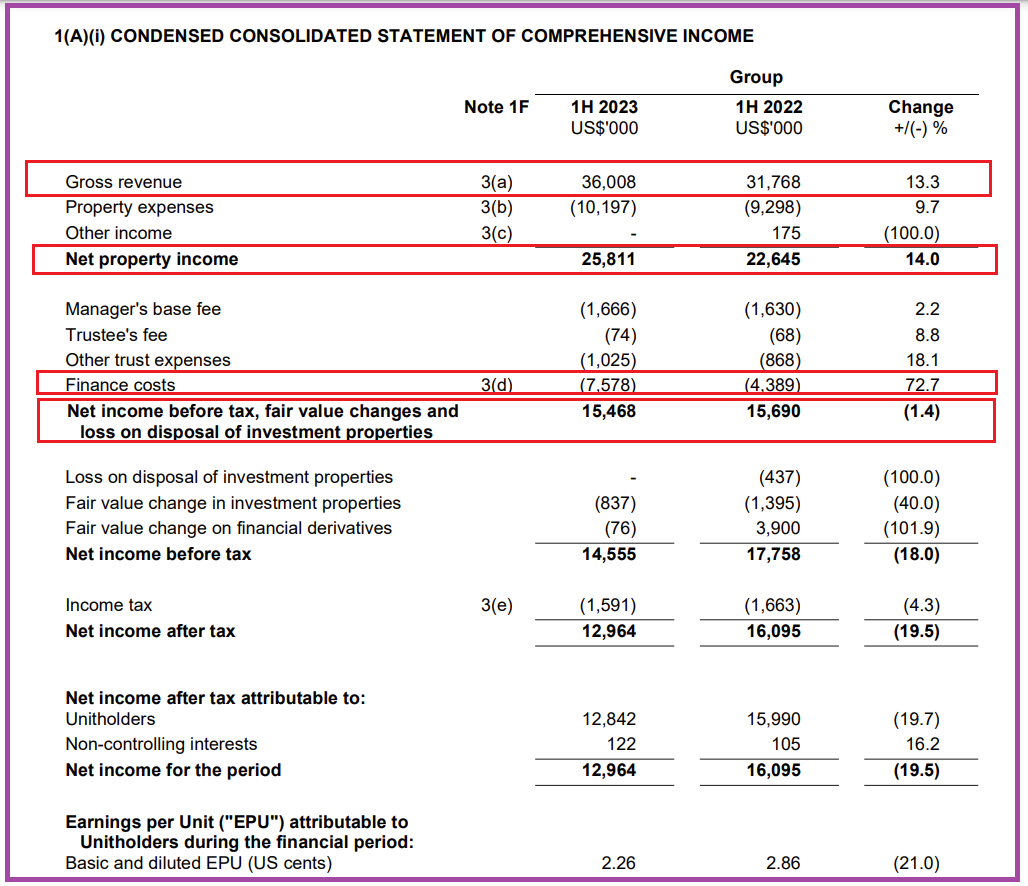
As aforesaid mentioned, the net property income has increased by 14%. However, the finance cost has went up by a whopping 72.7% which thus dragged down the overall net income before tax and fair value changes by -1.4%.
One point to note here is that for "Fair Value changes to investment properties or financial derivatives", these have no effect on the cashflow and distribution payout unless they are realised.
From the financial statements, there are actually 2 key risks that one should take note of and which I will elaborate further in the final portion on "Parting Thoughts" section later on.
2. Debt Profile Status of UHREIT

UHREIT has no major refinancing exercise coming up until November 2026. For 2024, there is a small tranche of US$21.1Mil of mortgage loan maturing only. Moreover, 80.9% of its debt are fixed interest at a weighted rate of 3.57%.
Aggregate leverage is at 42% which personally to me is on the high side- Please see UHREIT planned disposal of Big Pine Centre in section 3 below to repay part of its debt to bring down this ratio.
3. Planned disposal of Big Pine Centre at 3.7% Premium to Valuation

As part of its proactive portfolio and asset management strategy, the Manager has entered into an agreement to divest Big Pine Center, Florida, for a sale consideration of US$9.9 million. The consideration represents a 3.7% premium over the 31 December 2022 appraised value of US$9.5 million, and 7.7% premium over the purchase price of US$9.2 million.
Assuming the net proceeds are used to repay debt, UHREIT’s proforma gearing is expected to be reduced by 0.8%.
4. Million Dollar Question On UHREIT's Investment Properties Outlook- Will It Go Down the Road Of Manulife US Office REIT or Prime US Office REIT?

Interestingly, the Green Street Property Price index indicates that the remote work from home arrangement post COVID pandemic which severely affects US Office Commercial properties actually benefitted the Strip Centre sector which is the key properties held by UHREIT. Apparently, workers working from home increased the demand for the goods and services offered in Strip Centres.
From June 2020 to June 2023, the valuation of Stripe Centre increased 19%.
Similarly, Self-Storage properties (this is also one of the type of commercial property held by UHREIT but to a lesser extent) valuation went up by 58% over the past 3 years.
Parting Thoughts
The 2 key risks faced by local unit-holders of UHREIT are (i) forex risk arising from weakening USD due to wide-spread money printing by the US Fed and (ii) the high aggregate leverage ratio of 42% which makes is susceptible to breaches of bank loan covenants that automatically lead to loan default should there be structural headwinds in demand or higher interest rates hikes in the event that the inflationary monster comes back.
In addition, the structural setup of UHREIT seems to be eerily similar to Manulife US REIT which leads to a further question on whether rights issue to all unit-holders- as a last resort to raise funds- is actually feasible in the event of a debt crisis. According to Manulife US REIT, this rescue option cannot work as each unit-holder can only hold up to 9.8% of units in such a setup and the sponsor are thus unable to step in. This render having a "reputable and financially strong" sponsor as good as useless. I will probably be sending out queries to the management/public relation team of UHREIT to find out more.
Thursday, 13 July 2023
Manulife US REIT Webinar Updates: "What lies on the horizon for U.S. office?"

For those who are unable to attend the Manulife US REIT (“MUST”) webinar on 12 July 2023, please see below key highlights with two seasoned researchers from JLL, Scott Homa and Jacob Rowden, discussing on the US office sector outlook as well as insights into how the cities that MUST's properties are located in are performing:
<QUOTE>
Dear Media,
Here are three key takeaways we had from yesterday’s ‘MUST Insights: What lies on the horizon for U.S. office?’ webinar, conducted in conjunction with JLL.
Takeaway #1: When will U.S. office recover?
It’s not so much a question of timing as it is of asset quality. With flight to quality, trophy and Class A buildings that were completed recently continue to see strong leasing volume and rental growth. Building quality will be a major driver of office recovery going forward. In addition, an end to interest rate hikes, stabilising loan spreads, clarity on hybrid work’s impact on office demand, and dwindling office supply due to demolishment, conversions and a delay in new construction will help to fuel this recovery.
Takeaway #2: How can we expect office valuations to move this year?
U.S. REIT valuations have seen a ~30% decline from their peak. Asset valuations, on the other hand, are hard to generalise with limited data points in the market. Still, there is healthy investor appetite for the top tier of office assets, while some distressed assets have had their valuations beaten down due to several anchor tenant departures and deferred capital expenditure. Valuation movements are highly situational based on specific assets in each micro-market.
Takeaway #3: When will U.S. employees return to the office?
Return-to-office mandates will cumulatively impact ~2.2 million employees in 2023, a third of whom have yet to return year-to-date. The office sector could reach a new equilibrium in two to three years at about 60% of the pre-pandemic office attendance. This transition is already unfolding and reflected in tenant downsizes and space rationalisation.
</QUOTE>
Parting Thoughts
I thought that it is rather interesting to note that the worst be over for the US Office commercial sector if the above analysis by the "experts" are correct. Nevertheless, the main hurdle to clear now is still the selling off of Phipps Tower to lower the aggregate leverage ratio that is bordering on breaching the 50% imposed by the Monetary Authority of Singapore. I thought that MUST management will try to close this before 30 June 2023 but till now, I have yet to see any further developments.
Tuesday, 10 January 2023
The Hidden Danger Of Investing in US Based SREITs Due to Shareholding Restriction.


Why rights issue exercise may fail for SREIT with properties in US?
This is because the Sponsor may not be willing to undertake the rights issue given that they need to maintain less than 10% stake to qualify from withholding tax exemption for dividends received. If not, US withholding tax of 30% will need to be applied for all future distribution. Nevertheless, it is not the end of the world. The sponsor could still form a private equity property trust to buyover some of the investment properties at the revised net book value to provide liquidity to the REIT for reduction of leverage.
The sad thing is that if a rights issue exercise is not conducted, the alternate option via sales of investment properties to its sponsor at this juncture would still be a lower price due to bad market timing and also lead to another vex issue of cherry picking the best assets out and leaving the worst properties in the REIT. While this is better than a fire-sales at depressed pricing to non related external parties, existing unit-holders may not be happy and there would be some unit-holders who still preferred a rights issue exercise instead.
Parting thoughts
Will a good and reputable sponsor be able to save their listed REIT from financial challenges given unit-holding consideration that hampers the prospect of the usual rights issue? The upcoming corporate action from Manulife US REIT will be a good case study on what will happen to the rest of the US SREITs like Keppel Pacific Oak REIT, Prime REIT and US Hampshire REIT in the event that they faced the same aggregate level crisis due to plunging valuation of their investment properties from higher discount rate and lower future cashflow projection.
(P.S: Please also see my previous post: "Manulife US REIT Spectacular Self Implosion- Risk of Firesales of Office Properties Or Dilutive Rights Issue".)
Subscribe to:
Posts (Atom)