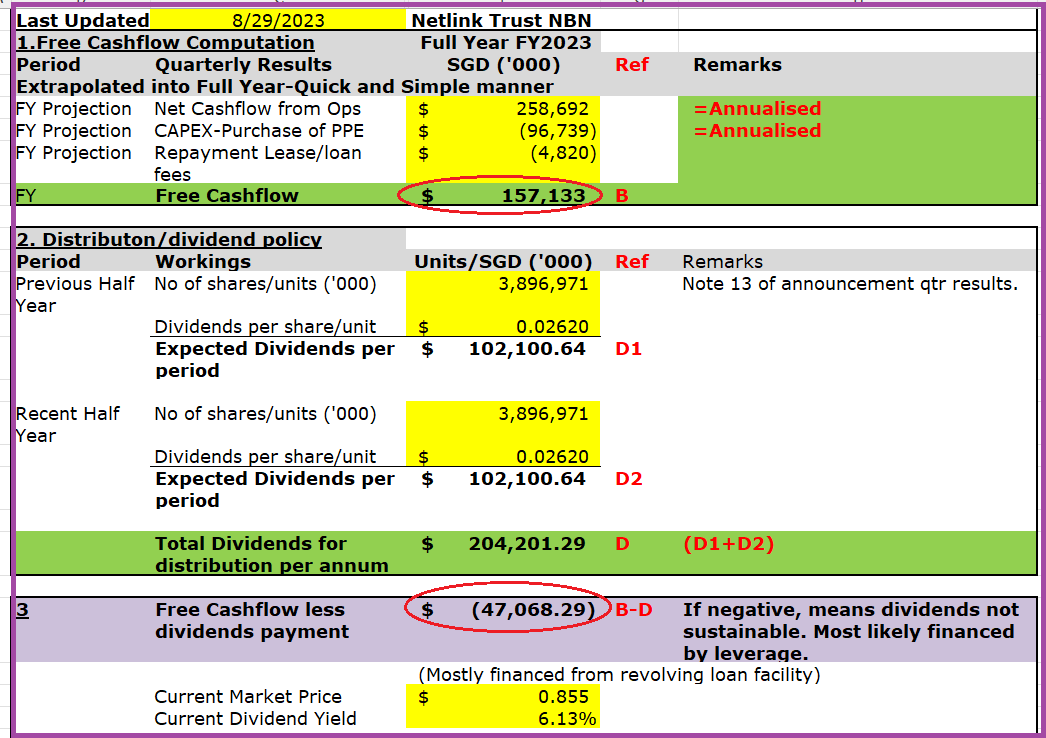
Netlink Trust ("Netlink") seems to be back to a free cashflow deficit position again for FY2023. This means that it is borrowing from bankers to finance its CAPEX or if we put it bluntly, this means that part of the distributions back to unitholders for FY2023 is being funded from borrowings instead of earnings and will not be sustainable in the long run. Please see the YouTube version on my channel.
Who dares win.....create your own passive income and achieve financial independence. Be in control of your own destiny.
Wednesday, 30 August 2023
Tuesday, 29 August 2023
Netlink Trust 6.1% Distribution Yield Not Sustainable For Long Term- FY2023 Distribution More Than Free Cashflow Again.
Netlink Trust ("Netlink") seems to be back to a free cashflow deficit position again for FY2023. This means that it is borrowing from bankers to finance its CAPEX or if we put it bluntly, this means that part of the distributions back to unitholders for FY2023 is being funded from borrowings instead of earnings and will not be sustainable in the long run. I initially thought that this issue has already been resolved 3 years back as I understand that in one of the previous AGM (please see the comments section of this post), the management had mentioned that they will pay out distribution after taking into consideration the free-cashflow.
1. FY2023 Distribution More Than Free Cashflow Again.
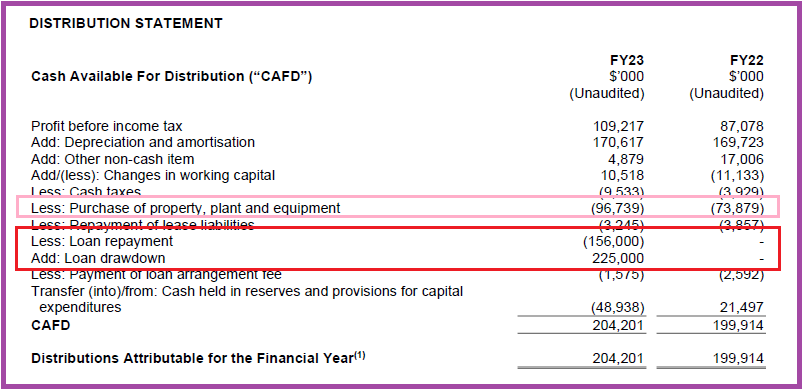
From the above computation screenshot using FY2023 full year numbers, the free cashflow generated is S$157Mil. However, it is paying out dividends of S$204Mil which exceeds the free cashflow by <S$47Mil>. The gap most certainly would have come from additional bank borrowings, so next step would be to drill down further for a sanity check using alternative verification on the Distribution Statement as per below screenshot.
From the Distribution Statement, we can see that Netlink incurred CAPEX ("Purchase of property, plant and equipment") of S$97Mil for FY2023, At the same time, Netlink repaid a loan of S$156Mil but strangely draw down a higher amount of bank loan of S$225Mil which is an additional <-S$70Mil>. Therefore, we can conclude that most of the CAPEX is being funded by bank borrowings or alternatively, we can also infer that 23% of the distribution is being paid for with bank borrowings since the existing cashflow is insufficient to finance such payout.
2. Anything Wrong With Paying For CAPEX Using Bank Borrowings Considering The Low Leverage Ratio of Netlink?
This is the question that is tough to answer. The only way that Netlink can grow its income is through organic growth as we have not seen any major M&A deals after many years. Netlink did indeed have growing revenue over the years albeit at a very slow pace. There is also the upcoming rates review by the Infocomm Media Authority ("IMDA") that is expected to increase the rates by 2%-3%. From an annual revenue of S$400Mil and assuming ceteris paribus, this will at most increase the free cashflow by +S$12Mil which still leaves a significant gap to plug the <S$47Mil> deficit.
Manulife US REIT used to be paying for CAPEX using bank borrowings as their management (via their investor public relation) mentioned that their gearing of 40% then is far from the 50% MAS statutory limit. But look how they ended up. I would rather Netlink management adopt a more conservative stance despite the "resilient" revenue from its business.
Parting Thoughts
Clearly, from the above, this kind of payout is not sustainable in the long run if the CAPEX remains high and pricing increase after the IMDA review is only 3%. The bad news is that the distribution yield will drop to 4.72% (instead of the current 6.13%) if Netlink were to purely pay out its dividend using free cashflow. Nevertheless, the good news is that if Netlink managed to get a higher rate hike increase from IMDA due to the severe inflationary pressures and if CAPEX came down, then the 6.1% distribution yield will still be sustainable for the longer term.
(Maybe folks who have been attending the AGMs or closely following up on Netlink can help share some input/comments into the sudden higher CAPEX of S$97Mil in FY2023 relative to S$74Mil in FY2022 to determine whether it is a one-off operational expenditure for FY2023).
Friday, 25 August 2023
Family Portfolio Management Update-25 August 2023
I am currently handling the above investments for my family members in accordance to their low risk tolerance and will be documenting this on my blog for ease of personal reference for this particular portfolio and also for general sharing purpose.
Current passive income generated from this particular portfolio is around +S$21K per annum from this portfolio (please also refer to my other Investment Portfolios under management which is projected to yield +S$53K per annum).
1. There were additional S$30K being injected into the Endowus Income Portfolio. This is a product with 80% invested into bond funds and another 20% in equity funds that seeks to payout 5.5% to 6.5% of distribution per annum. So far, my wife has been rather impressed with the Endowus Income Portfolio and is comfortable in it. Payout frequency from the many funds is on a monthly basis. In theory, Endowus has asserted that the capital should increase over time amidst the monthly payout.
2. Other overseas assets continued to underperform miserably and only generate 0.8% of passive income per annum.
3. The UOB savings account continues to generate an attractive 5% interest income per annum.
Will be further building up the Endowus Income Portfolio over the next few months.
Tuesday, 22 August 2023
Updates on United Hampshire US REIT and Manulife US REIT- The Curse of the 9.8% Unit Holdings Limit Imposed On US REITs Sponsor.
Hi Folks, this is to follow up on my last United Hampshire US REIT ("UHREIT") post on whether rights issuance to all local unit-holders of US REITs- as a last resort to raise funds- is actually feasible in the event of a financial crisis faced by the REIT. According to the Investor Relation team of Manulife US REIT, this rescue option cannot work as each unit-holder can only hold up to 9.8% of units in such a setup and the sponsor are thus unable to step in. This is the one critical piece of information that no one thought is important for many years until the recent US Office REIT crisis exposed this aspect as the weakest link in the chain which can lead to devastating consequences for US REITs listed on SGX. What it means is that even if a sponsor (referring to US properties REIT) is financially strong, it throws a spanner into the works for the last available rescue option on the table- which is the equity fund raising exercise.
I have sent in an email query to UHREIT Investor Relation last week as well as attended the SIAS UHREIT Webinar session just now (22 Aug 2023; 7pm). The response has been quite general FAQ kind of answers which I do not blame them as UHREIT team can only work with disclosure that have already been made known to the general public. Mr Gerard Yuen (CEO of UHREIT) also kicked the can further down the road when rights issue question was raised citing it is in a very different asset class relative to what happened to the commercial office sector. I have pieced together some of the key points from what UHREIT is able to disclose as well as general information that are available online.
1. What exactly is this 9.8% unit-holding limit and the implications?
This is the maximum unit-holding that an individual can hold in the US REIT and is crafted into the Trust Deed as the foundation that is cleared and permitted by Uncle Sam. Any breach of this 9.8% limit will mean an immediate withholding tax being levied for distributions. To be more exact, a breach of this will not just mean an immediate withholding tax being levied on that particular unit-holder- it will apply to all local unit-holders. Since the general Withholding Tax Rate in US is 30%, so we can assume that the amount of distributions received will dive by a whopping 30%.
2. Any other consequences of a breach of this 9.8% unit-holding?
Using what happened to Manulife US REIT recently due to the breach of bank covenant and consequently no distribution being made, there will be additional corporate tax exposure once the REIT structure is being punctured.
3. Breach of this 9.8% will mean a breach of MAS requirement and be suspended from trading?
Nope, apparently this is more of a tax efficient vehicle issue. But the grave financial implication is that it will lead to further downward spiral in its pricing given the additional tax expenses and risk premium demanded by unit-holders.
Hence based on the above mentioned adverse consequences in Pt 1 and Pt 2, any recuse by the Sponsor via a rights issue that leads to excess subscription support will breach the 9.8% limit and lead to the unravelling of the structure being put in place. This is also why the sponsor of Manulife US REIT has not been keen to do a rights issue since commencement of the November 2022 Strategic Review.
4. Does that mean rights issue will not work for these US REIT during a financial crisis?
Not exactly. Let me try to explain 3 scenarios:
4(a) Scenario 1: Rights issue exercise with bankers stepping in to undertake excess unsubscribed rights
In a normal case, an US REIT will be able to get investment bankers to undertake any unsubscribed rights by paying an additional professional fees for stepping in to mop up the excesses. But for very risky cases like the structural demand challenges in US Office sector and the out of the world high interest rate environment, I don't think any sane bankers will dare to underwrite the rights issue for such REITs lest they get stuck in REIT equities that need to be written down to zero in a few months if things deteroiate further.
4(b) Scenario 2: All existing unit-holders are willing to subscribe to their entitlement hence 9.8% for sponsor remain intact
This scenario is an ideal scenario where the World as we know is PERFECT- every unit-holder do their part and their percentage unit-holdings remains the same after the rights issuance exercise. Unfortunately, we all know that this will never happen in real life. There will be unit-holders that will not subscribe due to individual unique circumstances as well as reasons.
4(c) Scenario 3: Rights issue exercise with existing unit-holders (besides the sponsor which is already at 9.8% max limit holding) willing to take up any unsubscribed excesses.
This is again another theoretical ideal case scenario whereby we are assuming other existing unit-holders are willing to pick up the slack for the Sponsor. These "other" unit-holders must also have deep pocket to be able to do this. Practically, this is very tough to execute with lots of coordination, unknowns and the rights exercise might fail to raise the required amount of funds.
Parting thoughts
I can only say that holding on to US REIT is extremely risky as having a good sponsor has limited value add point during crunch time. Once the management missed the opportune time to do a rights exercise, the REIT will most likely end up in a death spiral or take a long time to climb out of its woes. The 9.8% max limit imposed on the sponsor is the Achille's heel of holding US REITs. The one thing that is exceptional about United Hampshire US REIT relative to Manulife US REIT is that its strip centre properties are a very resilient asset class thus far which have performed extremely well over the past few years.
Dasin Retail Trust Trading Price Possibly Being Manipulated By An Unknown Individual Investor- Investors Beware!
Hi Folks, for those who are trading in Dasin Retail Trust ("DRT"), please be very careful. SGX Regulators have put up a notice that they have observed an individual investor who have pushed up DRT unit price by 46% during an intra-day low of S$0.063 per unit to S$0.092 per unit on 16th August 2023. There were various instances of possible price manipulation over the past month to maintain its price despite the bank loans default notice served by the bankers of DRT.
SGX regulators have referred the matter to the relevant authorities for their necessary action. Do tread with caution for those who are bargain hunting in DRT. Price may crash or trading may get suspended in the worst case scenario for DRT unit-holders. Take care and have a great week ahead!
Monday, 21 August 2023
Aiya- Not Much Benefits Given By Government After National Day Rally!
To be honest, I was a tad disappointed by yesterday's National Day Rally as I do not qualify for much freebies given by our Prime Minister Mr Lee Hsien Loong. The S$7 billion "Majulah" goodies package is being reserved for 50years old plus this round. Nevertheless, I am happy that my parents will benefit from the one-off retirement as well as Medisave top up- think they are probably getting handout of S$2K each. Also, some additional good news for my elderly parents as Mr Lee has announced that there will be enhancement next year for the Silver Support Scheme. These measures do help the sandwiched class like myself who have to take care of elderly parents and support young kids some breather.
Other major announcement
The prime plus flat schemes for good located BTOs is interesting. Finally, the government decided to step in to plug the lottery effect loophole. For many years, some small group of lucky Singaporeans have been making a fortune selling their BTOs and using the enormous proceeds from such flat to upgrade to private property. I know of ex-colleagues who sold off their Pinnacle@Duxton flats and made obscence profits of S$500K- S$600K from the sales. I do hope that with a minimum occupation period of 10 years as well as being made to pay back part of their sales proceeds to HDB, this will make it fairer for all Singaporeans.
HDB flat is meant for living and to help citizens have a roof over their head and not build private swimming pool or tennis court in such public development
Well, some people are not going to like what I am going to say next. Sorry but no offence intended, I seriously think that HDB should stop building Executive Condominiums ("EC"). HDB flats are for folks who need financial support for the absurdly priced housing in Singapore. So why waste space for EC which has luxurious facilities like swimming pool and tennis courts and also giving out generous grants? These space wasted could have been used to build additional block of flat in a plot of land and the EC grants be given instead to other Singaporeans who needed it more so as to have a roof over their head. The government should just leave the building of luxurious condominiums to the private sector instead of wasting resources to have such unnecessary amenities using public funds. I failed to see the reason why for folks who wanted luxurious swimming pools, gyms or tennis court in their home, then the common tax-paying folks have to subsidise their EC grants. If so, then why not build "Executive" Landed Property for those who aspires to stay in private landed property?
Parting thoughts
I think that HDB need to differentiate between essential needs and luxurious craving so as to be fair to tax-payers.
Thursday, 17 August 2023
Latest 17 August 2023 Treasury Bills Results Out- Cut off Yield of 3.73%.
Hey Folks, the latest round of MAS Treasury Bill auction is out. The cut off yield is 3.73%. Total application sent in is a staggering S$11.8 billion and only S$5.6 billion were allotted. The earlier 3rd August 2023 auction for T-bills were going for a slightly higher 3.75%. I have applied for S$10K at a non-competitive bid on behalf of my family members.
The good thing about T-bills is that one is paid the coupon rate upfront unlike many fixed deposit where the interest is only paid out at the end of the duration.
(Note: I have also started my own You-Tube Channel- please click here to follow & subscribe to support content creation)
Subscribe to:
Posts (Atom)