Friday, 11 December 2020

COVID Vaccine Will Only Be Successfully Developed in 10 Years Time According to Colleague Who Worked As A Nurse Before.

Yesterday, I was working from home and had a very interesting tele-conversation with one of my colleagues in Sales and Marketing team. We were talking about the current work from home situation and how I find it not that effective but have to adhere to Business Continuity Planning.

"I wonder when will the COVID vaccine be imported by our Ministry of Health for use by Singaporeans," I said.

"Aiyo, not so fast one. I tell you this. I worked as a nurse in a hospital before and know about such thing. Successful vaccines take as long as 10 years to develop. So we will need to wait at least 2-3 more years fastest before a successful tested vaccine is rolled out for mass inoculations. Also viruses keep mutating, so a successful vaccine may never be developed," exclaimed my colleague confidently.

When I heard the above, I was stunned for a moment and bewildered. Is my colleague, Sarah, working from home or more of "sleeping from home" for a few months to be so out of touch with the biggest global news this month?

"Sarah, Moderna and Pfizer vaccine have concluded their phase 3 trial and both are more than 90% effective and safe for use. As a matter of fact, UK had already started their mass vaccination programme for covid. The US is not far behind and they expect an emergency authorization as soon as this week or early next week by their FDA for Pfizer followed by Moderna," I remarked.

"Oh, I didn't know that....haha...I was very busy with business development work hence did not see the news," Sarah replied hastily.
 
Apparently, some folks maybe too relaxed with working from home and lost touch with reality. Luckily I updated her on the latest news else it will look bad on the image of our organisation if she meets clients and tells them the weirdo theory and misconceptions of hers.

Thursday, 10 December 2020

7 Things Eagle Hospitality Trust Unit-holders Need to Know About The Upcoming EGM (30 Dec 20) and Restructuring Plan

Eagle Hospitality Trust ("EHT") finally released the details on the restructuring plan on Dec 9, 2020, along with a 194 pages circular. The proposed new REIT manager is SCCPRE Hospitality REIT Management Pte Ltd ("SCCPRE"), a member of SC Group. 

7 key highlights EHT unitholders need to know:

1. SCCPRE rescue plan is straight forward and does not involve equity raising at the kick off stage. They will negotiate for an 18mth bridging loan of US$125Mil @ around 10.25% interest rate per annum from a group of lenders led by the Bank of America to re-start hotel operations in the stabilization phase before moving on to the growth phase. This represented the best proposals received so far as it preserves value within EHT with minimal dilution impact due to current weak market sentiment.  

2. If Resolutions 1, 2, 3 and 4 associated with the appointment of SCCPRE fails, then unitholders will need to move on to Plan B (final resolution number 5) which is the voluntary winding up of EHT and an immediate liquidation.

3. The name of EHT will no longer exist and amended to SCCP Hospitality Real Estate Investment Trust if the change of new REIT Manager is approved by unit-holders (pls refer Pg 39/194 of Circular). This actually bodes well for all stakeholders as EHT branding is now negatively associated with breach of numerous listing regulations and also famous for the 2 USA based directors who make decisions such as signing non-disturbance agreements that has conflict of interest by transferring liabilities from lessee to the lessor as well as unauthorized loan application on behalf of EHT for US COVID Loan programme- pls see pt 5 below also. 

4. By opting for a new REIT manager, the key risk here is a potential litigation risk from the creditors of outstanding hotel liabilities, the lenders of EHT under the Bank of America Facilities Agreement as well as Sponsor (Urban Commons) and the Master Lessees. Litigation are expensive and may burn up existing working capital and lead right back to square one.

5. The unauthorized loan of USD 2Mil taken out by ex-Directors Taylor Woods and Howard Wu using the name of EHT Master Lessor for the United States Paycheck Protection Program, has not been transferred to the correct party which is the lessee. There seems to be a hidden agenda by Taylor Woods and Howard Wu to transfer the liability to EHT unit-holders, that is, making EHT investors pay for their own Urban Common hotel lessee operations. There is a risk that EHT unit holders may have to bear the liability for this fraudulent loan application.

6. In order for EHT to eventually lift its trading suspension, sufficient progress would need to be made towards stabilising EHT's operations and EHT would have to ensure that it can operate as a going concern. This would mean the fastest turnaround for trading suspension to be lifted will be as at end of June 2021 if (i) SCCPRE managed to divest at least 1 hotel properties to raise cash on hand and to pay down the bridging loan and (ii) the hospitality sector starts to recover with the COVID vaccines for sufficient cashflow generation to at least breakeven point.

7.  In the event of a liquidation under Chapter 11 if unitholders choose not to vote in a new REIT manager, there is a probability that a further 14% to 43% discount off the last valuation report of US$727Mil maybe required to liquidate them immediately (Pls refer to Pg 69/194 of Circular) due to COVID.

Parting Thoughts:
Based on the aforesaid mentioned points, if the unit-holders choose to liquidate immediately, they will most likely get back nothing due to the current weak market. Hence the better option is obviously to vote for resolution 1, 2, 3 and 4 to appoint the new REIT Manager. In addition, the Trustee DBS is of the view that the proposed change of managers and related matters is the most credible proposal put forth to stapled security holders in the best interest of EHT.

(P.S: Please also "Follow" me on Facebook-Investment Income For Life.)

Wednesday, 9 December 2020

Eagle Hospitality Trust New White Knight- SC Capital and EOGM Showdown Coming

The recent announcement of SC Global coming into the picture as White Knight is good news for Eagle Hospitality Trust ("EHT"). SC currently controls the managers of two listed real estate investment trusts in the region, Japan Hotel REIT Investment Corporation and Thailand Prime Property Freehold and Leasehold REIT. It is very strong financially and has the networking and experiences to restructure EHT.

The bad news now is how much will be the placement units issued to SC Global for them to re-capitalise EHT and at what price. Current unit holders will suffer from massive dilution in their original holdings if the new unit issuance is based on recent valuation report of the hotels. But no choice, given that SC Global need to have a significant stakes in order to water down the current units controlled by Howard Wu and Taylor Woods.

More details should be released soon on the re-capitalization plan and the Extraordinary General Meeting to be convened to formally approve the change in REIT Manager and acceptance of the rescue package. Perhaps the other interesting question is whether current unit holders need to also cough up additional funds in order to raise working capital. 

(P.S: Please also "Follow" me on Facebook-Investment Income For Life.)

LATEST updates on 10 Dec 2020: Please refer here for the key highlights on the detailed rescue plan and EGM.

Sunday, 6 December 2020

First REIT Nightmarish Rental Restructuring- Good Buy Now With Huge Drop in Price and High Potential Dividend Yield of 12.2%?

First REIT has to be one of the most disastrous performing REITs over the past 3 years (the only worse one is Eagle Hospitality). From a record high S$1.40 per unit in 2018, it has now dropped to just a mere former shadow of itself of S$0.40 per unit as at 3rd December 2020. When the detailed rental restructuring plan was released on 29 November 2020, it crashed the previous week ending market valuation of S$0.475 per unit. What was released in the announcement on that fateful day was apparently worse than the basic expectation of most investors.

1. Sponsor and main lessees Lippo Karawaci & Siloam in trouble
Lippo Karawaci is having cashflow challenges due to COVID-19. It is having problems selling its properties in development amidst the current pandemic and also having problems divesting off assets such as retail shopping mall to raise cash. On 2nd December 2020, unitholders of Lippo Malls Indonesia Retail Trust (“LMIRT”) grilled the Trust’s manager over the pricing and timing of purchase of strata title units of Lippo Mall Puri in West Jakarta from Lippo Karawaci for S$336.5Mil. There are doubts by LMIRT unit holders on whether or not the valuation done at the end of 2018 is reasonable enough given the current adverse impact of COVID-19 in Indonesia. Hence there is a probability that Lippo Karawaci is unable to download the asset into LMIRT to raise fund.

First REIT Trust Manager’s rational for the new Master Lease Agreement (“MLA”) is to avoid the adverse consequences of a default by Lippo Karawaci if it maintains the existing MLAs. Personally, I thought that this move is as good as admitting that First REIT is undergoing a potential default by its tenants as it had already given 4 months of rental waiver to its tenants. 

2. Nightmarish terms of new MLAs for First REIT owners

(i) What are the main changes to the MLAs? 
The aggregate commencement base rent for the bulk of the portfolio, LPKR hospitals, will be reduced from S$80.9 Mil to approximately S$50.9Mil (or around IDR550.7 billion) per annum. This is a whopping cut of <58.9%> in base rent. The restructured MLAs will also feature a new performance-based rent mechanism where the actual rent paid will be the higher of either the base rent

The main changes is that instead of receiving the rental in Singapore dollars, the new MLAs changed this to Indonesian Rupiah. The commencement base rent will enjoy a fixed escalation rate of 4.5% per annum, compared to the previous base rent escalation capped at 2.0% per annum under existing LPKR MLAs.

(ii) Is the higher annual escalation rate of 4.5% relative to the current 2.0% per annum a much better deal?

The answer to this seems to be no better. Investors are generally worst off albeit the seemingly higher escalation rate of 4.5%. This is because the risk of foreign currency risk is now being passed on to First REIT investors as the rental denomination currency has been changed to IDR instead of SGD. The IDR lost around 32% of its value over the past 10 years. If there is hyper-inflation or changes in monetary policy such as printing lots of money by the Central Bank, then the IDR may face a substantial drop that is double digit and definitely more than 4.5%. 

(iii) What is the point of signing a new lease agreement if the tenant does not intend to honour it?
The important question here is what if there is another pandemic or major recession in another few years’ time? Will Lippo Karawaci come back to ask for another restructuring of MLAs? If one can dishonor an agreement one time, then one can surely do it again to the unit-holders a second or third time. They should have only changed the terms for the upcoming first batch of hospitals that have leases expiring and do for the rest later on upon expiry. Personally, I think this has seriously damaged their reputation and branding. They should have gone for a rights issue to raise cash at the holding company level back in Indonesia to meet future obligations instead of blatantly breaching signed lease agreements. 

3. Dividend trap with high yield or really good buy now?

Dividend yield look good with 4.44 cents after the restructuring. At the last traded unit price of S$0.40 per unit, this is an attractive dividend yield of 11.1%.. If we exclude the one off non-recurring restructuring costs of S$3.4Mil, then one will get an even higher dividend yield of 12.2%.

As at 30 June 2020, net asset value dropped from S$0.969 per unit to S$0.494 per unit after the restructuring exercise. Compare to the market price of S$0.40 per unit last traded on 4 December 2020, there is  thus a current discount of around 19% to NAV.

However leverage ratio jumped to 48.6% which is almost near the new ceiling of 50% by MAS. 

4. Parting Thoughts
I am not sure how First REIT will be able to get any yield accretive new properties acquisition at the current super high yield expected by investors and also the fact that it is near to bursting the debt limit of 50% hence unable to take advantage of the current low interest rate environment.

Hence despite the seemingly very attractive potential dividend yield of up to 12.2% per annum, I will give First REIT a miss due to the change in rental base (forex fluctuation risk) from SGD to IDR and an over-leveraged financial position. Perhaps most importantly, I looked at the sorry state of another Lippo Karawaci sponsored Reit, LMIRT, and can't help but worried that any investment in First REIT will go the same way in the near future. Last but not least, my personal thoughts are that breaking lease agreements means that the senior management of Lippo Karawaci group will simply repeat the same act once there is another economic crisis.    

(P.S: Please also "Follow" me on Facebook-Investment Income For Life.)

Thursday, 26 November 2020

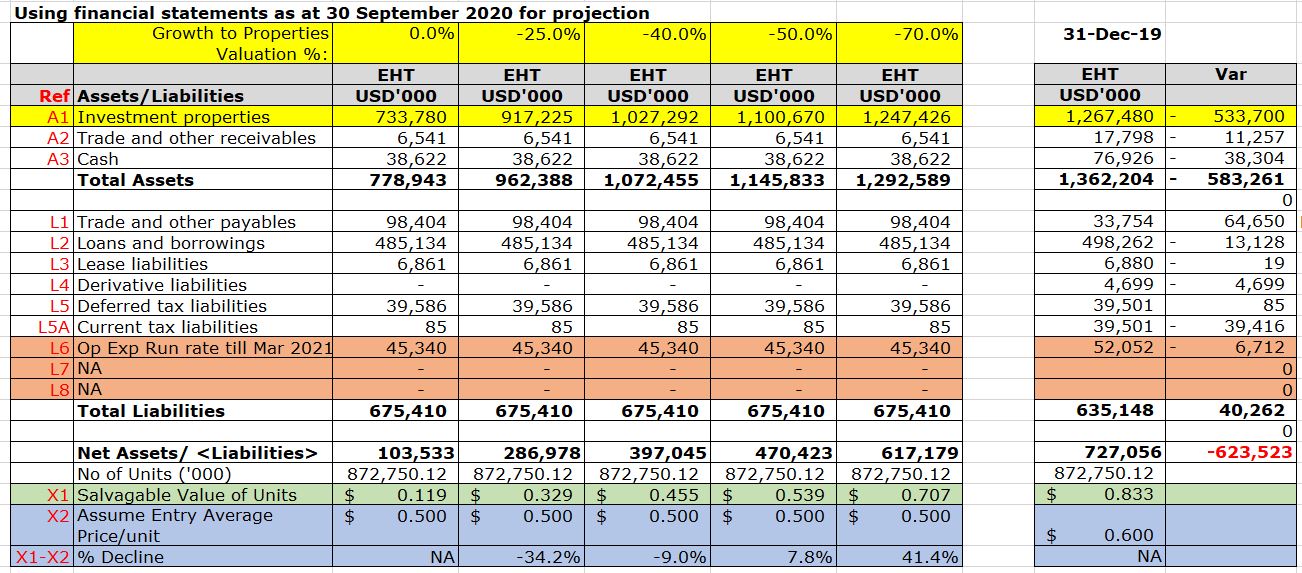
Eagle Hospitality Trust- Updates On Projected Salvageable Hotel Properties Value from Fire-sales (End 2020)

This is an update on the valuation of Eagle Hospitality Trust ("EHT") in the event of forced liquidation and also an estimation of the fair market value once it is removed from suspension.

Based on the Q3 financial results released, I have updated the various numbers on the statement of financial position.


Elaboration on Financial Projection
1. I have revised the valuation of the investment properties to S$734Mil from the original S$1.27Bil. This is a significant drop in fair valuation of S$533Mil amidst COVID-19.

2. Assuming no more hidden liabilities, then immediate liquidation if a buyer can be found will be around US$0.119 per unit. 

3. If the business can continue running and valuation recovers as denoted in the various columns on the right side, investors will be able to recover more money. Hence it is important for the new white knight to be appointed as REIT Manager to continue the business. The recent successfully tested COVID vaccines should lead to a gradual recover in the US hospitality industry.

MAS instruction to DBS Trustee to terminate REIT Manager and to appoint new one
EHT REIT Manager has responded to MAS on 13 November 2020. Since then, there have been no update on whether MAS decided to accept and retain the current REIT Manager or to carry on with the appointment of a new one that will be unveiled soon. Personally, if the current REIT Manager is retained, this means EHT will still be under the control of Howard Wu and Taylor Woods. I will rather EHT liquidate and end their current business under such scenario.  However, if the REIT Manager did indeed change to a new one, then it maybe worthwhile to carry on holding on to the units of EHT.
 
(P.S: Please also "Follow" me on Facebook-Investment Income For Life.)

Sunday, 22 November 2020

Stock Investment Portfolio Updates-22 November 2020


It is coming to almost the end of 2020. COVID seems to have become part and parcel of our lives. Everyday, seeing everyone wearing masks and the non-stop reporting of ever increasing 2nd or 3rd wave record breaking infections and fatalities overseas reminds us that the battle with the deadly virus is far from over. Even right now, the travel bubble between Singapore and Hong Kong which was supposed to commence today got postponed by at least another 2 weeks due to a new severe outbreak declared by the Hong Kong government. SIA and Cathay Pacific are most likely to decline slightly in the opening of the stock markets Monday morning.  I remain optimistic that the immediate emergency approval of Pfizer and Moderna COVID vaccine in December 2020 will pave the way for an eventual defeat of the COVID virus and revert back to our normal way of life by Q4 of 2021. Changes since my last update in August 2020.

1. Rally in DBS, UOB and OCBC share prices
My investments in DBS, UOB and OCBC under cash purchase portfolio and margin portfolio roared back into life with the announcement of the successful vaccines against COVID-19. I intend to sell off part of my banking stocks and switched them into Retail REITs which are likely to be the next counters in recovery as the vaccines will signal the end of devastating economic lockdowns. 

2. Investing into CapitaLand Integrated Commercial Trust ("CICT") at average price of S$1.78 per share
The plunge in REITs pricing provided a rare entry opportunity to buy into a good quality blue-chip in CICT. I immediately invested S$5K into CICT when its prices hit around S$1.80 per share. When it fell below S$1.80, I switched out of SingMedical and  invested the proceeds into CICT. 

3. Additional investments into Capitaland Retail China Trust ("CRCT")
CRCT has been an integral stockholding in my margin account portfolio. Pumped in additional cash when CRCT announced a change in their investment mandate to include also industrial and commercial properties. Thereafter on 6 Nov 2020, CRCT announced a 1 billion acquisition of 5 business park properties in Suzhou, Xi'An & Hangzhou as well as the remaining 49% stake of Rock Square retail mall in Guangzhou. I will be participating in the upcoming rights issue as CRCT undergoes a transformation from pure retail play into an integrated properties holder.  I expect further growth from the strong China pipeline of Capitaland. The holding of different asset classes will also provide good diversification in future economy crisis.  

4. Eagle Hospitality Trust ("EHT")- Notice served by Monetary Authority of Singapore ("MAS") to Trustee for removal of REIT Manager
This is one of my worst performing investment which I have been averaging down in buying in but got suspended due to defaulting of bank loan covenants. Subsequently, it also appeared that its REIT manager has breached various Securities Act as well as making decisions such as undertaking liabilities for its various leasee in direct conflict of interest with unit-holders. There was also a dubious COVID support loan taken out in USA under EHT but went to its sponsor Urban Commons instead. 

The current S$500Mil losses reported in 3rd quarter is due mainly to fair valuation losses of its investment properties under COVID adverse effect on the hospitality industry. How the future plays out depend on whether the MAS is firm in going ahead with the appointment of a new REIT hotel manager.  

If a new REIT manager takes over, it maybe worthwhile to wait a few years for the US hospitality industry to recover. But if the sponsor Urban Commons retains control of EHT, then I will choose an immediate exit option at whatever price upon removal of trading suspension due to management integrity issue.  Of course, the worse case here is the restructuring fails totally and EHT have to liquidate all investment properties at the latest valuation which means that investors will most probably get back at most USD 0.120 per unit assuming no further discount on the latest fair valuation of the hotels (and assuming no further hidden liabilities). 

In short, it does not make sense to liquidate/sell away any hotels at such lowly valuation as per the 3rd quarter report due to COVID. The best option for all stakeholders will be for a new REIT Manager to takeover the hotels and run it as a non-going concern business. 

(P.S: Please also "Follow" me on Facebook-Investment Income For Life.)

Sunday, 15 November 2020

Undervalued Gem- Global Investments Limited Stable Valuation

Global Investments Limited ("GIL") has maintained its net asset valuation per share which hovers around S$0.1832 as at 30 September 2020. For October'20 and November'20, its stock price has also remained stable despite the recent market turmoil where most stocks plummeted, largely due to the daily share buy-back exercise.  The accounting for its investments are also marked to fair market value. Hence at market price of S$0.137-S$01.39 per share, this represented a discount of between 24% to 25% to its most recent fair valuation of S$0.1832. 
Based on total dividends of S$0.009 for this year, the dividend yield from holding GIL at S$0.138 (as at 13 Nov 2020 market price) is about 6.52% per annum with a potential capital upside of 24%-25%.

Risk Area to Note:
The bulk of the investment of GIL are held in the higher risk asset class of Bank Contingent Convertibles (CoCo). Coco is a fixed-income instrument that is convertible into equity if a pre-specified trigger event occurs. CoCo is actually a creature created to help under-capitalised banks and to prevent a similar global financial crisis in 2008-2009. Hence Coco is a high risk but high yield financial instrument. 

75% of GIL's CoCo are with banks in France, Switzerland, Germany and the United Kingdom. However, with the huge discount to Net Asset Value per share, it appeared that there is a compensatory margin of safety in event that the European banks sunk into bankruptcy should the COVID-19 2nd wave outbreak worsened the prevailing economic situation.

Summary
I believe that with the announcement of more and more successful phase 3 COVID vaccines being rolled out, the risk associated with holding some of GIL's financial instruments will be reduced going forward.

(P.S: Please also "Follow" me on Facebook-Investment Income For Life.)