Showing posts with label Netlink. Show all posts

Wednesday, 22 May 2024

Netlink Trust 6.13% Distribution Yield Unsustainable and Ballooning Accumulated Losses of -S$617Mil.

I was looking through the FY2024 results of Netlink Trust ending 31 March 2024. It was shocking to see that once again, it is still paying out excessive distributions. Its accumulated losses ballooned to <-S$617Mil> as at 31 March 2024. Apparently since this is a "Business Trust", it is thus "ok". Today, I will be sharing my thoughts on the latest results in the following video and the key risk to take note if one were to invest in Netlink Trust.  

Please see below for my latest video on YouTube channel. Going forward, I will be posting various exclusive investment contents onto my YouTube channel only. Please subscribe to my YouTube channel also to get the latest content for sharing.


Tuesday, 28 November 2023

Netlink Trust Disappointing Results From IMDA Pricing Review.

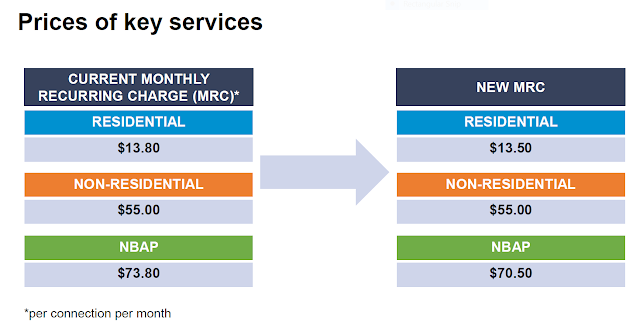
Netlink Trust ("NLT") announced on 27 November 2023 that the Infocomm Media Development Authority (“IMDA”) has completed their pricing review. I was shocked that the chargeable tariff has not increased at all despite inflationary pressures on labour costs, CAPEX and escalating financing charges. What was even more surprising was that the chargeable tariffs for Residential Connection and Non-Building Address Point got adjusted downwards (please click here for the YouTube Video version).

Basically, over the past 5 years, residential connections have grown from 1.2Mil to 1.5Mil which gives an compound annual growth rate ("CAGR") of 4.5% in terms of volume. Non-Building Address Points ("NBAP") has grown at an impressive 26.5%. Hence due to surge in volume economies of scale over total cost of operating the fibre network, this leads to a regulatory reduction in prices per connection.

Distribution yield of 6.43% not sustainable over longer term
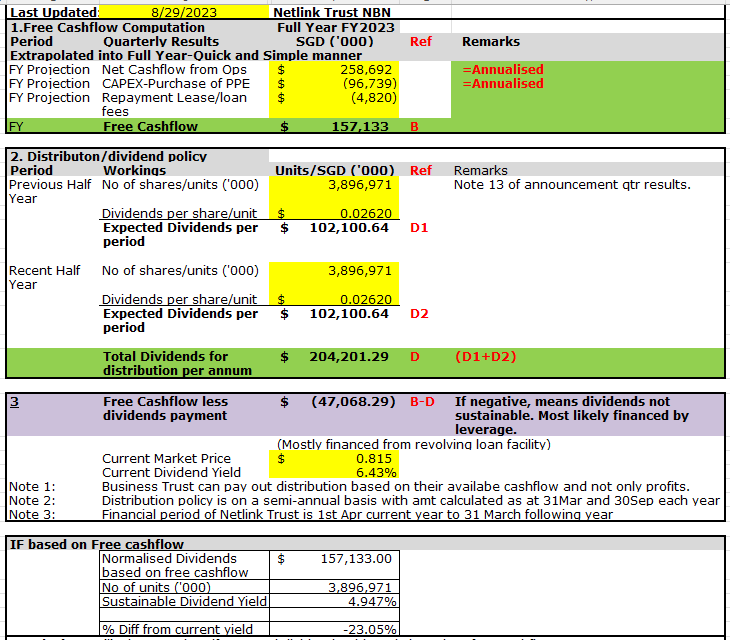
At the price of S$0.815 per unit, this represented a distribution yield of 6.43%. However, note that part of the distribution is being financed from bank borrowings which is not ideal. From a free cashflow perspective, the sustainable distribution yield will be at a lower 4.95%. Given that money market funds with online brokers hover around 4% to 5%, a mere 4.95% distribution yield from investing in NLT equity is beginning to look like a really bad choice. 

Parting thoughts
As aforesaid mentioned, I am extremely disappointed by the outcome of the IMDA pricing review. If one is sure of the continued compound annual growth story of new connections in driving revenue, then NLT seems to be still a good investment. Personally, I will not be adding on to my stakes in NLT as I think that the IMDA wants the shareholders to do charity work and the borrowings to fund dividend distribution is a strange concept to me. Nevertheless, I will still be keeping my minor stake in NLT for now. 

Wednesday, 30 August 2023

Netlink Trust 6.1% Distribution Yield Not Sustainable For Long Term (YouTube Version)- FY2023 Distribution More Than Free Cashflow Again

Netlink Trust ("Netlink") seems to be back to a free cashflow deficit position again for FY2023. This means that it is borrowing from bankers to finance its CAPEX or if we put it bluntly, this means that part of the distributions back to unitholders for FY2023 is being funded from borrowings instead of earnings and will not be sustainable in the long run. Please see the YouTube version on my channel


Tuesday, 29 August 2023

Netlink Trust 6.1% Distribution Yield Not Sustainable For Long Term- FY2023 Distribution More Than Free Cashflow Again.

Netlink Trust ("Netlink") seems to be back to a free cashflow deficit position again for FY2023. This means that it is borrowing from bankers to finance its CAPEX or if we put it bluntly, this means that part of the distributions back to unitholders for FY2023 is being funded from borrowings instead of earnings and will not be sustainable in the long run. I initially thought that this issue has already been resolved 3 years back as I understand that in one of the previous AGM (please see the comments section of this post), the management had mentioned that they will pay out distribution after taking into consideration the free-cashflow.

1. FY2023 Distribution More Than Free Cashflow Again.
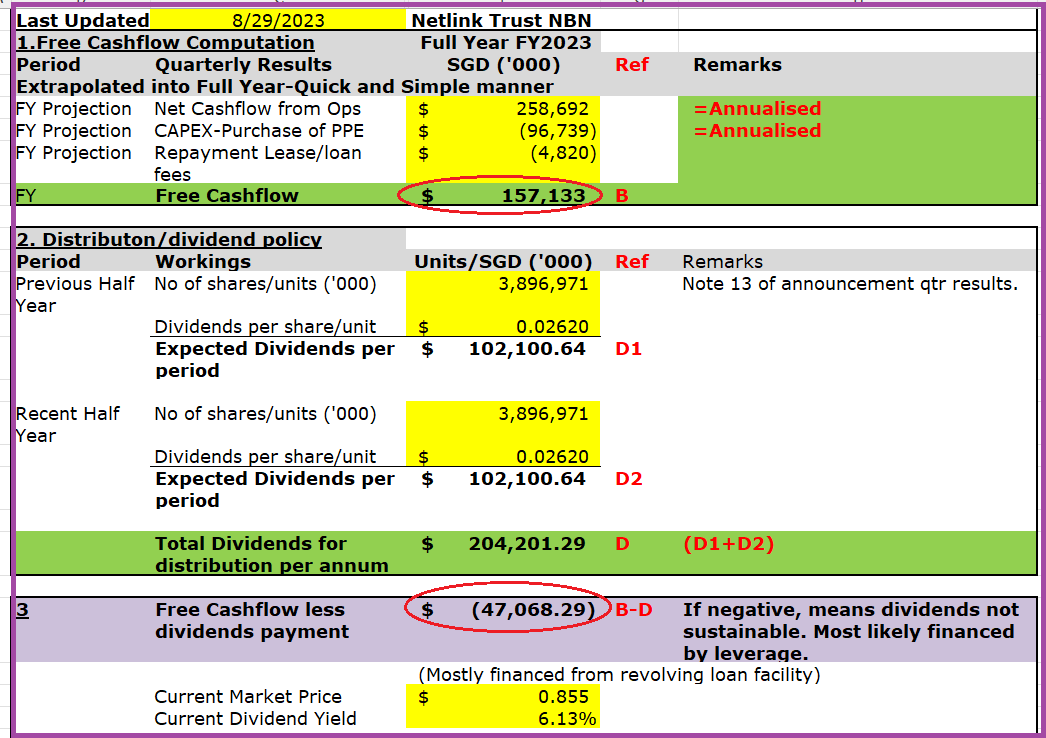
From the above computation screenshot using FY2023 full year numbers, the free cashflow generated is S$157Mil. However, it is paying out dividends of S$204Mil which exceeds the free cashflow by <S$47Mil>. The gap most certainly would have come from additional bank borrowings, so next step would be to drill down further for a sanity check using alternative verification on the Distribution Statement as per below screenshot.
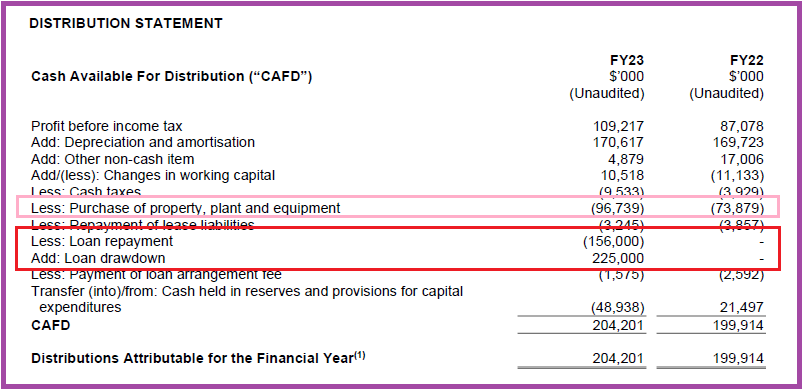
From the Distribution Statement, we can see that Netlink incurred CAPEX ("Purchase of property, plant and equipment") of S$97Mil for FY2023, At the same time, Netlink repaid a loan of S$156Mil but strangely draw down a higher amount of bank loan of S$225Mil which is an additional <-S$70Mil>. Therefore, we can conclude that most of the CAPEX is being funded by bank borrowings or alternatively, we can also infer that 23% of the distribution is being paid for with bank borrowings since the existing cashflow is insufficient to finance such payout.

2. Anything Wrong With Paying For CAPEX Using Bank Borrowings Considering The Low Leverage Ratio of Netlink?
This is the question that is tough to answer. The only way that Netlink can grow its income is through organic growth as we have not seen any major M&A deals after many years. Netlink did indeed have growing revenue over the years albeit at a very slow pace. There is also the upcoming rates review by the Infocomm Media Authority ("IMDA") that is expected to increase the rates by 2%-3%. From an annual revenue of S$400Mil and assuming ceteris paribus, this will at most increase the free cashflow by +S$12Mil which still leaves a significant gap to plug the <S$47Mil> deficit. 

Manulife US REIT used to be paying for CAPEX using bank borrowings as their management (via their investor public relation) mentioned that their gearing of 40% then is far from the 50% MAS statutory limit. But look how they ended up. I would rather Netlink management adopt a more conservative stance despite the "resilient" revenue from its business. 

Parting Thoughts
Clearly, from the above, this kind of payout is not sustainable in the long run if the CAPEX remains high and pricing increase after the IMDA review is only 3%. The bad news is that the distribution yield will drop to 4.72% (instead of the current 6.13%) if Netlink were to purely pay out its dividend using free cashflow. Nevertheless, the good news is that if Netlink managed to get a higher rate hike increase from IMDA due to the severe inflationary pressures and if CAPEX came down, then the 6.1% distribution yield will still be sustainable for the longer term. 

(Maybe folks who have been attending the AGMs or closely following up on Netlink can help share some input/comments into the sudden higher CAPEX of S$97Mil in FY2023 relative to S$74Mil in FY2022 to determine whether it is a one-off operational expenditure for FY2023). 

Sunday, 2 April 2023

Bad News From Mapletree Logistics Trust And Recent Investment Notes.

To be honest, I was initially dancing with joy when Mapletree Logistics Trust (“MLT”) announced that it was on an acquisition spree of up to 10 logistics properties that will be yield accretive to DPU. However, my joy turned into deep sorrow quickly when it was revealed that there will be no rights issue for existing unit holders but only a private placement for the equity component funding. I think that this is very unfair to existing unit-holders as new unit-holders got their units (@$1.649 per unit) at a discount to market price. But guess that MLT wants to complete the deal lightning fast and to have absolute certainty on the fund raising so all existing unit-holders just have to suck thumb. The only consolation here is that there will soon be another cash distribution from MLT (1 Jan 2023 to 10 April 2023) to existing unit-holders before issuing out new units.

Other investment highlights
For me, I do not usually do “monthly investment portfolios” updates like other bloggers at every month end as many times, nothing much has changed within 1 month but nevertheless, I try to update it every 2-3 months for documentation purpose- will probably update it at end of April’23 or beginning of May’23. 

Basically, stock markets are still in doldrums. Things may get worse before it gets better. Personally, the old adage that the stock market is always 6 months ahead of actual economic fundamental is eerily true for me at most time. My thoughts are that there are many good bargains out there for the picking during these dark times. My recent own acquisition sprees in the past month are:

1. ComfortDelgro (recovery play);
2. Hong Leong Finance (boring pick but historically well managed financial institution);
3. NetLink Trust (stable and resilient recurring revenue);
4. Haw Par Corporation (“Tiger balm” company that holds lots of UOB stocks as its strategic investments);
5. DigiCore REIT (its price crash till all time low due to concerns over another tenant bankruptcy);
6. United Hampshire US REIT (resilient revenue from its grocery tenants) and 
7. Fidelity Global Dividend Fund (decided to use Endowus and further diversify investments into funds)

Parting thoughts
Will the global economies and stock markets go down further from here despite the recent rally? Well, I am not sure and does not have a crystal ball. After the past years of abundance and excesses, the COVID pandemic finally ended the prosperous era and kicked off the “years of famine”. I will just continue to invest regularly to build up my passive income portfolio and wait for the better time to return and reap capital returns. 

Saturday, 26 December 2020

Starlink By Elon Musk For Satellite Internet Broadband Services Operational Soon- Possible Threat to Singtel, Starhub and Netlink Trust?

Elon Musk is planning to launch its SpaceX's Starlink services soon. Starlink is actually a satellite internet constellation being constructed by SpaceX providing satellite Internet access. The constellation will consist of thousands of mass-produced small satellites in low Earth orbit, working in combination with ground transceivers. An estimated investment of more than US$10 billion has been pumped into this decade old project from Elon Musk. This space internet broadband project actually went on track as per forecasted with various beta testing being done already. It is scheduled to launch soon in USA and Canada this year and to rapidly expand to attain global coverage of the entire world by 2021. I was rather surprised that Elon Musk managed to pull this off and they are in the midst of going live soon. 

Will it pose a threat to 5G technology and fibre optic network of Singtel, Starhub and Netlink Trust?

Firstly, the original market segment for Starlink seems to be more for rural areas. In big countries such as USA, the vast geographical area makes it almost impossible to lay fibre optic cable to connect every home. I do not think that there will be many take up  in Singapore even if it is given regulatory approval by the Singapore Government due to the fact that Singapore is a tiny country that is already very well connected by fibre optic and also upcoming planned 5G base stations setup from the telecommunication/internet cabling companies.

Secondly, the technology of satellite connection based on beta testing has speed of only 150Mbps and latency rate of 20ms to 40ms. With 5G network deployment using high frequency bandwidth, we can get up to 1Gbps and latency rate of 1ms. Hence competitive services such as direct fibre optic cable and upcoming 5G network services are superior relative to the connectivity services offered by Starlink.

Thirdly, the reported cost seems to be US$99 per month and a one time USD500 setup kit. SpaceX expects to generate US30 billion per annum from selling this internet services globally. In Singapore, the US$99 is a lot more expensive than what the main telecommunication companies, Singtel, Starhub and M1 are offering. Hence I think there is a lack of competitive advantages for such services in certain countries which are small and already built up extensive fibre optic cabling infrastructure.

Parting Thoughts
Satellite internet connection seems to be an upcoming technology ready for deployment. There are also other players like Amazon and OneWeb (went into bankruptcy but subsequently rescued by UK government and India Bharti Group). Elon Musk's Starlink seems to be leading ahead in the global deployment of thousands of satellites to beam high speed internet from anywhere in the world. My personal thoughts are that it should not pose a threat to Singtel. Starhub and Netlink Trust in our Singapore market due to the aforesaid mentioned 3 points. 

What are your thoughts?

Tuesday, 11 February 2020

Netlink Trust Delivers Excellent 9.6% Increase in Net Profits for Q3 FY2020- Holding Steady Amidst The Novel Coronavirus Outbreak

Netlink Trust seems to have weathered the current coronavirus storm well and its price shot up to S$1.010 per unit from S$0.945 per unit just 2 weeks back (13 Jan 2020). For its Q3 FY2020 results, Netlink Trust reported a 9.6% year on year increase in profit after taxation from S$19.6Mil to S$21.5Mil. For the 9mths YTD FY2020 performance, it was even more impressive with a 14.5% profit after tax increasing from S$57.3Mil to S$65.6Mil mainly due to the higher revenue generated from residential connections from the shift of Starhub cable subscribers to fibre optic which was completed by period ending September 2019.
With the upcoming collaboration with telecom companies for the deployment of 5G infrastructure, Netlink Trust should be able to continue to deliver even higher revenue and profitability. Netlink Trust will be able to charge a connection fees for every new 5G base station being setup. The national 5G network deployment exercise has a downside risk to Netlink Trust, that is, it may lead to cannibalism of existing fibre optic network as well as the eventual retirement of the previous 3G/4G network base stations. If TPG decides to pull out of the current oversaturated telecom market, then there will also be some drop in the base station connection fees.

The improved net profit position has also resulted in excess free cashflow to sustain the current rate of dividend payout. 

Please see my other posts on Netlink Trust:

Tuesday, 7 January 2020

Netlink Trust Finally Proved Itself- Free Cashflow Now Able to Sustain Dividends.

During my last review of Netlink Trust after its Q1 FY2020 results announcement (Netlink Trust- Stable Cash Cow Or Just Another Time Bomb Waiting To Explode?), I was disappointed that its free cashflow was insufficient to sustain dividends and seems to be using bank borrowings to fill the gap. But with the announcement of its Q2 FY2020 results, Netlink Trust has shown an amazing 17% increase in quarterly net profit relative to FY2019 on the back of the switch by many customers of Starhub from cable to fibre services. This is an awesome delivery of results considering the previous quarters of mediocre financial performance which lead to the prolong lackluster unit price since IPO. 

I have re-run the free cash flow testing using 3 scenarios:
1. The first one is using Q1 FY2020 net operating cashflow and CAPEX and then annualized the results to assess yearly impact on dividend sustainability.   There is a gap of <S$33.4Mil>.

2. The 2nd one is simply just using the latest Q2 FY2020 results for assessment. Due to the excellent performance in Q2 FY2020, there is now a surplus of +S$11.5 Mil in free cash-flow after extrapolation. If the good performance sustain, then the dividend yield can go as high as 5.5% based on the latest closing price of S$0.94 per unit. 

3. The 3rd scenario is  adding up Q1 and Q2 cash-flow projection and then extrapolating it for full year impact- something like a mix and match average. Such scenario does still show an annual deficit of <S$12.4Mil> which is significantly lesser than the <S$33.4Mil> in scenario 1. 

Which is the most likely scenario?
I believe that scenario 2 is the most likely scenario going forward based on actual results released. Q3 FY2020 results will be out soon and it should mirror the same excellent performance. Also, with the government award of 5G licenses, the telecos will be busy setting up new 5G base stations for connecting to Netlink's fibre network. There is thus potential new upsides over the next 2 years which will lead to increase in dividend distribution as well as capital growth. I have started to accumulate more units of Netlink Trust at the range of S$0.93 to S$0.94 in view of the good financial performance. 

Parting thoughts:
95% of what the eyes can see is real and 95% of what the ears can hear is illusion. Given the actual display of excellent financial performance, I decided to change my pessimistic view of Netlink Trust future prospects. If the upcoming Q3 FY2020 results continue to outshine the previous year, I think it is worthwhile then to take up additional stakes in Netlink Trust. 

Wednesday, 11 September 2019

Netlink Trust- Stable Cash Cow Or Just Another Time Bomb Waiting To Explode?


In my previous free cashflow analysis post using Frasers Commercial Trust, I have briefly sidetracked to touch on the problematic nature of Business Trust and that Netlink Trust is another business that actually borrows from the bank to finance its current high dividend distribution of 5.42% (based on 9 Sep 2019 closing price of S$0.90) and that it will most likely not be sustainable in the long run due to a deficit of <S$33Mil>. I will illustrate this using a shortcut methodology below and discuss some of the main technical points:

1. Is interest paid for loans an operating activity or financing activity?
The good thing about Netlink Trust financial statements is that unlike many companies which deemed interest paid as “Net cash used in financing activities”, financing cost paid by Netlink Trust is included under “Net cash from operating activities”. Many of the partners of Big 4 accounting firms argue that interest paid is not an operating activity and chuck it under financing activity. Hence if one based the free cashflow computation using such approach, one will end up with a bias and impractical modelling as REITS and Business Trusts made use of leverage as an essential tool in acquiring yield accretive assets. If one exclude it, then you will end up with a higher operating cashflow that throws you off track.
Screenshot 1:Extract of Q1 FY2020 Cashflow Statement

Screenshot 2:Free Cashflow Stress Testing
2. Apparent deficit of <S$33Mil> in terms of distribution based on free cashflow computation
Using the most recent quarterly results (Q1) of Netlink Trust to extrapolate the numbers for Free Cashflow modelling, the expected annualized operating cashflow is S$226Mil and yearly recurring CAPEX will be <69.2Mil>. Free cashflow is thus S$156.8Mil per annum. Please refer to screenshot 2 above.

To see whether the recurring CAPEX number of S$69.2Mil is reasonable estimate, I did a further deep dive back into the previous financial year whereby Netlink Trust spent <S$71.1Mil> in FY2019 (pls refer to screenshot 3 below). Hence the current estimation of CAPEX using Q1 extrapolation of <S$17.3Mil> to arrive at <S$69.2Mil> appears to be a reasonable and consistent run rate.
Screenshot 3: Extracted from FY2019 Annual Report
This means that we are staring at a gap of <S$33Mil> in annual cashflow deficit for the senior management team of Netlink Trust to resolve, if they wanted to maintain the high dividend distribution rate to shareholders.

3. Where is the money coming from then to pay out dividends? Parallelism to Asian Pay TV Trust- Another creature of the business trust structure in Singapore
Obviously, the money for the distribution thus came from bank borrowings by Netlink Trust. This is similar to Asian Pay TV Trust which used to finance dividends using bank borrowings until a point whereby the dividends is no longer sustainable and a massive cut had to be declared by their senior management which led to the famous collapse in its unit price by half last November.

Of course, from the perspective of Netlink Trust senior management, they are not using bank borrowings to finance the distributions. Rather, they are only using bank borrowings to finance the CAPEX in order to be more efficient in capital management. Hence the dividend distributions are financed from operating cashflow using this argument. 

Again, this rationale seems ostensibly purely due to optimizing the use of debt in terms of actively managing the capital structure of Netlink Trust. But problem starts arising when one keeps repeating this year after year in order to keep investors happy.

4. Problems with the Business Trust Structure
The problem with most business trusts is that they are extremely CAPEX intensive in nature. Look at Netlink Trust and Asian Pay TV Trust. Put it this way, the net asset that investors are holding on to will decline due to depreciation of CAPEX.

Some of them such as Keppel Infrastructure Trust (“KIT”) appeared to have very high dividend yield but actually derives most of its earnings from concessionary service agreements which means that net assets value (“NAV”) as aforesaid mentioned will definitely decline over time. My thoughts are that the complex accounting treatment on capitalizing concessionary service agreements makes it hard to understand for many retail investors and that their effective return overtime is actually a lot lesser than what has been received due to the issue of confirmed declining NAV. In KIT’s case, the Axiom acquisition was a much needed M&A to acquire a different form of more sustainable business relative to the current form of concessionary holdings.

The idea that business trusts are less risky investments as they produce very stable and predictable future cashflows is thus fraught with multiple flaws. Hutchison Port Holdings Trust is a perfect analogy. Its prices languished from USD1.01 per unit at IPO in March 2011 to the current USD0.152 per unit- a whopping 85% price plunge.

Hence as a matter of fact, my thoughts are that holding on to Business Trusts are very risky contrary to popular folklore.

5. So is Netlink Trust a stable cash cow or just another time bomb waiting to explode?
With regard to this question, investors should ask themselves and consider the following 4 pertinent points based on their own outlook:

5.1        Whether one thinks that the annual CAPEX run rate will halve itself eventually such that the dividends payout will be sustainable;

5.2        Whether the 5G implementation will lead to a surge in volume from connection fees earnings as per mentioned by Netlink Trust Senior Management;

5.3        As alluded to pt 5.2, 5G technology can also be an imminent threat to the business of Netlink Trust and there are various downside risks and 

5.4     Whether the government in 2022 will maintain or raise the controlled fees due to the 5G implementation. Or the government can change the whole game totally and reduce connecting fees prices.
IMDA regulated pricing for Netlink Trust Services
For the short-term, I believe that there should not be any major issue. Debt level is only at approximately S$635Mil out of S$2,952Mil of equity and at a very healthy debt equity ratio of only 21.50%. I guess it is more of a musical chair scenario right now, enjoy the dividends paid out using bank borrowings for as long as possible. Just don’t be the last one standing or holding on to Netlink Trust when the music stops.

Wednesday, 8 August 2018

Upcoming 5G Network Technology and Imminent Threat to Netlink Trust Business

The faster than expected development of the 5G network caught me by surprise. Just last month (July’18), Singtel and Ericsson announced that they will be launching a 5G pilot network test by the fourth quarter of 2018 to support drone and self-driving car tests in the one-north district. Also, Optus (Singtel’s Australian subsidiary) and Globe (Singtel’s Philippine Associate Company) have announced plans for the rolling out of commercial 5G services next year. I have done up some technical readings and post it here on the 5G technology characteristics so as to analyze the potential implication on Netlink Trust, which is supposed to be the backbone of our Smart Nation initiative.

Technical Characteristics of 5G   
5G builds upon today’s 4G mobile network technology. It refers to fifth-generation mobile technology which is expected to open up industry and consumer applications with promise of super-fast wireless connection speeds and lesser latency (lag time). 5G higher connection speeds will be possible due to advances in current radio technologies, increased allocations of radio spectrum, and by using many more antenna sites or base stations than today’s networks. Each mobile antenna will thus serve a smaller area or cell.

The one major difference between a fixed fiber network and 5G mobile network is that the latter’s connection speed decreases as the number of users increases. This is due to the contention effect. If 5G network has successfully been deployed at Marina Bay Float, Singaporeans attending the National Day Parade who are surfing the internet to upload photos or watch video will find the less than satisfactory connection speed. All 5G mobile devices in a vicinity connect to the local base station and will always share its data capacity. This will not affect users using a fixed broadband network.

5G base stations will always need a backhaul to connect to the internet. This will likely be in the form of optical fiber network. Hence this could be further monetize by our current Broadband Network Operator, Netlink Trust. The problem is that while Netlink Trust can theoretically earn some money from this, the bigger issue will be the loss of monthly fixed line connection fees from customers of Singtel, Starhub, M1 and TPG, that will switch to the 5G network. I will elaborate more on this aspect in later paragraph on this scary scenario.

Will 5G Replace Cable Broadband?
Similar to Netlink Trust Singapore, Australia also have their own Company operating National Broadband Network (NBN). It is interesting to note that the Australian NBN CEO thinks that there will be damaging and intense competition from the up and coming 5G network technology. This is a stark contrast to a study done by the Media Asia Partners (commissioned by Netlink Trust Singapore) which gives the following reasons on why our NBN will not face any threat from 5G: 
(i)                   Slower speed of the wireless mobile network;
(ii)                 Latency issue- average time for pockets of data to travel between 2 points tend to be slower relative to fixed broadband network;
(iii)                Mobile networks suffer from network congestion and
(iv)                Data limit suppression by current telco- there is no unlimited data plans on offer in Singapore yet.

Lightning Speed Development of Latest 5G Technology
5G provides for speeds up to 20Gbps in theory. Current trials are still ongoing worldwide. But getting 1Gbps will not pose a challenge within the next 5 years or probably even faster. This will definitely rival fixed broadband network.

Latency issue for 5G has vastly improve to 1 millisecond relative to up to 20millisecond for 4G. This is amazing as it paves the way live TV programme streaming using a mobile wireless network.

Also once the 5G base stations deployment begin, this will eventually cover the entire country. In a small country like Singapore, this can definitely be achieved within 5 years. If we take into consideration the permission clearance to access private or commercial buildings, I reckon another 2-3 years on top of the 5 years for the network infrastructure to be widespread and ready. Singapore has always embraced new technologies.

Another point to add is that in Taiwan, there are already telcos offering unlimited data plans. Fixed Broadband operators such as Asian Pay TV have reported losing their broadband customers to mobile broadband. Such a development will definitely happen in Singapore with the widespread build up of the 5G infrastructure.  

5G Impact on Netlink Trust
I was very much surprised at the availability of a technology in the near term that pose a significant threat to Netlink Trust. Initially, I thought that such technology is at least a decade away from full deployment and mass market adoption. From my personal perspective, this is a major threat to Netlink Trust.

The issue of whether Netlink Trust will be commissioned to build up the 5G network or being left to individual telcos has not been addressed. Even if appointed, Netlink Trust will need to incur significant capital expenditure before it can monetize the new wireless network. This will lead to inevitable reduction in cashflow available for dividend pay out to shareholders.

The most likely scenario will be that telcos will be investing heavily in the 5G infrastructure. While not all subscribers will switch to wireless broadband, I envisage a strong take up rate once the infrastructure gets build up and 5G permeate through every part of the country. This will lead to loss of revenue and profitability despite perhaps some upsides from the backhaul support of 5G base stations.

As alluded to the above points, I am adopting a rather pessimistic and conservative outlook on the future of Netlink Trust in view of the upcoming pressure on its cashflow due to the competition from 5G. I will thus be paring down my shares in Netlink Trust and re-deploying the capital into other businesses.

Various articles are taking different standpoints with regard to 5G technology impact on fixed broadband network. Fellow investors, please feel free to help share your thoughts on the outlook of 5G on Netlink Trust. 

Saturday, 9 June 2018

Netlink NBN Trust- From Boring Stable Counter to Jaw Dropping 8% price drop since IPO


Netlink Trust-the Fibre of a Smart Nation- dropped to a 52 week low of S$0.745 per unit on 8 June 2018 (Friday) during its mid-day trading, before recovering to close off at S$0.780 per unit. During 2018, most analysts were all setting price target of over S$0.915 per unit, but instead it dropped from the S$0.810 to S$0.745. Taking into account Netlink's IPO price of S$0.810, the Business Trust would have dropped 8% at its lowest point since the announcement of its year end results. What happened to this counter which investors used to praise for its relative stable business outlook and thus stable unit prices that was expected?  


The other mind blogging aspect is that Netlink Trust's net profit that was announced was higher than expected and so was the dividends distribution. (Please see my previous post on "Netlink NBN Trust- Boring but Stable".)

Are there changes in business fundamentals since the last announcement by Netlink?
A quick search on SGX announcement and Netlink Trust official website did not reveal any profit warning or negative business developments. However, overall market interest rates is expected to go up in the upcoming months due to better than expected US job data. Market is expecting another 2 rounds of interest rate hikes this year by the US Federal Reserve due to the better economic outlook.   

The interest rate hikes is a factor for consideration but the price decline seems to be overly done with the dividend yield expected for FY2019 to be over 6% based on the last closing price. In view of no news of worsening business fundamentals, absence of any known significant earnings deterioration and also the cost of equity should not deviate too much, the current sell down by existing shareholders seems to be overly done. With the increasing use of fibre broadband services for day to day activities, Netlink Trust is one of the few businesses that has a resilient business model with recurring earnings. For those holding on to Netlink NBN Trust, what are your thoughts on the recent dip? 

Friday, 18 May 2018

Netlink NBN Trust- Boring but Stable

Now, this is an extremely boring counter that I observed having a low volatility with the price range hovering around S$0.815 for a very long time. Since IPO, its highest price was only S$0.845 and lowest point at S$0.805. I actually sold off all my Singtel stocks and invested in Netlink Trust a few months back for the relatively easy to understand business model which is tightly regulated by the Singapore government. 

Its key business activities as per below from its Q4 results announcement:
  
Initially when I was reading the announcement, I nearly had a heart attack (8% of my overall portfolio was vested in this one)  when I saw the revenue dropped unfavourably against the forecasted revenue during IPO. Luckily, Netlink was able to lower its operating costs more than the decline in revenue. Hence its net profit was actually lifted higher than forecasted, meaning that it performed better than expected. Consequently, 3.24 cents of final dividends per unit was declared which seems to be 5% above market expectation. This translates to a dividend yield of 5.7%. 


Also, during IPO, it was forecasted that for year ending 31 March 2019, dividend yield based on S$0.81 was to increase by 0.3% (5.43% to 5.73%) relative to year ending 31 March 2018. There is thus a strong likelihood that the forecasted improvement in business will lead to an eventual 6% dividend yield. 

So yes....boring counter but A+++ for regulated business and potential gain from future entry of TPG Telecom which will probably be leveraging on Netlink Trust infrastructure.