Showing posts with label Singtel. Show all posts

Monday, 29 April 2024

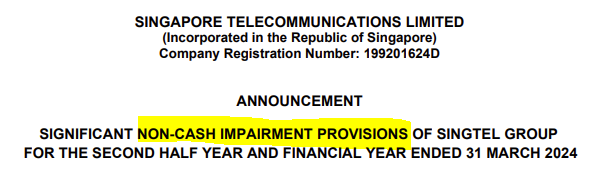
Singtel Announced Shocking S$3.1 Billion Impairment Losses!


On 29th April 2024 (Monday) before trading commences, Singtel Group just announced that it will be taking up impairment provision of approximately S$3.1 billion for its 2nd half financial year ending 31 March 2024. While these non-cash impairment does not impact current cashflow or upcoming dividends, a huge chuck of net assets per share has been wiped off. Previous CAPEX and investments have declined in valuation due to drop in fixed carriage revenue generation and the associated plunge in future cashflow. 

1. Optus main culprit
(i) The Optus Enterprise segment has been badly hit due to the prevailing Australian market. As a result, Optus reported steep declines in its fixed carriage revenue. It will be taking up <S$470Mil> impairment for its Enterprise fixed assets.

(ii) The plunge here further triggered Singtel impairment review of its goodwill in Optus. Goodwill refers to the excess over the book value of Optus during its acquisition back in 2001. Coupled with higher discount rate and softer macroeconomic outlook in Australia, a whopping <S$2 billion> is being wiped off here.

2. Other impairment hits
(iii) Singtel also took another <S$340Mil> impairment for goodwill of its Asia Pacific cyber security business due to lower corporate spending in the region.

(iv). Singtel will also take a hit of <S$280Mil> of goodwill impairment provision for its business vested in NCS Australia.

3. Some good news amidst the impairment losses shockwave-Network sharing deal with TPG
Optus announced the good news that Optus has inked an agreement with Australia TPG Telecom on network sharing by providing TPG with access to its regional radio network.

The non-exclusive network sharing agreement has an initial term of 11 years and include an option for TPG Telecom to extend the agreement for a further 5 years. Optus will receive +A$1.6 billion (S$1.4 billion) over the duration of the 11 years term.

Summary
Due to the above, Singtel will be announcing a rare loss for its 2nd half of its financial year ending 31 March 2024. Nevertheless, Singtel expects itself to be overall profitable for the whole financial year performance taking into account its 1st half results. 

Wednesday, 3 April 2024

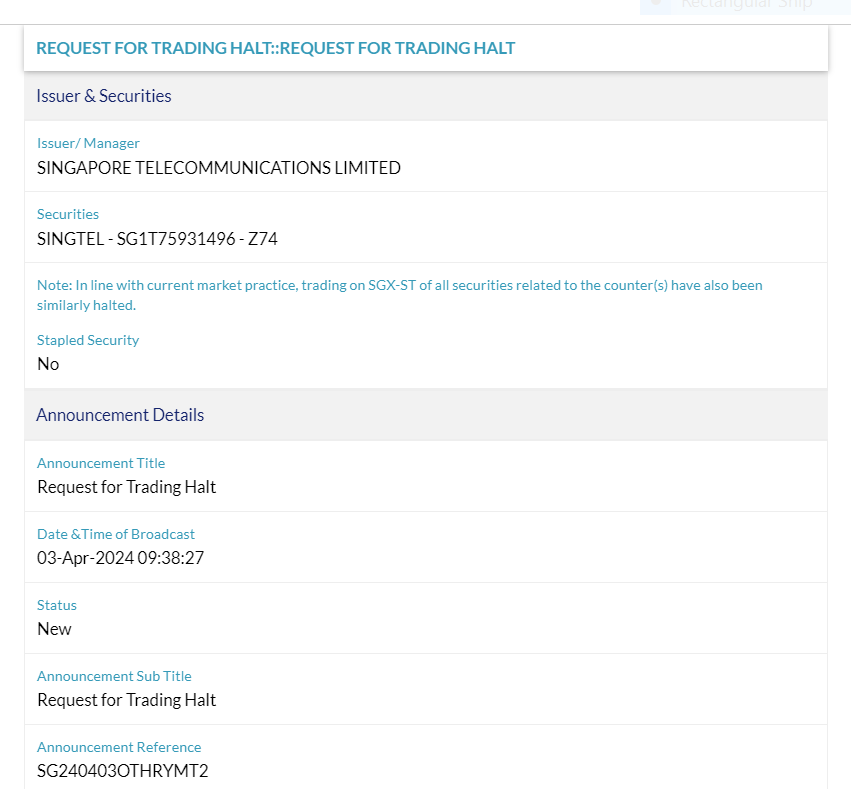
Singtel Trading HALT and The Perpetual Rumour of Optus Sales.

This is really weird. Singtel actually needs to call for a trading halt this morning (3 April 2024) to tell investors again that it is not in talk or discussion to sell Optus. Earlier this year as well as recently on 13th March 2024, Singtel had already vehemently denied that it was in a deal discussion with Canadian private equity firm Brookfield to sell away its strategic stake in Optus. 

The strange rumour is being perpetuated by the Australian media on an impending sales of Optus to a Canadian Private Equity firm and the eventual "latest breakdown" of the deal during negotiation is kind of absurd.  

Parting thoughts
For the past few weeks, a number of investors seemed to believe and harbour hope that there is "no smoke without fire" and Singtel is going to announce a big surprise with a sales of Optus. Singtel price declined by <-3.15%> from S$2.54 as at 2 April 2024 to S$2.46 at of 12pm, 3 Apr 2024 after the trading halt was lifted.

Friday, 6 October 2023

Singtel Finally Managed To Divest Cash Burning Cybersecurity Division For US$205Mil.

Singtel has finally found a buyer for its cash burning Cybersecurity business of Trustwave. It has agreed to sell Trustwave to MC2 Titanium (growth equity fund of the advisory firm The Cherloff Group) for US$205Mil. Singtel had purchased Trustwave for an astounding US$770Mil in April 2015. This is now half a billion dollar losses in terms of investment capital. If we take into account the losses retained since 2015 M&A, Trustwave has burnt a big hole in the treasury chest of Singtel ever since the acquisition. 

Back in 2015, while I was still working in Singtel Group, I could still vividly recall this much talk about "strategic acquisition" of this new business which is supposed to catapult Singtel to become a global player in Cyber Security.  This is meant to expand Singtel’s existing portfolio of cloud based solutions and further entrench its leadership position in the managed services market. Singtel will leverage Trustwave’s threat intelligence, technology and talent to meet the growing demand for always-on managed security services in North America and the Asia Pacific region. However, no one knew that this venture was destined for failure and became a white elephant. 

Parting thoughts
I am pleasantly surprised that some industry player is willing to part US$205Mil to buy this piece of cash burning business and attempt to turn it around. With this disposal, the balance sheet of Singtel will become even stronger. 

Anyway, I am looking forward to Singtel latest re-organisation where it has crafted out its local and regional data centre businesses  as a standalone infrastructure unit. Singtel seems well positioned to unlock latent values in this new engine of growth.

Saturday, 15 May 2021

Singtel Reported Impairment of S$1.2 Billion- Horrible Results Expected for Full Year of FY2021 and "Strategic Review"

On 14th May 2021, Singtel announced a shocking S$1.2 billion in impairment charges for its investments in digital marketing firm Amobee (-S$589Mil), cybersecurity business Trustwave (-S$336Mil) and also Optus (-S$204Mil). Singtel used to be extremely defensive about its Amobee and Trustwave businesses and argued that the thrust towards digital investments in new business and North America market is good for Singtel in the long term. However, Singtel appears to be singing a different tune this time round with a power-point deck on "lessons learnt" from these digital investments that are now being partially written off. It should have focused on digital opportunities in Asia to leverage on its current customer base instead of focusing too much on the North American markets for its Trustwave and work with strategic partners by taking up minority stakes instead of a majority. 

S$1.2 Billion Impairment Charges

Strategic Review Commencement
Group Digital Life still facing huge losses during past 9mths till Q3 FY2021

It is quite disappointing that S$1.2 billion is wasted and thrown into the drain just like that. Apparently, Singtel had taken a bite more than it could chew. It does not have enough internal talents to pull off its digital businesses by itself.  On top of the impairment, Singtel has been throwing more good money after the bad in terms of running the business as it has always been in the red. But at least the new CEO of Singtel seems to be making a right decision to embark on a course of corrective action to try to stem the losses at the underperforming business segment. 

Any bright spots?
I think it would be hard to market an IPO off the loss making digital business in the near term. Singtel is more likely to be looking for a strategic partner to sell off a majority stake in them. 

The bright spark may lies in Singtel’s information and communications technology (ICT) arm NCS which, since 1st January 2021, operates as an autonomous business unit, reporting directly to the Group CEO to accelerate its expansion into Asia Pacific, with special focus on Australia and China. It is highly likely that Singtel will decide to spin off its former Enterprise Group NCS through an IPO to unlock intrinsic value in Singtel Group. The good thing about NCS is that it has many Singapore government IT contracts as its operations executives have good networking and understanding of the local requirements of government agencies.  

Parting thoughts
I think that the upcoming full year results for year ending 31 March 2021 is going to be super ugly for Singtel. With the departure of the former CEO and a new CEO on board, this is now a good time to clean off legacy issues and move towards "supercharging the future". 

Tuesday, 16 March 2021

Equity Portfolio Updates (15 Mar 21)


1. Write off remaining estimated residual value for Eagle Hospitality Trust ("EHT")- S$20K
I have done a full write off of S$20K of my remaining investment in EHT. Latest update from DBS Trustee is selling off of most of the hotel properties (15 out of 18 properties) via a "stalking horse" bid. The stalking horse bid is a technique use to reserve a minimum floor price during upcoming auction.  The opening bid is way below even the recent market valuation and stapled securities owners will not get anything back after paying off bankers and creditors at such a low price. Good news is that the 3 remaining hotels do not need to be sold off immediately under duress pricing as apparently, they can still be operational and not under chapter 11. 

Clearly, the only viable option was to appoint a REIT manager during the last EGM to re-start hotel operations but this was voted down by unitholders and unable to gather the required 75% in Dec 2020 (only 55% obtained). Frustrated and irrational voting by unitholders during EGM thus lead to Chapter 11 bankruptcy protection and restructuring with the US courts which is as good as a forced liquidation at one of the worst possible time. 

Anyway, this is water under the bridge. Stay away from weak sponsor. Personally, I think there are a few conflict of interest operational decisions being made by 2 of the directors as well as multiple counts of breaches of the Securities and Future Act. Even the Monetary Authority of Singapore stepped in to sack the previous REIT manager. 

2. Purchase of United Hampshire REIT
I started accumulating units in United Hampshire US REIT. Its main tenants are blue chip companies dealing with grocery and seems resilient enough to withstand any recession and downturn. IPO price was US$0.80 per unit but current unit price is at only US$0.65 per unit.

Results so far so good but trading liquidity for this REIT is poor. Good point on United Hampshire US REIT is that if it continued to report good results going forward, the dividend yield will be close to 9% per annum along with potential room for capital appreciation.

3.Accumulation of Ascendas REIT and Mapletree Industrial Trust ("MIT")
I have taken advantage of a momentary weakness (due to concerns over steepening US yield curve) in recent market pricing to accumulate units in Ascendas and MIT in both my cash and margin portfolio respectively. Ascendas and MIT provides good exposure into data centre businesses. Looking forward to the additional M&A by Ascendas as well as MIT acquiring remaining 50% stake in their data centres. 

4. Building up position in Singtel of my margin portfolio
I have raised my stakes in Singtel in view of the turnaround in India Bharti Airtel and also the winning of the digital banking license. With COVID vaccine being rolled out worldwide, I expect the further opening of the world economy as well as gradual lifting of travelling restrictions by end of the year. Singtel will thus logically perform well again. With the Singapore government as the main stakeholder in Singtel, this adds further resilience and diversity to the margin portfolio. 

5. Opening of trading account with Tiger Brokers and new Portfolio
I have created a new portfolio to invest in riskier assets such as FSL Trust or overseas market using Tiger Brokers. Basically, I will be tweaking my current investment allocation and diverting a small portion of my future funds into buying overseas stocks for capital growth and diversification as well as those riskier investments here. However, the main focus of my investment approach will still be a dividend focused one.

Looking forward to receiving my dividends of around S$10K (derived mainly from Lendlease, United Hamsphire REIT, Manulife US REIT & Prime US REIT) by end of March'21 for additional deployment. 

Saturday, 26 December 2020

Starlink By Elon Musk For Satellite Internet Broadband Services Operational Soon- Possible Threat to Singtel, Starhub and Netlink Trust?

Elon Musk is planning to launch its SpaceX's Starlink services soon. Starlink is actually a satellite internet constellation being constructed by SpaceX providing satellite Internet access. The constellation will consist of thousands of mass-produced small satellites in low Earth orbit, working in combination with ground transceivers. An estimated investment of more than US$10 billion has been pumped into this decade old project from Elon Musk. This space internet broadband project actually went on track as per forecasted with various beta testing being done already. It is scheduled to launch soon in USA and Canada this year and to rapidly expand to attain global coverage of the entire world by 2021. I was rather surprised that Elon Musk managed to pull this off and they are in the midst of going live soon. 

Will it pose a threat to 5G technology and fibre optic network of Singtel, Starhub and Netlink Trust?

Firstly, the original market segment for Starlink seems to be more for rural areas. In big countries such as USA, the vast geographical area makes it almost impossible to lay fibre optic cable to connect every home. I do not think that there will be many take up  in Singapore even if it is given regulatory approval by the Singapore Government due to the fact that Singapore is a tiny country that is already very well connected by fibre optic and also upcoming planned 5G base stations setup from the telecommunication/internet cabling companies.

Secondly, the technology of satellite connection based on beta testing has speed of only 150Mbps and latency rate of 20ms to 40ms. With 5G network deployment using high frequency bandwidth, we can get up to 1Gbps and latency rate of 1ms. Hence competitive services such as direct fibre optic cable and upcoming 5G network services are superior relative to the connectivity services offered by Starlink.

Thirdly, the reported cost seems to be US$99 per month and a one time USD500 setup kit. SpaceX expects to generate US30 billion per annum from selling this internet services globally. In Singapore, the US$99 is a lot more expensive than what the main telecommunication companies, Singtel, Starhub and M1 are offering. Hence I think there is a lack of competitive advantages for such services in certain countries which are small and already built up extensive fibre optic cabling infrastructure.

Parting Thoughts
Satellite internet connection seems to be an upcoming technology ready for deployment. There are also other players like Amazon and OneWeb (went into bankruptcy but subsequently rescued by UK government and India Bharti Group). Elon Musk's Starlink seems to be leading ahead in the global deployment of thousands of satellites to beam high speed internet from anywhere in the world. My personal thoughts are that it should not pose a threat to Singtel. Starhub and Netlink Trust in our Singapore market due to the aforesaid mentioned 3 points. 

What are your thoughts?

Saturday, 16 November 2019

Singtel Share Price Resilient In the Face of Billion Dollar Impairment and 2nd Quarter Losses of S$668Mil

Singtel is a very weird stock. In late December 2018 to early Jan 2019, the share price dropped below S$3 per share when it was making quarterly profits of over S$680Mil. However, when it was announced recently that Singtel had made a huge loss of <S$668Mil> for its second quarter results, its share price dropped only slightly from S$3.30 to S$3.18 which is a mere decline of only <3.64%>.  I am not sure whether shareholders of Singtel recalled that in March 2019, Singtel had just subscribed to a rights issue of S$730Mil  worth of additional shares for Bharti Airtel for working capital purpose to assist the Indian Telco to fight a bruising price war with Reliance Jio.

The current losses was due to the adverse ruling by Supreme Court of India over the government's computation of "Adjusted Gross Revenue (AGR)" whereby license fees and spectrum usage charges are payable. The result of the ruling was a US$ 4.3 billion due within 3 months. So, it may mean another rights issue coming of over S$1 billion for Singtel. In such  a terrible scenario, shareholders should ask themselves whether Singtel can afford to sustain the current dividends payout to them. Of course, most of the stakeholders (from Singtel's CFO to retail investors) seems very confident that despite the adverse court ruling, the India government will come out to save the telcos by either waiving off the amount payable or giving a huge discount to it. 

As for me, I do not share such bright optimism that Singtel will remain totally unscathed from this adverse court ruling.


Thursday, 3 October 2019

The Tragic Fate of Singtel- Will Price Plummet Continue?


Since Singtel announced its Q1 FY19/20 results (ending 30 June 2019) on 8th August 2019, it has dropped from its peak of S$3.56 per share on 5th July 2019 to the current S$3.10 per share. That is a huge plunge of its share price by almost 13% within 2 months. But if one compares Q1 FY19/20 to the prior Q1 FY18/19 financial results of a whopping 35% drop in profits, then this is considered as just a small chink in the armour of Singtel.
Even if we just compare it to the previous quarter of Q4FY/18/19 of S$773Mil, this still represents a 30% decline in net profits from 2 consecutive quarters. Is this the start of an ominous downward trend?
To complicate matters, investing in Singtel shares also depends on widely fluctuating seasonality market sentiment. There are certain period during the year whereby the share price rally without any apparent reasons and at other times, it is in doldrums form regardless of financial performance. The strange pattern of huge plunge in share price typically happens after dividends declaration during the second half of the year and then all the major players started jumping right back in before the final dividends declaration the following year tends to repeat itself all over again and again.
A few key points to highlight with regard to the latest performance:
1. Disastrous results in overseas market for associate companies.
From the financial results (please refer to screenshot 1), the chief culprit for the weak numbers is once again the performance of Singtel’s associate results. A closer look will reveal that this is actually the result of Bharti Airtel fighting a brutal price war in India when Reliance Jio jumped into the fray in September 2016. Investors need to be skeptical of the honey coated words from analysts that the situation is expected to improve due to consolidation of players in the India telecom industry and “the sun will shine once again soon” talk.
So far, I have not seen any signs of major improvement in getting out of losses yet despite the crystal ball predictions by these analysts for the past 1 year. The rights issue for Bharti Airtel was the last straw for me to sell off all my stakes in Singtel. In March 2019, Singtel pumped in US$525Mil (around S$719Mil) for its 15% direct stake in this fund raising exercise to re-capitalize the balance sheet of Airtel. The funny thing is that after I sold off my shares, it went on to rally to a high of S$3.54 before taking a plunge back to S$3.10 recently.
The only good news is that excluding Airtel’s disastrous financial results, contributions from regional associates would actually have risen by 10% driven mainly by Indonesian Telkomsel. So not all is bad.
2. Cybersecurity and Group Digital Life businesses continue to make losses
Singtel’s cybersecurity business continue to chalk up losses of S$102Mil (before taxes) in last financial year and the bleeding continues in the latest first quarter results announcement. As usual, Group digital life is also still in the red.
The hope here is that Trustwave will start turning in profits and eventually, an IPO can make spin off these Trustwave along with digital life businesses by Singtel to reap a return on investments similar to what they did for Netlink Trust.
Singtel management kept emphaisisng a different set of KPI should be used to measure these businesses instead of just purely profit and losses. I am not sure whether I buy their logic. To me, a business must definitely be profit making else it will end up like WeWork IPO- a USD47 billion valued business is now possibly facing bankruptcy. The strange phenomenon of technological startup companies going for IPO with track record of huge losses is something which I cannot comprehend the sanity of it.
3. Bright spot- Rise of 5G Wireless Network for Australia, Singapore as well as for other Asia overseas markets. 
Singtel has already made major investments in network spectrum under Optus in Australia. In Singapore, it is expected to be pump in significant capital expenditure into the 5G network development. Given the high demand for high speed internet services and the conveniences offered via mobile network for this technological leap, Singtel would be able to attract lots of customers to drive its earnings forward.
4. Excellent corporate culture in using technology for innovation and cost control
Singtel’s management team is well known for using technology to drive productivity and cost control. For example, it had long began implementing Robotic Process Automation (“RPA”) into its various internal work processes. This has greatly enhanced productivity by removing routine work using manual labour. 
In addition, continuous developments in its digital services and products and bundling them with existing services as well as the synergy in implementing them across various overseas market offers great value in retaining existing clients and attracts new customers.
5. Valuation of Singtel share price
Now this is extremely challenging as it is a reflection of one’s outlook of the future variables that determines its pricing. For me, I will use what I can see with my own eyes that is, based on the latest published financial results. A quick and dirty way to do the valuation would be since Q1 FY19/20 profit dropped 30% from the Q4 FY18/19, we will apply the same discount to the price on 30 June 2019 of S$3.50 to derive a conservative floor target of S$2.45 per share. The assumption here is that given ceteris paribus and the only main driver is the worse than anticipated financial performance, then the share price should drop accordingly in percentage.
Given that Bharti Airtel is already reaching the bottom of the price war and also the potential growth of new 5G services subscription as well as growth in digital services, I will reduce the haircut by 15% to derive an estimated S$2.98 per share.    
Parting thoughts
At the current pricing of S$3.13 per share, I thought that Singtel is slightly overpriced but overall still decent given its businesses spread across various overseas markets and the impending rise of 5G technology adoption which offers attractive value proposition to consumers. The only question mark is whether Bharti Airtel in India can win the competition for subscribers to become profitable again after quarters and quarters of losses in the India market. The gain in India market share and revenue seems to be pointing to some obscure revival signs-albeit still not that clear at the current juncture- that things may improve next year.
Wednesday, 26 June 2019

Threat to Singtel and other Telco Profit Margin- TPG Offering Unlimited Data Roaming in Malaysia and Indonesia

Singapore’s 4th Telco TPG wasted no time in firing a fresh salvo against the telco big boys (Singtel, Starhub, and M1) by offering free unlimited data roaming in Malaysia and Indonesia as part of its many innovative services to its current subscribers. To prevent the potential loss of customers, Singtel and its brethren may very well be forced also to match the new service offering. In 2018, around 10.2Mil Singaporean visits were recorded by the Malaysia Tourism Board. Most Singaporeans would have activated the special promotional package of S$5/GB for such trips across the causeway. There is thus a potential total revenue loss of at least S$51Mil which used to flow directly into the Net Profit Margin of the current 3 telco players that have been dominating the Singapore market for close to two decades.

On the topic of overseas data roaming, many colleagues and friends that I know of, have often found themselves in the predicament of paying for exorbitant data roaming charges while in Malaysia or Indonesia (Batam or Bintan in particularly) as most would have forgotten to activate the promotional package beforehand. A typical situation would be that once you reached Malaysia or Indonesia, one would then switched on the phone or switch off the “Plane mode” and the SMS and emails would then have “flooded” your phone before you can activate the S$5 promotional offer package for the data roaming via SMS. Hence a few dollars would have been wasted and most folks would not have bothered to appeal for a waiver. This is actually quite a common and irritating problem. Hence TPG’s move to implement the free data roaming for Malaysia and Indonesia will definitely be appealing to price-sensitive consumers. 

I do look forward to more innovative products and services offering from TPG to disrupt the local telco market to benefit local consumers. There is no doubt that Singtel, Starhub, and M1 are going to face intense competition and downward pressure on their profit margin over the next 2-3 years. While “market experts” have frequently asserted that the local market cannot sustain more than 3 telco and the industry will eventually consolidate, the fact remains that the telcos still have a fat profit margin and are not in a loss position. I believe that there are still enough fats to be trimmed off and passed on to TPG and consumers. Well, at least this is good news for consumers albeit bad news for investors of Telcos.

Saturday, 10 November 2018

Singtel 1st Half 2018 Results Review And Interim Dividends Payout (6.8cents per share)

Singtel just announced its first-half results ended 30 September 2018. I actually think that it is a fairly good results being announced considering the intense competition faced by its overseas associate companies and Optus. Operating revenue surprisingly remained resilient and even grow 3% to S$8.4 billion. Margin eroded by over 21% (after normalisation from one-off gain from disposal of Netlink Trust in the previous year) mainly due to lower contributions from Airtel and Telkomsel as well as foreign currency translation losses from the effects of stronger Sing dollars against other currencies.

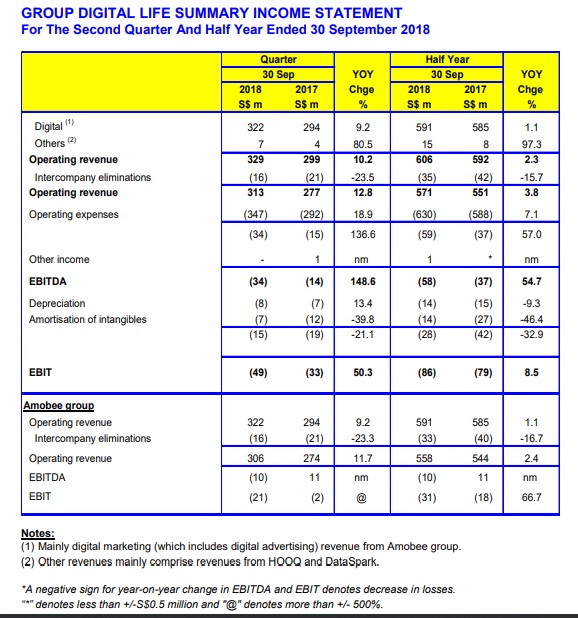
The only concern I have is that Singtel still has not stemmed the bleeding from Group Digital Life business. It continued with  a widening of losses of <S$84Mil> based on the first half results. While I understand the importance of investing in this business segment which management seems to believe that there are perceived synergy to exploit on the Group's service offerings, the results have been depressing for years. They just can't seem to breakeven despite growth in revenue.

I have previously disposed all my Singtel stocks at prices of S$3.78 level as I do not like the intense competition with TPG jumping into the Singapore market by year-end. With the sharp decline in the prices of Singtel and which I think have been oversold, I have been accumulating new Singtel shares at prices ranging from S$3.060 to S$3.180 recently. The current business model from telecom business is still relevant and Singtel has proven to be defensive in nature over these past few months with lesser trading volatility relative to other blue chips. 

An interim dividend of S$0.068 per share has been declared which represented a 2.19% yield based on the last traded price of S$3.10 per share and in line with expectation. Hence Singtel is still on track for its dividend guidance over the next 2 years of S$0.175 per share. This represents an annual yield of 5.65% which is fairly attractive while waiting for the share price to recover.  

Saturday, 7 July 2018

Singtel- Hidden Danger And Downside Risk That May Have Been Neglected By Potential Investors


Singtel dropped to a 5 year all time record low of S$3.02 per share on 3 July 2018 (Tuesday) before rebounding to S$3.23 per share on 6 July 2018  (Friday). The plunge to the lowest point is a 16% dropped from S$3.60 at the start of this calendar year. The mind blogging part is many well known analysts over the past 2 months have predicted a targeted price of over S$3.57 to S$4.22 per share for Singtel. Hence it is certainly bewildering to see the price of Singtel flopping and wiping billions of dollars off its market capitalisation and deviation from the crystal ball prediction by so many Oracles.  
Reasons for analysts "optimistic" outlook on Singtel
Well, of course, proponents will believe that the Oracles cannot be all wrong. This must be a special case of short term and one off market overselling of the Singtel counter. No doubts Singtel will recover back to S$4 soon.  

One of the key belief in Singtel was its diversified businesses across geographical region such as Digital Life, Smart City & Security Business on top of its traditional historical business in mobile and internet subscription services. 

In addition, the 3 national outages by Telstra , Singtel-Optus's competitor, are believed to be beneficial to Optus in terms of attracting market share. 

It is also a popular belief that out of the 3 main telecom, Singtel will be the least affected by the entry of  TPG at year end due to this geographical diversification- up to 70% of revenue is from overseas.

Hidden Dangers/Downside risks that may have been neglected by many investors
It is a fallacy to believe that the entry of TPG affects only the Singapore market. TPG has also been aggressively expanding its operations in Australia. TPG had announced last year that it will be building Australia's 4th mobile network. It has spent billions in M&A deals as well as capital expenditure improving on its broadband network and also building up its Australian mobile ambition to rival Telstra and Optus. 

Singtel Group derives 50% of its revenue from Optus which is operating in Australia.  The effect of the more intense competition and the adverse effect on average pricing and market share in the Australian market will definitely lead to a decline in overall businesses in its traditional core mobile and broadband businesses. 


The entry of TPG in both Singapore and Australia markets thus erodes the revenue and profitability of its core businesses of mobile and internet which makes up more than 56% of the Group's revenue. The speed of building up the new business segments is thus crucial for the future of Singtel.

Also key is the belief that the new Digital Life business and Cyber Security (Trustwave) business will play an increasing significant role in future revenue generation for Singtel Group. I am unsure of how these businesses will unfold or behave in the event of a market downturn with global capital expenditure being delayed. Some may argue that in this information age, these will be key essential items but it remains to be seen in such drastic scenario how it will materialise. 

High level valuation of Singtel
I will do a quick and dirty projection based on some simplistic assumptions. Assuming the beginning of the year pricing already factored in investors expectation based on the previous year, the results released in May'18 for financial year ended 31 March 2018 will be the key base of further price movement due to revised market projection. We know that Singtel after normalising for the net gain of S$1.9 billion from Netlink Trust IPO, the performance so far for the previous audited financial year and Q4 had declined against the prior year and prior Q4 respectively by <8.4%> and  <17.9%>.


For the beginning calendar year of 2nd Jan 2018, Singtel pricing was at S$3.60 and I will use it as a proxy for the initial expectation before the final year and Q4 results was released. 

Taking into account the full year performance and Q4 decline, the estimated revision in price should theoretically be in a range of S$ 2.956 to S$3.298.   

Future Outlook
Prediction of value is really based on investors' outlook and a summation of all the available market information and making a judgement based on a peek into the future. 

If one takes a more pessimistic views of the possible downsides, well, it may drop below S$3 per share by year end until the new business initiatives taken up matures and proven themselves to be successful.    

If one believes the diversification story and that the overseas revenue contribution and new business segments will continue to grow, then now is the perfect time to accumulate more of Singtel at its 5 years low. I would just want to add on that investors or potential investors should also take a look the impressive resume of Singtel's key management. The Group CEO and the various divisional CEOs leading the various businesses are some of the best of the best talents in the ever dynamic Singtel Group.