Saturday, 10 September 2022

Frasers Property Offers S$420Mil Fixed Rate Bond At 4.49% Interest Rate- 3 Reasons Why I Am Staying Far Away From The Retail Tranche.

Frasers Property is offering S$420Mil worth of 5 year green notes with a seemingly attractive coupon rate of 4.49% per annum for investors. Out of these, S$300Mil are being offered to retail investors while the remaining will be offered to institutional investors- this is indeed a rare instance whereby we see a fund raiser reserving up to 70% of the exercise for retail investors like us. If there is oversubscription, the total offer size maybe increased to up to S$650Mil. Noteholders will receive semi-annual interest payout on 16th March and 16th September per annum from 2023 onwards. While the interest rate of 4.49% appeared to be one of the highest we have seen so far, I think that it will be  risky for investors looking into buying these debts for investment. I don't mean to rain on the parade of enthusiastic fans of Frasers Group, but personally, I think it is suicidal to be holding on to debenture instrument in this particular economic climate which I should further elaborate below:

1. US Federal Reserve expected to hike borrowing rates by 0.75% in late September 22 meeting.
Folks, don't forget, we are still in the midst of fighting inflation at this critical juncture. With the hawkish tone still being adopted by Jerome Powell, the majority of investors all believe that the upcoming interest rate hike will be between 0.5% to 0.75%. There are also more series of hikes coming to ensure the inflation monster is being contained. Singapore will not be an exception to interest rate hikes. By subscribing to this tranche of debentures, one will be locked up with 4.49% for 5 whole years (in case you are thinking that one can always liquidate the bonds in the secondary market at any time, please see pt 2).

There is a substantial risk that future tranches of Singapore Saving Bonds, Singapore Government bonds or other debentures from private companies will have similar or higher interest rates.

I thought that Frasers Property should be offering this debenture issuance at a higher 5% interest rates to compensate adequately for mid-term risk premium over risk free bonds, in order to cater for the upcoming interest rate hikes.

2. Capital loss during early selling off on secondary market 
As alluded to pt 1 above, the price of this particular debenture issuance looks very likely to drop immediately in the face of an inflationary environment and ever increasing borrowing rates that is required by investors. Economics theory 101 states that the price of a bond is inversely related to the market interest rates, that is, when the cost of borrowing money rises in the market, bond prices will fall. 

A high inflationary global environment, like the current climate, is one of the worst time to be subscribing for fixed rate debentures as one will be locked in for 5 whole years. Any resales of the dentures (in the secondary market) will most likely mean that the bondholders faces an immediate capital losses in valuation. 

3. Risk of bankruptcy ever present despite being held by renowned shareholder.
Frasers Property group is controlled by Thai billionaire Charoen Sirivadhanabhakdi. I think that the overall Thai group's financials has weaken after the COVID pandemic with the share price in bad shape. Even related companies like Thai Beverage is trying to raise funds through an internal beer business unit IPO spin off (which it had cancelled once again due to unfavorable economic climate). My preference is to stick with Temasek linked instruments if one die die want to invest in corporate bonds. Look at SIA, it managed to magically survive the COVID downturn with the might of Temasek bull-dozing through the re-capitalization exercise during crunch time.

Parting thoughts
I will be staying far away from this issuance by Frasers Property. I personally think that the fixed rate on offer of 4.49% fixed rate being put up for 5 long years smacks of shortchanging retail investors. If it had been a higher fixed rate on offer or having certain component tied to a variable rate that is linked to inflation, I will probably then be more willing to participate in its issuance. 

Tuesday, 6 September 2022

Income Focused Investing Strategy Is Akin To Stock Picking And Risky- Stick with S&P500 Instead for Average of 10%+ Annual Return.

Many Singaporean investors love SGX listed companies for their relatively higher dividend yield compared to other stock markets. However, this is just stock picking or worst still, a form of gambling. Look at those long term income investors who were holding on to Singapore Press Holdings and Sembcorp Marine- these investments ended up in disaster and tears for many of them. Most people do not do well picking individual stocks. There is just not enough diversification for retail investors to do stock picking themselves unless one buys 50 over stocks in one's portfolio basket. Buying index-fund such as S&P 500 is a safer bet and superior in returns as compared to adopting the so called income-focused investment strategy to grow your wealth. S&P 500 will never be zero in valuation given its components being made up of 500 great US companies unlike individual stock picking which can lead to total loss of your investment capital. 

Well, the above were actually summarised points that I gathered from a local You-Tube investment channel. I have great respect for the man and subscribed to his channel. In spite of that, I only agree with 50% of the points being made. The main contention which I have is that the income focused investing is vastly different from a capital growth focused approach. It is like trying to compare apples and oranges. Let me elaborate a few points on the main differences.

1.  It is a fallacy to assume that one can always sell the S&P500 at an optimum price whenever one needs cash hence this is nothing similar to the income focused approach.
I hope I can simplify this to try to articulate out the essence of what I am trying to express here. Basically, the dividends focused strategy allows one to have access to consistent cash distribution from the business which is more related to business fundamentals rather than the vagaries of market pricing like the S&P500. The stock market is a weighing machine in the long run no doubt but during short-term period, it can lead to grave mispricing depending on market sentiment of the day. For example, the S&P500 dropped more than 20% this year while income distribution this year from SGX banks and REITs held steady if not increased more. So if one sold off some units in his/her S&P500 to raise much needed cash at this juncture, he/she automatically gets a 20% cut in "distribution".  Also, who the hell knows when is the best time during the year to time the market to sell off his/her S&P 500 units?

(Note: The only times so far that I encountered a massive breakdown in the income thesis is during the 2008 global financial crisis and the recent COVID-19 lock down. For the latter instance, Hospitality REITs and retail REITs were severely affected. But industrial REITs were relatively still holding up well albeit some decrease in distributions which were being held as reserve for working capital.) 

2. Some people need regular cash distribution for retirement, critical illnesses or when one is facing retrenchment- disposing S&P 500 units to raise such cash is not ideal.
It is easier and more convenient to get cash distributions automatically rather than having to manually trigger off the process to sell part off one's S&P500 units frequently. Again, I have to point out that the needs of every individuals are different from one another. The "forced distribution" from income focused approach is thus more practical for myself personally. It also allows oneself to choose what to do with the money from the dividends such as keeping it for future investment during market crashes, re-investing it into other stocks, re-investing it into same stock, paying off living expenses, repaying margin loan, or repaying housing mortgages etc. 

3. Most income focused investors practise diversification of their investments.
The S&P500 is praised widely for its vast diversification into 500 great US companies. While such level of diversification typically can never be achieved by retail investors on an individual basis, the big question is why would anyone need to have 500 US companies in one's portfolio just for safety? Let there be no mistake that even with a basket of 500 stocks in S&P500, it is still an index fund that is equity in nature and does not guarantee 100% capital protection at any juncture when one choose to exit this index investment.

For many income focused investors, holding on to 15-20 or even more companies already ensures sufficient diversification to recover from total bankruptcy or forced liquidation of some of their individual investment. 

Summary
Personally, I do not think that the S&P500 ticks every investor's checklist for their own needs. I also do not think that it is comparable between an income focused strategy and capital growth focused approach. It is like the Lord Of the Rings whereby the S&P500 became the One Ring to rule all. Saying that, I have personally invested part of my CPF Ordinary funds (S$25K in different tranches) into the S&P 500 when it was hovering in the 3700-3900 range after the recent US stock market crash of 20%. I will also be adding cash into the S&P 500 as part of my capital growth investing. However, the bulk of my portfolio is still geared towards the income investing strategy which had worked well for me over the years. 

Saturday, 3 September 2022

Investment Portfolios Updates- S$613k (2 Sep'22)-Added Additional Alibaba, Capitaland China Trust and Fu Yu Corp.

With the US Federal Reserve still combating inflation, global stock markets remain in doldrum with the ever increasing borrowing rates. The "Big Short legend" Michael Burry holds the view that the S&P 500 will crash below 2,000 points (50% plus decline) but of course, he has been predicting a major crash since 2019. Recent rallies are nothing but fake bear market rallies according to this group of pessimistic investors. Other investors held the contrarian view that the stock market will rebound soon in another 2-3months once inflation is under control and whereby US Federal Reserve start to reverse monetary policy to fight global recession after keeping severe inflation in check. Commodity prices, oil prices and lower employment rate seem to suggest that the red-hot global economies are gradually slowing down. 

1. Portfolio 1- Stocks held in SGX Central Depository 
(Note: This portfolio is designed to provide immediate dividends for use (if required) as it is under my own CDP account and the dividends credited goes directly to my bank account.)
i
I sold off some of my Ascendas REIT in early July 22 and purchased DigiCore REIT ("DC REIT") which I held on for 1 month. In view of the sudden August 2022 surge in DC REIT market prices which resulted in the extremely low distribution yield of less than 5% for DC REIT as well as the issue of major tenant facing bankruptcy, I have exited all my positions in DC REIT at US$0.865 per unit and took an immediate profit of US$2,440 (S$3,318). 16% realized return within a month is equivalent to waiting on capital deployed for 3 years to get the equivalent income distributions. I have since re-deployed the sales proceed back to United Hampshire US REIT and Ascendas REIT. 

2. Portfolio 2- Margin purchased securities
(Note: My margin purchased securities has grown to a sufficient scale to sustain itself and also to repay annual financing charges as well as to gradually pay down the margin loan through dividends generated.) 
The slight change made here was the additional investments into 5,000 units of Capitaland China Trust at average price of S$1.11 per unit in late August 2022. 

US Office REITs in my holdings continue to perform badly. Manulife US REIT held the worst performance REIT in my entire portfolio with losses of <19.35%>. The fortunate thing is that the high distribution yield of the 3 US office REITs helped to reduce the overall unrealised capital losses. 

Overall, for my margin portfolio, the dividends received since 1 Jan 2021 outweigh my slight unrealised capital losses by +S$40,059. The income focus investment approach is still holding up well despite the economic storm that has been raging relentlessly for the past 3 years.

3. Portfolio 3 (with Tiger Brokers)- Venture into higher risk as well as capital growth stocks here
Major change here is the disposal of all my Dasin Retail Trust due to the heighten probability of the Trust defaulting on its existing bank loans which it has been struggling to renew. Latest red flags is the huge loss of S$56.4Mil for 1st half of 2022 as well as the declaration that no distribution will be paid out to conserve working capital. Please see "Dasin Retail Trust And Investors In Trouble- Loss of S$56.4 Mil for 1st Half of 2022 And No Distribution Being Paid Out Red Flag".  

I have also added additional investments into Alibaba (800 shares), Fu Yu Corp, SingMedical as well as Lion-OCBC Sec HSTECH.

Summary:
I have unpaid S$21K of dividends upcoming for this month of September 2022. Most likely will be using the bulk of it to pay down on my margin loan in view of the stock market turbulence as well as the higher financing cost these days.

Sunday, 28 August 2022

First REIT Just Thrown Its Investors Under A Bus Again Despite Offering a 9.78% Attractive Distribution Yield.

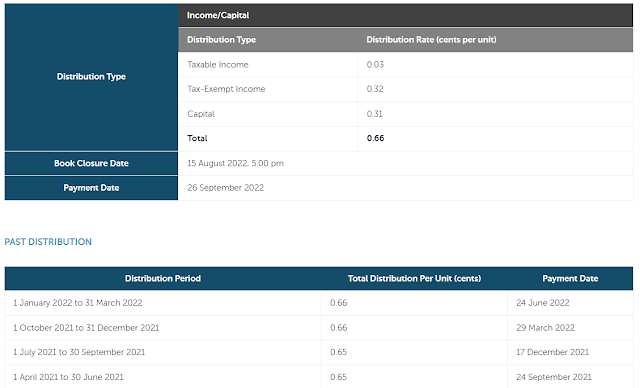
Recently, I was just wondering whether it is time to go back to holding a small stake in First REIT given the "2.0 Growth Strategy" implemented by its Manager to diversify concentration risk in Siloam hospital group in Indonesia. I thought that the 12 Japan nursing homes acquired in March 2022 was a good start for this new visionary strategic direction. The over-reliance on Lippo Karawaci's Siloam  healthacare group has been nothing short of a disaster during the COVID crisis in Indonesia which led to a renegation of the original Master Lease Agreements (of course it was cleverly crafted as a "restructuring" of the master lease agreement) for 14 hospitals in Indonesia from 1st January 2021. Its last quarterly distribution was 0.66 cents per unit which when annualised gives an amount of S$0.0264 per year and an amazing annual +9.78% distribution yield at the closing price of S$0.270 per unit as at 26 August 2022.

1.High distribution yield of +9.78% per annum looks super attractive is it not?
Is the high distribution yield a value trap given the REIT's management horrendous track record? Free cashflow for the 1st half of FY2022 improves significantly relative to the prior comparative period. Cash and bank balances also doubled relative to 1st half of FY2021 from S$36.Mil to S$78.8Mil. Just when I was about to drill further into its cashflow statement and other financials, I saw a piece of shocking development in its announcement. 

2.Perpetual Unitholders which lent money to First REIT in 2016 got screwed by Management.
First REIT recently launched a tender offer to buy back S$60 million in Series 002 subordinated perpetual securities in cash, at only 70% of the original principal amount. My first thoughts were: "Like that also can for redemption of perpetual securities?" 

The management of First Reit said that the rationale for its offer is to “provide liquidity to the securityholders given the illiquid nature of the outstanding securities”, and to optimize the trust’s debt capital structure as part of its continuing capital and liability management initiatives.

Again, First REIT looks set to take advantage of its investors by not redeeming back the bonds at its original issuance price. Perpetual security lenders of First REIT will find that they barely got back the entire capital ploughed in even if the interest rate was 5.68% per year in 2016. Future prospective investors of perpetual securities may ponder whether it is a wise move to invest with First REIT.
 
Parting thoughts
With an attractive annualized distribution yield of 9.78% and the forage into other healthcare properties other than Indonesia's Siloam hospitals, First REIT seems to be embarking on a new growth path that at the same time also aims to diversify its over-reliance on a single tenant as well as geographic segment. This is definitely a step in the right direction.

However, its recent sales of a hospital at only a slight premium plus redemption of perpetual securities at a fraction of the original principal amount does make one suspicious of whether First REIT is back to short-changing investors again notwithstanding the bad track record of "restructuring" of the Master Lease Agreements 2 years back to reduce the rental expenses of Sponsor's Siloam Group. In short, First REIT management's penchant to throw investors under the bus maybe a reason for the extremely high risk premium relative to the risk free rate. Hence I think I will still be staying away from First REIT for now.

Saturday, 27 August 2022

Poor Steven Lim- Used As Educational Content By Many People.

Haiz....I saw another investment You Tube Channel talking about Steven Lim and his "all in" S$300k into Singapore Post. Getting bored on this topic. Steven maybe one of the strangest personality out there in Singapore but think he is very poor thing to be turned into an investment topic content and educational material on taboo of lack of diversification investment strategy. It is interesting to note that Steven Kor Kor do Birthday shout out/sing or dance also for S$100 on his Instagram- if you guys are bored, can check it out. :)   

Wednesday, 24 August 2022

Forgetting And Leaving Laptop Unattended for 30mins And Miraculously It Is Still There.

I think that Singapore has indeed one of the lowest crime rate in the world. This morning, while having early breakfast with a colleague at McDonald's, we were initially seated outdoor of the restaurant. My colleague changed her mind as it was rather dusty outside and decided to shift indoors where it is cleaner and cooler. So we rushed into McDonald air-con indoor premises. 

After finishing our chit-chat and breakfast (almost 30mins), my colleague suddenly exclaimed in terror that her laptop bag is not with her and panic. Then she recalled she had placed it on the seat outside McDonald's and forgot to bring it in. She quickly sprinted outside to look for the laptop and miraculously managed to find it intact at the same spot! This is despite many people going by the outdoor area already. 

Singaporeans also seem very confident and trusting in our society. I seen some folks leaving their bags and laptops at foodcourts and hawker centres while they go on to buy their food at the food stalls. Leaving bags besides tissue paper to "Chope" tables and seats thus also seemed to be a popular Singaporean culture. On this, I recalled an incident whereby the tissue chope does not work to guarantee a seat every time. There was once an elderly man who just picked up the tissue on the table and throw it away and sat down. The choped owner came back with food and had an ugly spat with the Uncle who is now sitting on the "reserved" table. Hard to judge who should be awarded the seat in such event- Singaporean unique societal norms/culture of "chope" VS first come first get it in person arguments....haiz!

Saturday, 20 August 2022

Asian Pay TV Trust Broadband Rises From The Ash With 5G Adoption and 8.5% Distribution Yield- Undervalued Or Value Trap Again?


Asian Pay TV Trust  ("APTT") used to be the market darling for income investing investors which pays over 8% in dividend yield from IPO. However, APTT has since dropped from its IPO price of S$0.97 (in 2013) per unit to the current S$0.116 per unit as at 19 August 2022. This is a whopping 88% plunge in market valuation for investors did not bail out and are still holding on to APTT. In short, the high dividends then were not sustainable. I have made close to 46% return from capital gain and dividends back in its more glorious days under the Macquarie Infrastructure Fund. But have since lost most of it after accumulating new units from the IPO spin off. I even accumulated more units when its price drop after IPO. But eventually, I was forced to cut loss and sell off at various prices ranging from S$0.60 to S$0.80 due to its worsening cashflow position and declining earnings. But I count myself fortunate that I sold off the bulk of the holdings before its price collapsed further from May 2018 onwards.

1. Is APTT at S$0.116 per unit and 8.5% distribution yield now a STAR buy?
The previous strategy of APPT senior management is to use borrowings to finance CAPEX. This means that its free cashflow actually cannot finance the dividends paid out with massive debt incurred. At one point, the debt issue will explode in particularly if the underlying business decline and can no longer generate sufficient cashflow. Due to its current low price and current free cashflow of up to S$80Mil, the question is whether it is a good to time to accumulate units  of APTT now.

2. Current high gearing ratio despite cutting dividends by 80% since 2018 and 2020 rights issue to repay colossal debt of over S$1.4 billion.
In 2018, borrowings of APTT was at round S$1.4 billion. As at 30 June 2022, its borrowings is still at approximately S$1.4 billion despite cutting dividends by 80% in Nov 2018 and launching a rights issue in 2020. It looks like APPT network CAPEX over the years have been rather intensive. Its current gearing ratio stands at an eye popping 48.8% notwithstanding cutting dividends by 80% in 2018 and rights issue in 2020 to cut down on bank borrowings.

3. Broadband is growing with 5G adoption but Cable TV decline remains worrying
Broadband is growing as APTT partnered with mobile operators to drive fixed-line broadband segment and higher speed plans. However basic cable TV remains in doldrums. For its half year revenue, Cable TV makes up 74% of its overall revenue which implies that it remains an extremely heavily weighted segment in terms of the business performance of APTT. Hence any upsides contribution from its Broadband segment will still be outweighed by the declining basic cable TV segment.

Parting thoughts
As alluded to the above points, I am rather surprised that an analyst from Phillip Capital recently upgraded APTT to "buy" due to recent share price weakness and has a target price of S$0.150 per unit. Personally, I will still be staying far away from APTT. Its core cable TV business is a sunset business segment in view of intense competition from IPTV service providers that will continue to wilt away its core earnings.