Sunday, 27 February 2022

United Hampshire US REIT Super Attractive 10% Distribution Yield Per Annum- Cash Cow Too Good To Be True?

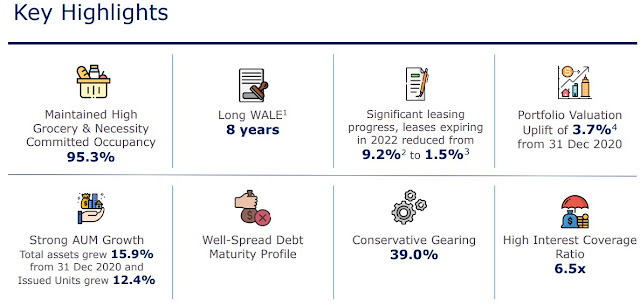
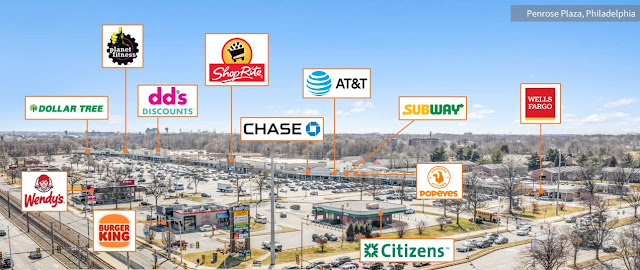
With the invasion of Ukraine by Russia, United Hampshire US REIT ("UH REIT") was not spared the carnage on world-wide stock markets with the already low trading price being further hammered till US$0.61 per unit as at 25 February 2022 (Friday) closing despite the relatively good results just being announced. Given the total DPU for the full FY2021 is US$0.061, this means an extremely attractive distribution yield of exactly +10.0% per annum, not withstanding the fact that the latest acquired properties contribution only came into effect on 14th October 2021. This also means that for FY2022, UH REIT stands to enjoy another upside of 9.5 months of additional rental contribution coming from Penrose Plaza Philadelphia and Colonial Square Shopping Centre Virginia. I will also attempt to elaborate a bit later on why the current ongoing war in Ukraine actually benefits REITs based in US. 

1. 2nd half 2021 results highlight
Financial highlights comparison to forecast and historical results

Operating metrics appear healthy

As we can see, UH REIT financial results remain well within expectation. Its performance has also improved a lot if compared to historical 2nd half numbers. Operating metrics such as leases expiring in 2022 has been reduced from 9.2% (as at 31 Dec 2020 )t o only 1.5% (as at 31 Dec 2021) with good work by their business development team on renewal. In addition, its WALE is relatively high at 7.9 years which gives much stability to recurring rental income. 

2. Sales of self storage facilities and income support complaint by retail investors
I am glad that UH REIT has entered into a conditional sales of their self storage properties Elizabeth and Perth Amboy for a sales consideration of US$49 Mil (before transaction costs). Taking into account the purchase price of US$43.4Mil inclusive of income top-ups, this represented a +12.9% sales premium. 

Whenever UHREIT is mentioned, there will be retail investors bringing up the topic of income support of these facilities and associated grievances about the "artificial" rental income. It is thus good to realise the associated profits with these self-storage to lock the profits and then recycle the capital. 

3. Effect of ongoing war in Ukraine by Russia on US.
The ultimate winner of the current Ukraine war will be USA. US will be selling more weapons to its European allies in view of the "belligerent" Russia Federation. The shale oil industry in US will also benefit from the upcoming sharp increase in oil & gas prices not to mention the possibility of exporting oil to European allies should Russia stop the shipment of oil & gas to Europe in view of the SWIFT ban being imposed on Russian banks. 

During world war 1, the US economy was in recession. But a 44 month economic boom ensued from 1914 to 1918 as Europeans begin purchasing US goods for the war. Such is the economic reality of war. So, I expect the economy of US to be doing very well in the near future albeit the ongoing smaller scale war. This should continue to support grocery and necessity properties from the trickle down effect. 

4. Main key risks for investors of UH REIT
Retail investors need to also consider risk factors associated with holding on to UH REIT and not get overly excited with the incredulous 10% distribution yield annually.

a. Rental rates cannot catch up with the rapid inflation. 
While there are rental escalation clauses, the rate of inflation spike may be a lot higher and faster than the allowed rental escalation.

b. US withholding tax changes.
We need to be careful of US tax authority IRS changes in tax rules. Currently, the US REITs listed on SGX are using special vehicles in US and sending back dividends to Singapore via a capital distribution model in order to get past the withholding tax requirement (tax shield). Note that US authorities may pass legislation to change this and having withholding tax being levied will reduce a substantial part of the dividends derived from US properties. 

For those interested on the technicality of the US tax shield employed by US REITs listed on SGX, I have previously done up a short write-up on the background and origin of "capital distribution" of US REITs in my Manulife US REIT posting here.

c. Low trading volume on SGX.
Personally, I find the daily trading volume of UH REIT to be on the low side. It is not very liquid. If one is in urgent need of cash and needs to sell, you may have to drop the price a lot in order to liquidate your holdings fast.

d. Loss of economic moat due to e-commerce
What if online fulfilment became cheap and efficient enough to deliver groceries directly from vendor's warehouse to the consumer at their own home? Will renting physical property still be necessary? Retail investors will need to keep a close watch on the market trend and sell immediately if this model of ownership is no longer relevant. The issue of being geographically far from the actual location of the properties to have adequate and timely visibility is another physical challenge in monitoring. 
Parting thoughts on UH REIT being a cash cow with super attractive yield of 10%
Notwithstanding the key risks as discussed above, FY2022 looks set to be another good year for UH REIT with the upcoming sales of the self-storage properties at a premium of 12.9% to cost as well as the additional rental contribution from Penrose Plaza and Colonial Square Shopping Centre. If UH REIT can re-deploy the sales proceeds fast enough for additional yield accretive acquisition towards the end of FY2022, this could be another price catalyst. I do hope that the sales of the self-storage properties would at least unlock part of the hidden value trapped within the current US$0.61 per unit which is grossly undervaluing the REIT from its IPO price of US$0.80 per unit in March 2020. UH REIT has so far produced a good track record of its resilient earnings throughout this COVID pandemic since IPO.  

Friday, 25 February 2022

War in Eastern Europe- Time to Sell Off All Stock Investments or Investment Opportunities Arise Again?

I will start off this blog post with some personal updates about myself. The past 2 weeks has been a real struggle for me. Last Monday, while preparing to go back to office, I performed my ART routine as usual and this time round, I was shocked to see a double line. I did not feel unwell except for feeling a bit of itchiness in my throat at that time only. I also became the pioneer employee who became the first staff to contract COVID in my company. Thereafter, all hell broke lose and COVID became rampant in Singapore with daily cases over 15K to 16K. Good news is that it feels like getting the normal flu with a bit of blocked nose and sore throat similar to what the MOH website published 99.7% statistics of people who got COVID will experience mild symptoms. But well, you never know whether you will end up as the 0.3% statistics of severe case that need hospitalization treatment for oxygen or other medical treatments if we take this too lightly.
1. War in Eastern Europe by Russia against Ukraine- Time to sell off investments or Investment Opportunities?
Just coming off the worldwide interest rate hike crisis which hits stocks badly, we now have another crisis coming out of Eastern Europe. Russia has decided to invade Ukraine. The Singapore Stock market plunged on 24 February 2022 (Thursday) with the short announcement by Putin (who increasingly seems to be behaving a lot like the previous dictator Joseph Stalin of the Soviet Union) that Russia will be launching a "military operations" against Ukraine. I think that this is just playing with words. An invasion and war is what it is. Let's call a spade a spade. 

It is interesting to see their ally China being placed in an awkward position with their foreign affairs ministry also trying to label this invasion as a "military operations" instead of an ongoing war in order to show solidarity behind Russia.

So is it now the time to sell off all stocks to avert the current market instability and further downsides?

2. Time to sell off all stock investments?
My usual thoughts are that it is very difficult to time the market. While the initial shock will typically cause the stock markets to sink into the red, the stock markets will eventually recover. I only did some minor sell off during the past few days to capitalize on stocks which have dropped significantly. No point trying to do mass selling and then trying time a market low to re-enter as one may miss out on the recovery surge. Anyone who tells you that they can accurately predict high point to sell and low point to re-enter the market from their crystal ball is just nonsense.

My own personal thoughts are that the end game is near. Without US and NATO support, Ukraine is doomed from the start against a more advanced and bigger armed forces of Russia. It also does not help that by end of Day 1 of the invasion, Russia has won air supremacy over the whole of Ukraine. 

I do not think that this will be a long drawn out war that will affect oil and gas supplies for too long.  While Ukraine history with Russia is complicated and both of its people are vastly different, there are many with families with ties in both countries. Hence I do not think Putin is out to totally destroy the people of Ukraine. Rather, Russia is trying to control the government of Ukraine to turn it into a puppet state in order to secure its own dominance in Eastern Europe.

3. Investment opportunities and my watchlist
There are many good bargains from the recent decline in stock prices on SGX. USA stock market still appear very high to me. China stock market is worrying due to the near collapse of their property sector which made up a huge proportion of GDP. As alluded to point 2 above, I do not think the current fear of sanctions and oil supplies disruption will spill over excessively on a long term basis to cause irreparable damages to global economies.
OCBC is interesting. Despite missing their Q4 2021 results against expectations of market analysts, it is still at an overall improvement of 35% net profit for FY2021 relative to FY2020. What's more, the reason for missing target is due more to conservative allowances being made. Personally, I felt that the market seems to have overreacted with a 5.8% drop in OCBC from S$13.16 to S$12.40 on 23 February 2022. Then as at 25 Feburary 2022, it further slumped to S$11.85 per share following Russia's invasion of Ukraine. I have started accumulating additional OCBC shares during this period. 
Another fascinating one would be United Hamsphire US REIT. It has consistently performed well with an extremely attractive distribution yield of 10.0%. United Hamsphire has delivered resilient results throughout this COVID crisis. However, its unit price is currently at a miserable US$0.610 as at 25 February 2022. 

Parting thoughts:
For every crisis, there will also be an opportunity. 2022 seems to have kicked off with a big bang.  I look forward to deploying my upcoming dividends receipt of S$12K in March 2022 back into the market. 

Last but not least, I wish everyone good health and all the best to you folks in your 2022 investment!

Sunday, 6 February 2022

Dividend Growth Investing Approach Actually Do More Harm Than Good?

Investing in dividend stocks can actually do more harm than good? I was looking at this local You-Tuber channel and his proclamation and nearly fainted. First and foremost, I think it is strange that someone can actually brand a particular type of investor as "growth investor" or "dividend investor". I am not sure whether such a simplistic view holds true given that most investors actually invest in a number of assets and stocks. Anyone, for me, I guess i am mostly a "dividend investor" mentioned by the You-Tuber so I will proceed to examine some of the interesting points raised by the You-Tuber below:

1. One should not invest just based on dividend criteria alone
Of course. I thought every investors know this. The high dividend yield trap is a well known phenomenon. We need to look at many aspects of the business and also macro-economic situation. 

If we look at dividend alone, then all investors would have invested 100% of their portfolio in Dasin Retail Trust for a 15% dividend distribution yield. But obviously, no one does that right- in view of the significant risk of default of bank loans. 

2. Dividend does not matter at all
According to this You-Tuber, whenever a company pays dividends, the stock price will drop by the same amount. Hence dividend does not matter at all and it is just a "forced withdrawal".  Yes or No? Yes according to Accounting Theory. But "No" based on imperfect market. For example, on 3rd January 2022, Keppel DC REIT was trading at S$2.47 per unit. Then on 31st Jan 2021 Ex-Dividend date, its price was only S$2.14 per unit which is a drop of S$0.33 per unit despite dividend declared of only S$0.04927 per unit for 2nd half of 2021. What I am trying to say is that real-life situation are complicated. 

3. Hard to compound/reinvest dividends that has been paid out.
The You-Tuber mentioned that if you get say S$40 dividends from your stock investments, it is hard to reinvest this back as the standard board lot size is 100 units. One would have to wait till the dividends grew to a significant amount to reach at least 100 units (the standard board lot size on SGX) to re-invest the dividends proceeds. I have to say that this is one of the weirdest point I ever heard. SGX took the effort to reduced the standard board size from 1,000 units to 100 units already since January 2015 for the benefit of all investors. 

Let's use Mapletree Industrial Trust as an example which cost S$2.52 per unit. 100 units will be S$252.  Assume one has S$40 of dividends, one just need to top up S$220 and above to participate in the reinvestment. This is actually quite easy to reinvest back the dividends. The only show stopper will be the high traditional brokerage fees which has a minimum charge of around S$30 per trade. However, since online brokerages like Tiger Brokers ramped up their businesses, they have been offering very attractive commission of 0.03% or minimum S$0.99 per order.

Parting Thoughts
A dividend strategy actually matters a lot to me personally. The "forced withdrawal" allows one to keep or re-deploy the cash generated from the business at regular intervals during the year. If anyone told you that they consistently know the exact exit time in the market to sell off their growth stocks, chances are that these are fake experts. Hence the dividend strategy instead provides much flexibility in terms of the options available on how to re-allocate resources for one's overall investment portfolios.

Sunday, 30 January 2022

Keppel DC REIT Market Price Collapse Nightmare- Should One Start Dumping All Units?

Recently, S-REITs unit price collapsed along with most of the world wide stock-markets. The once rising star of data centres focused REITs, Keppel DC REIT, plunged to a record 52 weeks low of S$2.16 per unit as at 28 January 2022 (Friday) . The speed of the devastating plunge in the last 2 weeks shell-shocked many retail investors as just 12 months ago, the price of Keppel DC REIT was at its 52 week high of S$3.040 per unit in the midst of the COVID pandemic and its meteoric rise looked unstoppable. So what has happened to this infallible bright star, that some investors proclaim is a REIT with the potential of a growth stock with numerous upcoming M&A opportunities yearly, to cause it to fall into the abyss? Should investors start dumping all units in Keppel DC REIT in view that prices seems to be plunging dramatically every day?
 
1. Upcoming macro-economic background changes- sky high inflation in US. 
The Federal Reserve has left interest rates and a key bond-buying taper plan unchanged on Wednesday 26th Jan 2022 but nevertheless, it has given a clear signal that the period of easy-money policies is coming to an end as inflation soars to a 40-year high and joblessness comes close to a half-century low. The current Federal Reserve fund rate is at 0% to 0.25%. The forecast by Analysts projected a 3-4 impending hikes for the Federal Reserve Fund rate of approximately 0.75% to 1.00% for FY2022 and 1.75% to 2.00% for FY2023. This will in turn push up world-wide interest rates. 

The severe decline in prices of Keppel DC REIT as well as other S-REIT is thus attributable to not just expected higher cost of borrowings but most importantly, if risk-free bond rate starts to go up, the expected returns from holding REITs by all investors will need to increase on top of current yield. To find the short term equilibrium pricing, ceteris paribus, the price of a REIT thus has to drop in order to adequately compensate investors for holding on. I expect the pricing volatility and the declining trend to continue for the next 2-3 months at least. 


2. What is the impact on REIT pricing and when will the price collapse bottom out? 
Let's use Keppel DC REIT distribution per unit as an example. Recent distribution per unit for FY2021 is 9.851 cents. Its price on average over the last 6mths is around S$2.50 per unit. 

This gives rise to a distribution yield of 4.1%. From a high level perspective, if risk free interest rate is expected to increase by an additional +0.75% to +1.0 % in the near term, one would expect a yield of 4.85% to 5.1% after the adjusted new risk free treasury rate.

This will mean a pricing range of S$1.89 to S$2.04 per unit eventually.  

However, I think that such simplistic basis and current panic mode is way too pessimistic on fair value assessment. I will also use another full data Centre focused REIT, Digital Core as comparative benchmarking to project my own assessment of a fair market value for a sanity check. Please see Pt 3 below. 
3. Proxy bench marking to other Data Centre REIT- Digital Core REIT.
The IPO price of Digital Core REIT is US$0.88 per unit. Taking into account many investors expecting the yield of 5.26% from its 2nd year onwards and the strong performance post IPO price of US$1.15 per unit, this will imply an expected yield of 4.03% for data centre assets despite the proclamation by the US Federal Reserve to increase interest rates. 

Personally, I view Keppel DC REIT to be vastly better than Digital Core REIT given that the former has a geographically wider diversification of its data centres relative to the latter. In addition, the sponsor of Keppel DC REIT is Keppel Corp with a strong pipeline of data centre in developments as well as the financial might of Temasek rallying behind them. 

Using 4.03% yield as proxy, Keppel DC REIT's fair valuation pricing should be around S$2.44 per unit. As at 25 Jan 2022, it is interesting to note that CGS-CIMB analysts have a target price of S$2.70 for Keppel DC REIT. 

Parting thoughts
Given the strong demand for data centres worldwide and the potential for acquiring yield-accretive assets in the pipelines for Keppel DC REIT, I think that the current interest rate hike issue has been overblown and that many investors have been beating it down way below its fair value at the current low price of S$2.16 per unit. For me personally, I have taken the opportunity in this recent sell down to increase my holdings in Keppel DC REIT. It has climbed to the top 3 investment holdings in my overall portfolio. 

Sunday, 9 January 2022

Don't Act Too Smart And Be Silly Instead- How To Survive In Workplace Full Of Office Politics.

Too busy to blog these days. I was busy chasing an interesting Chinese TV drama "Sword Snow Stride (雪中悍刀行)".  I like the story line a lot which reminds me of our workplace back at office. The story goes like this: Xu Feng Nian ( 徐凤年) is the son of the Great Grand Marshal General Xu of the Northern Army numbering 300,000 strong horsemen. Even the ruling emperor fear the Xu family due to their sheer military might.  As such, the emperor is constantly plotting against the Northern Army in a bit to weaken their leadership by all means which include assassination. The main lead, Xu Feng Nian, thus pretended to be a good for nothing since he was young who went around stirring trouble and womanizing in order to fool the imperial family into thinking that he is of no threat despite him being a genius. 
Similar to many workplaces, most people when joined a new company, tried hard to impress the boss or immediate superior by demonstrating their brilliance and capability in order to secure their confirmation and promotion. But sooner or later, one will come to a stage whereby one will realise such constant demonstration will only invite trouble. A sword that is constantly unveil tends to attract envy or hostility by colleagues or dumping of extra work by the boss or immediate superior and only marginal returns in terms of future staff remuneration. There are times when one will need to appear silly instead of striving to be in the limelight all the time which is akin to inviting one's own demise at the workplace.

As the saying goes, do things in moderation. Chasing after money and status are important but family relations and health are even more vital. Live long enough to enjoy life and be happy. Thanks for reading and have a great week ahead!

Sunday, 2 January 2022

The Merger Into Mapletree Pan Asia Commercial Trust- What Should Existing Mapletree Trusts Investors Do?

The talk of the town this week is the proposed merger between Mapletree Commercial Trust ("MCT") and Mapletree North Asia Commercial Trust ("MNACT") into a combined behemoth known as the Mapletree Pan Asia Commercial Trust with S$17.1 billion worth of assets under management. Through the proposed merger, MCT will gain ready access to footholds in key gateway cities across Asia, tapping on the established network, strong local expertise and on-the ground presence of both MNACT and their Sponsor, Mapletree Investment Group. Wider geographical exposure will also provide the combined entity a new trajectory for overseas growth. While the marketing materials make it seems everything is perfect, I will try to elaborate more on the elephant in the room for the upcoming merger: Yes- my thoughts are that this deal unfortunately does not bode well for certain group of unit-holders.

1. Existing downside risk for unit-holders of MNACT being transferred to MCT
(i) The biggest headache here is that the China and Hong Kong are still pursuing a zero COVID tolerance approach while many other countries have already started opening up and adopting a live with COVID strategy. Furthermore, Sinovac vaccines has been found in a recent Hong Kong study that it does not provide sufficient anti-bodies to neutralise the Omicron variant. It will be some time before things get back to normal before the pre-covid days. We can already see many negative rental reversion in the crown jewel Festival Walk of MNACT. Most Hong Kong retailers have remained conservative and cautious on committing to long-term leases.
There were 35 leases at Festival Walk in 1st half of 2021 that were renewed at an average -30% rental rate

Gateway Plaza at Beijing also have 13 office leases being renewed at an average negative rental reversion of -24% during the most recent results announcement.
Beijing office also performed badly with -24% rental reversion

(ii) Let me explain further here on another blip on the radar. Eventually, China and Hong Kong will have to open up their borders fully. This will lead to a stage whereby their healthcare system will be initially overloaded with many COVID cases and death rate will go up. This is similar to European countries and Singapore which have already went through this initial stage. Hence, there will be enhanced control measures in place which is obviously bad for business. I expect the opening up to be somewhere end of 2022 or even in 2023 which means that MCT will be picking up the tab for this issue while paying NAV price for MNACT. 

2. MNACT properties are not in the same league as MCT's Vivocity and Mapletree Business Parks
Compare Festival Walk, the China and Japan commercial office properties to Vivocity and Mapletree Business City- I don't think we need to discuss this further to know that existing MCT unit-holders will be getting the shorter end of the stick here. 
Vivocity
3. Should Unit-holders of MNACT sell off their units upon resumption of trading?
Well, this is the fun part which needs some form of mental acrobatics given that once the trading halt is lifted, the market price will fluctuate. Due to point 1 and point 2 as aforesaid mentioned, there is a very high probability that MCT will dip below S$2 as MCT unit-holders will most likely be frowning at being given the shorter end of the stick. As such, MNACT trading price will be below S$1.19 along with the fact that this deal is not done yet.

In short, we can expect MNACT to be trading in the range between S$1.11 per unit (the last traded price) to S$1.19 per unit. My guess is that it will hover around S$1.15 per unit for now. Of course, if the price of MCT suddenly shot up instead to more than S$2.0039 per unit (the offered consideration to MNACT), then one can consider keeping it.

To sell or not for existing MNACT unit-holders will ultimately depend on your own entry price, concentration of your own portfolio and other investment criteria.  For me personally, I maybe looking at exiting my MNACT current holdings as my entry price was around S$1.00 per unit for an immediate realization of my profits and re-deploy them to other undervalued commercial REITs. 
    
4. Should Unit-holders of MCT sell off their units upon resumption of trading?
As alluded to the above points, there are some short term downside risks being transferred over to MCT from MNACT. This has no doubt some short term repercussion. But current medical advancements against COVID is picking up pace. The long term picture still bodes well for unit-holders of MCT in terms of assets and geographical diversification. 

I plan to carry on holding my units in MCT to maintain sufficient portfolio diversification in my margin investment account portfolio
Mapletree Business City
Parting thoughts:
There will certainly be some unhappy unit-holders who would have preferred their own plain vanilla REIT focusing entirely on either overseas or Singapore. Another point that I want to bring up to everyone is that from long term perspective, I believe that the merged entity of Mapletree Pan Asia Commercial Trust will have economies of scale and more diversity of assets. Last but not least and most importantly, the sponsor is Mapletree and behind it is the financial might of Temasek supporting it- this is a premium factor in itself.  

P.S: I am currently an unit-holder of both MCT and MNACT units.

Investment Portfolios Updates- S$643k (31 Dec'21)- Upcoming Merger Between Mapletree Office And Retail Trusts

It is certainly great news that the SGX ended the last week of December 2021 with a little bang which brings much needed reprieve from the Omicron variant shock just over a month ago. The performance of Singapore REITs has so far been extremely disappointing.  It has been a lagger in 2021 compared to other sectors and if 2022 is good, hopefully, we can see at least 10% increase in capital appreciation which will bring my overall investment gross portfolio to over the S$1Mil mark. Saying that, as an income focused investor, I am happy to see my projected dividend growing gradually rather than the wild fluctuation up and down in stock prices throughout the year. Mapletree has also announced the proposed merger of 2 of its REITs into a $17 billion asset new entity known as the Mapletree Pan Asia Commercial Trust.

1. Portfolio 1- Stocks held in SGX Central Depository

During the past month, I have been accumulating units in Capitaland Integrated Commercial Trust ("CICT"). Its unit has dropped significantly since an all time high of S$2.35 per unit earlier this year to around S$2 per unit recently and I bought an additional 5,000 units in mid-December period.

On 27th December 2021 (Monday), I certainly regretted not buying more units of Mapletree North Asia Commercial Trust ("MNAC").  At that juncture, I was planning to add on another S$10K of investment into either MNAC or CICT. Since the price of MNAC surge suddenly (on hindsight, this seems most likely due to leakage of the upcoming corporate action), I decided to invest the additional funds into CICT instead. There is also an upcoming downside risk holding MNAC which I will probably elaborate more in another blog posting. Basically, this downside risk will also materialise in the proposed new entity but in a somewhat subdued form with the new geographical diversified property portfolio. Nevertheless, there will still be some adverse impact.

2. Portfolio 2- Margin purchased securities

I did not make any additional investments in the month of December 2021 into this portfolio. The only thing I did was to continue using my dividends received to pay down the borrowings from the margin facility. 

3. Portfolio 3 (with Tiger Brokers)- Venture into higher risk as well as capital growth stocks here

No change here for the month. 

Alibaba continued its downward slide. In short, terrible share price performance so far. 

Dasin Retail Trust is having problem getting the bankers to continue lending it money and was on the verge of syndicated bank loans default. A trading halt was called and an announcement was made that the loan renewal is still in discussion stage due to last minute new requests by some of the lenders. However, the bankers extended the loans by another 3 months to give it some much needed breathing space.

Parting thoughts
The venture into my portfolio 3 for capital growth using higher risk stocks seems to be doing badly. Good thing here is that I have restricted the funds being deployed here to keep it small. The rest of the portfolio following the income investing approach is still holding up well.  My StocksCafe is showing me a total of S$43K of dividends received this year (2021). Not too bad, considering the impact of COVID on low distributions declared from late 2020 to 1st half of 2021.