Saturday, 30 April 2022

The Risk of Holding On To Data Centre REITs Is Under-rated By Market- Digital Core REIT And Keppel DC REIT In Deep Trouble.

The astounding news that the 5th largest tenant of Digital Core REIT ("DCR") has filed for bankruptcy protection in the US sent out shockwaves to many investors out there who believed that Data Centre REITs are super resilient in earnings and with some proclaiming the nature of data centre REIT to be equivalent to government bonds. DCR's unit price which has been gravity defying since its IPO finally dropped below US$1 per unit to an intra-day low of US$0.95 per unit at one point, during market trading on the week of 22 April 2022. Keppel DC REIT itself is also not spared the bloodbath and in fact, its unit price suffered a worst fate than DCR and plummeted to a 52 week low of S$2.060 per unit. What ever happened to these data centres REITs once proudly proclaimed as precious jewels and infallible investments by investors? 
1. DCR's trouble with one of its top 5 largest tenant
While DCR's sponsor Digital Realty has guaranteed the cashflow of DCR in the event of any-near term shortfall arising from the tenant (Sungard Availability Services) bankruptcy, this is cold comfort. The invincibility myth of data centre REITs has been dispelled. Rising interest rates impact on bank borrowings and high energy prices posed a double whammy to the future performance of DCR.

The fortunate thing is that investors seem to have recovered from the initial shock and DCR has since recovered to US$0.995 per unit at the end of April 2022 last trading date. Many investors continue to keep faith in DCR and its sponsor. 

As for me, I continue to keep my distance away from DCR-please see my last post on this. My issue has always been about the unbelievable extremely low distribution yield of 4.18% and 4.63% expected from DCR at a price of US$1.00 per unit for the 1st year and 2nd year respectively projected during IPO and the US withholding tax risk that makes holding on to it not worthwhile. Not to mention that DCR just IPO and then in record time, we have a major tenant default risk event occurring, this does not bode well for its sponsor's reputation. 

Nonetheless, if DCR drops below IPO price of US$0.88, I may decide to re-consider adding some of its units into my current portfolio. 

2. Keppel DC REIT nose-dive that shell-shocked many retail investors
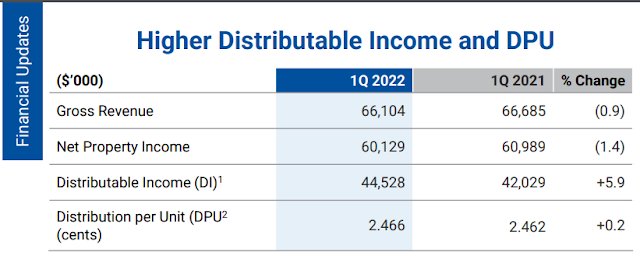
Interestingly, Keppel DC REIT unit price also plunged to a 52 week low of S$2.060 per unit. Despite the many acquisitions done in 2021, its Q1 Gross Revenue dropped by 0.9% and Q1 Net Property Income fell by 1.4% relative to Q1 of prior year. So what exactly happened? 
2.1 Current legal dispute with tenant DXC Technology
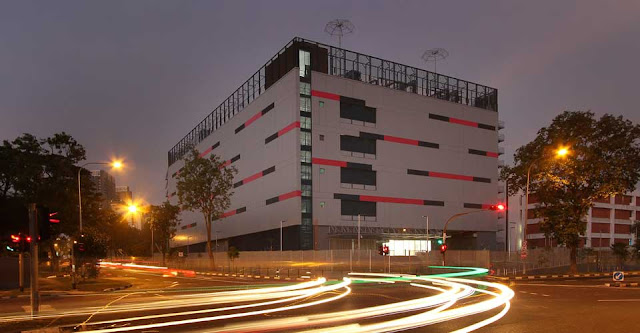
The current legal tussle with its tenant DXC Technology Services at the Serangoon North Avenue 5 data centre may have casted some shadow over the financial performance of Keppel DC REIT. Many investors were extremely disappointed over the negative revenue growth and Net property Income. But I think that it is prudent for Keppel DC REIT to stop recognizing any recurring disputed rental as well as making a provision for those that were already recognised.

2.2 Has the Keppel DC growth story stagnated and will it go below S$2 per unit?
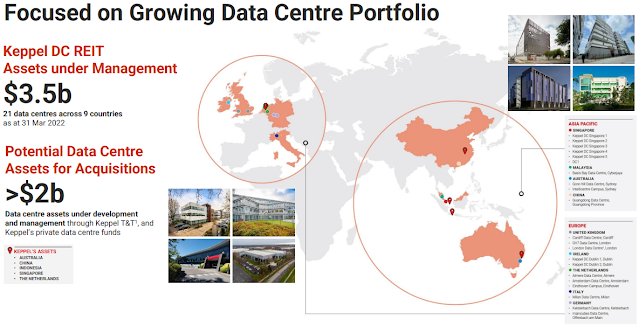
Keppel DC REIT has 21 data centres worth S$3.5b spread across 9 countries as at 31 March 2022.  It has a geographically well-diversified portfolio. In addition, in the pipelines are over S$2b worth of potential data centre assets for acquisitions. Furthermore, right of first refusal has been granted for 5 other data centres within the Guangdong Data Centre campus. The future remains extremely bright for Keppel DC REIT. 
Personally, I think that Keppel DC REIT is better diversified geographically than DCR as well as having a much higher distribution yield of 4.77% relative to DCR's 4.18% . Hence its current pricing of S$2.070 as at 29 April 2022 seems more attractive relative to DCR. I think that there should be enough support from its future growth story and benchmarking comparative to DCR to prevent further free-fall of its unit's price. It is interesting to note that CGS-CIMB Research analysts are keeping their target price unchanged of S$2.62 per unit. 
Parting thoughts
The current headwinds are good for investors to do a self check and also serves to flush out those weaker investors who thought that data centre REITs are invincible, thereby, totally forgetting that data centre REITs are ultimately equity in nature and the associated routine business risks are always present. 

Wednesday, 6 April 2022

Lendlease Rights Issue Part 2- Preferential Tranche Now Open And New Subscription Method Available.

For those who have not subscribed for their Lendlease Global Commercial REIT ("LREIT") preferential rights issue, please take note that the closing date is on 12th April 2022 (Tuesday) 5pm. As I had mentioned in my last post, unit-holders who have no money or refuse to subscribe will be severely diluted by the super low ball price of S$0.72 per unit which is a 20% discount to the January 2022 peak of S$0.90 per unit. Personally, my thoughts are to at least subscribe at S$0.72 first and then sell them off at the higher last traded price of S$0.795 per unit (as at 5th April 2022) upon issuance if cashflow are tight. 

Application options for LREIT Preferential Rights Offerings (for those who held units directly in their own CDP account)
Some folks have emailed me or posted query with regard to the subscription methods. The usual traditional participating banks for ATM application are (i) DBS (including POSB), (ii) OCBC and (iii) UOB.

There is a new payment method via PayNow that had been implemented by SGX-CDP. 
Extract of LREIT Rights application via PayNow

I do not really like the PayNow method as it is not intuitive enough in terms of user-friendliness. Those using it please read carefully on the instruction manual sent out to unit-holders on how to populate the fields after scanning the QR code using your bank payment App for PayNow. The parts that I think may pose some challenges to users:

(i)  One needs to know exactly how to key in the reference field using a mix of security counter code along with the last 8 digit of your CDP account number. Some unit-holders might forgot to key in the Lendlease counter code or key in full CDP account number. The ATM application is clearer on these aspect with the detailed step by step screen;

(ii) You also need to key in the dollar amount of the total amount of rights plus excess in the dollar value field- I am sure there will be some lost souls here who will key the number of units here instead of the dollar amount or just key amount for rights but forgot the "excess" rights one wanted;

(iii) You need to ensure your PayNow daily limits are set at an amount exceeding the amount you need to credit for this exercise.

Parting thoughts:
I will probably still stick to the traditional ATM application for the step by step instruction appearing on the ATM screen to guide one through the application process for the rights plus excess application. I hope that CDP will work on enabling the rights issue to be done via the internet banking interface in future instead of just ATMs. Last but not least, the initial huge decline in price of LREIT upon the announcement of the right issue has somewhat stabilized. It is intriguing to see that there is now an arbitrage situation with significant upsides arising from the rights pricing and most recent ex-dividend market trading price of LREIT. 

(Note: Recently, there is an interesting case of rights issue being priced higher than market trading price. Yup, I am talking about the Mapletree Commercial REIT fund raising exercise to pay for the acquisition of Mapletree North Asia Commercial REIT).

Tuesday, 22 March 2022

Lendlease REIT Rights Issue- What You Need To Know To Avoid Severe Dilution And Boost Your Chance For A Quick Realised Gain.

Talking about when the rubber meets the road from my last post and all hell broke loose indeed. Lendlease Global Commercial REIT ("LREIT") announced on 22 March 2022 the impending kick off of the private placement as well the preferential rights issue of 29 units for every 100 units owned and wow, this is more than double the amount I was expecting. As I read on the fund raising document, I nearly fainted when they revealed the price of the rights issue to be at a whopping 9.6% discount to the weighted average market price- a low ball offer of S$0.72 per unit. Unit-holders who have no money or refuse to subscribe will be severely diluted by the super low ball price of S$0.72 per unit which is a 20% discount to the January 2022 peak of S$0.90 per unit. 
I also expect the market price of LREIT to drop further upon the resumption of trade. Preferential unit-holders need to be aware of the dire predicament that they are in and to come out of the gate storming once the preferential rights issue commenced on 4th April 2022-which is a mere short 2 weeks to raise funds. Also, there is no escape, folks who tried to evade the rights issue by selling most likely will be  facing further decline in the already low price once trading resumes; and those who purchase LREIT recently and refused to subscribe will face heavy dilution in their holdings. LREIT management has screwed everyone by the low price of S$0.72 per unit on top of demanding 29 units subscription for every 100 units owned.
Other key points to note:
1. Those who have lost their ATM card or forgot their ATM password please ensure you go to your bank to rectify the issue before the kick off of the preferential tranche.

2. For those who received from your stock brokers the invitation to participate in the private placement, note that you will not be eligible to participate in the Preferential Offerings if you decided to take part in it to get more units. The most discount for this exercise for the new units will be from the Preferential tranche of S$0.72 per unit whereas the Private Placement tranche will be priced between S$0.725 and S$0.740. 

3. Opening date of the Preferential Offering is on 4th April 2022 (Monday 9am) and ends on 12th April 2022 (Tuesday 5pm). 

4. For those who bought units under nominee brokerage accounts instead of your own CDP,  please call up your brokers immediately if you do not receive any e-notification or physical letters to subscribe for the rights issue.

Will market price of LREIT drop below S$0.720 per unit?
Well, you never know. If the Russo-Ukraine war suddenly became a World War 3 with US and its European allies dragged in, then this is definitely a possibility but personally, I think such events will be remote for now. 

Parting thoughts
For long term investors, I think that LREIT offers an attractive dividend yield of over 6.2% and possibility close to 7% forward yield based on the current low ball offer. The recurring tax savings of S$5.6Mil from Jurong East Mall (JEM) being restructured into a REIT and also the redevelopment of the 48,200 sqft car park near 313@somerset into a new multi-functional event space do also provide further potential upsides in the short to mid-term. On a longer term basis, there is the potential yield accretive acquisition in the pipeline of Paya Lebar Quarter (PLQ). 

Monday, 21 March 2022

Dasin Retail Trust Unable To Renew Syndicated Bank Loans For Long Term- Forced to Sell 2 Shopping Malls in Guangdong Province.

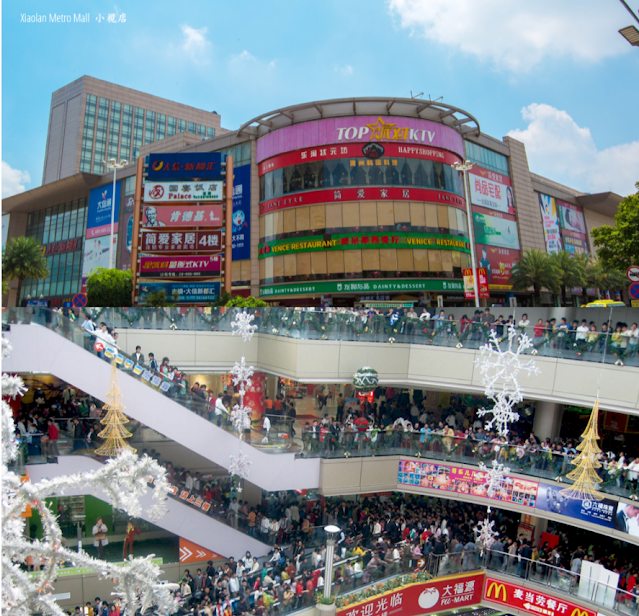
Dasin Retail Trust ("Dasin") made a shocking announcement on Sunday (20th March 2022) that it has entered into a non-binding memorandum of understanding ("MOU") with Wuhu Yuanche Bisheng investment Centre ("Purchaser") to explore the sales of Shiqi Metro Mall and Xiaolan Metro Mall in Guandong Province. This was a big surprise to me as instead of announcing whether the current syndicated loan (that has expired on 19th March 2022) has been extended for another 3 months, it went on to announce this first. Anyway, this is a sure sign that the syndicated loans bankers must have some serious concern on the entire Dasin for them to be only willing to give short-term extensions for the past 2 rounds and after another 3 months, no progress has been made. I will put up some points to take note of here on the various uncertainties still plaguing Dasin in spite of the upcoming sales of investment properties to raise cash for loan repayment. 
1. Syndicated bank loans default and unit-holders still entitled to the payout on 30 March 2022? 
The key issue currently is whether Dasin Retail Trust is in default of bank loans. A default will mean that the distribution being declared for 2nd half FY2021 cannot be paid out on 30 March 2022. Bank loans usually have extra terms and conditions imposed on the entity upon default. This is exactly what had happened to the last distributions which were being withheld due to objection by the bankers of the demised Eagle Hospitality Trust.

This pertinent question went unanswered as at 22 March 2022, 10.15am. I am flabbergasted by the lack of inquiries by our SGX regulatory team and have written in to SGX to raise my concern on the lack of transparency and the lack of prompt disclosure by the management team of Dasin. 

2. Sales proceeds to be use to repay Dasin's existing syndicated loans and working capital.
The net proceeds from the sale of the properties shall be used to repay the Trust's existing syndicated loans and the remainder if any for working capital purposes. The million dollar question here are:

(i) What is the sales price of the 2 properties given the seemingly urgency to offload them? 
(ii) How tight is the timeline to repay the syndicated bank loans? Till now no disclosure by the management of Dasin. 

3. Why sell 2 properties? Isn't the syndicated loans due only S$500 Mil?
Extract of Loan Payable Summary from 31 Dec 2021 FS
The bad news here is that while S$499.5Mil of bank loan is already due, another S$105.7Mil is due in September 2022; S$132.9Mil is due on 15 July 2022 and another S$17.6Mil due on 28 September 2022. 

Hence a total of S$755.7Mil of loans are either already due or due within 6 months. Dasin needs to sell at least 2 properties urgently to get out of the loan default mess.

4. Estimated sales proceed from divestment of the 2 malls
Extraction from valuation report from Jones Lang Lasalle
The total valuation of Xiaolan Metro Mall and Shiqi Metro Mall are RMB4,836,700,000 (S$1,015Mil).
Since it was mentioned in the recent MOU announcement that the Purchaser will grant Dasin put option for shares in the Special Purpose Vehicle created to acquire the 2 properties, I presume an estimated S$760Mil will be in hard cash so as to repay the bank loan while the remaining S$255Mil will be in a mixture of shares and cash to Dasin.
Parting thoughts
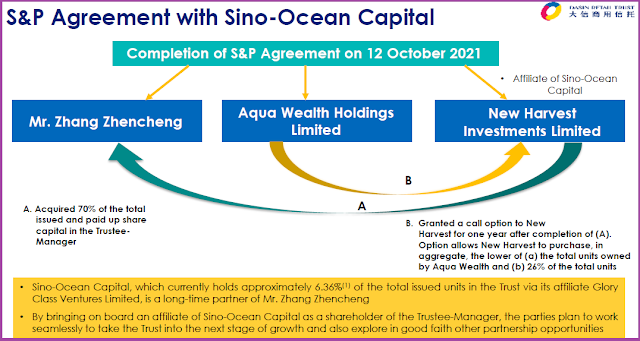
Overall, Dasin may end up in a distressed sales of not just 2 malls but perhaps all of its shopping malls at firesales price if the above divestment does not go through. Personally, I thought that the new Trust Manager, Sino-Ocean, seems to have done a lot to prevent a firesales of Dasin's investment properties by tapping on its networking to arrange a suitable deal. At the same time, I am apprehensive of the reason why Sino-Ocean did not propose a direct capital injection into Dasin with its partner but instead come up with such a financing structure. I smelled a rat somewhere which Sino-Ocean and the syndicated bankers are not revealing on why the syndicated bank loans failed to be renewed for the longer term of 2 to 3 years. 

Last but not least, Dasin is trading at just 0.225 times of its net asset value of S$1.40 as at 31 December 2021. So if the above deal pulls through at a close enough price to the Jones Lang Lasalle valuation, it is tantamount to the unlocking of a huge potential upside for existing unit-holders.  Of course, whether Dasin is investible or on its final death bed at this juncture is an enigma by itself....so beware.

P.S: Please see my previous posting on Dasin Retail Trust

Friday, 18 March 2022

Don't Be A Full Time Employee- Be An Options "Investor" Instead- Say Goodbye to Your 9-5 Job!

Tim: "I earned S$6K per month."

Duncan: "Me too! I also earned around S$6K per mth."

Tim: " I also got to use the Company car and work from 9am to 5pm and need to do overtime work sometime".

Duncan: " I work from home and so the car is not necessary for me. I only need to work 30 mins a a day and I have time to spend with my family"

Tim: "Wait? What? Wait a minute.....how?"

Duncan: " All I need to do is to spend some time doing research on great companies doing technical analysis and applying the right strategy in options trading and this helps me to generate about S$6,000 a month".  

Tim: "I see. So what are the strategies that you are mentioning? It is not for me. I am just asking for a friend."

Duncan: "Yes you can join us at our 2 hours option foundation class to find out how you can kickstart your option investing journey." 

Tim: "Alright, thank you!".

It is not necessary to do extraordinary thing to achieve extraordinary results. Similarly, just by working longer hours does not guarantee a higher pay in your 9 to 5 job. By learning how to invest in options, you are able to use less time to exchange for a better results than your 9 to 5 job!

Personal thoughts:
Wow, I saw the above advertisement video and is impressed. Looks like option trading can be a very good form of investment. Earning S$6K per month every month and only 30 mins required every day is definitely better than my sucky daily job as an employee. 

The Ministry of Education of Singapore should seriously consider including such courses in schools for all students to teach them to be financially savvy in options investing instead of letting many students eventually ending up as an employee in future and slogging in 9 to 5 job. Not sure whether Skills Future can be used for such courses offered by the advertiser. 

On a more serious note, I have seen seasoned investors using options and making money out of it along with their normal stock investments. However, options maybe risky....like a year ago, no one would have dreamed that Alibaba can hit $70-$80. So I am really wondering how many people can earn S$6K every month from it. If it is that easy, guess no one would be working in a 9-5 job....it would have destroyed many economies. 

Wednesday, 16 March 2022

Alibaba Rebounded Sharply After 30% Crash- Good Buy Or Time To Cut Losses?

Alibaba (9988) crashed from around HK$100 per share to HK$71 per share in less than a week. This is an incredulous plunge in value of almost 30%. US Sanctions on China over Ukraine interference, China regulatory on Tech firms as well as potential delisting of China businesses on US Stock market culminated in the spectacular downfall of China tech stocks and Alibaba was knocked out. The speed of investors bailing out of China equities reminded me of the days in 2008 Global Financial Crisis. 

Thankfully, Alibaba and most tech stocks rebounded today (16th March 2022) by over 20% after the irrational selling the day before. It closed at HK$90,70 as at 16th March 2022. I have already exited the bulk of my Alibaba investments on the 1st week of March 2022 and currently still vested in 100 shares of Alibaba 9988. I am also fortunate to have stopped additional investments into Alibaba from my Tiger Brokers portfolio since 2nd December 2021 as I decided to mitigate the risk of holding excessive Alibaba stocks.
Parting thoughts
Basically, I still think that the fundamentals of Alibaba are still intact despite the crackdowns by China regulatory, threat of US delisting and the lower growth rate going forward. However, I think that there maybe some good opportunities to take some calculated risk for investing the funds into other riskier stock investment. I may rotate the funds back into Alibaba later on as I think that the recovery for Alibaba will not be so soon given the above negative factors all coming together. 

Saturday, 12 March 2022

Dasin Retail Trust 15.4% Distribution Yield Per Annum- Typical Value Trap Or A Hidden Gem?

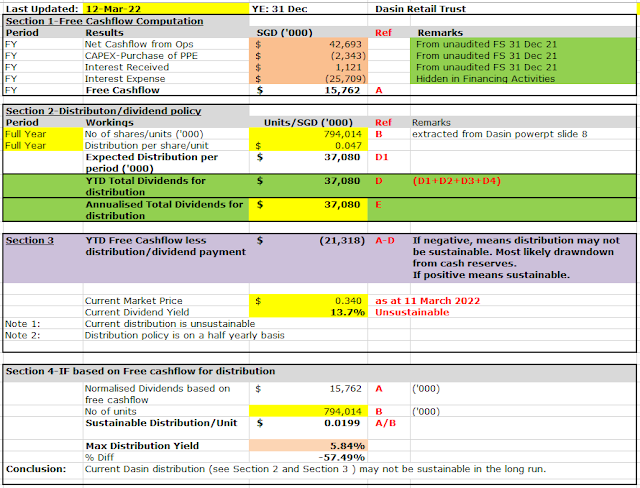
Dasin Retail Trust ("Dasin") S$500Mil syndicated bank loan is still in limbo despite the past 2 loan extensions- latest extension being given is from 20 December 2021 till 19 March 2022. Once again, there is not much news or disclosure from the Senior Management of Dasin with regard to the status of the syndicated bank loan albeit the deadline of 19th March 2022 fast approaching. The unit price of Dasin has been severely punished by the market and has dropped from its 52 weeks high of S$0.765 per unit to S$0.310 at its lowest point due to the high possibility of bank loan default. As at 11 March 2022 (Friday), the unit price of Dasin recovered slightly back to S$0.340 per unit. The late payment of distribution for the 1st half of FY2021 as well as the repeated failures to renew the syndicated bank loan for the long term have dented investors' confidence and it looks like Dasin will keep trading well below its NAV of S$1.40 per unit for a very long time. In addition, the free cashflow analysis which I came up with seems to be pointing to an unsustainable current distribution rate from Dasin in the long run (I will elaborate this point later on).
1. Dasin Retail Trust 15.4% Distribution Yield Per Annum- Typical Value Trap Or A Hidden Gem?
First and foremost, the super high +15.4% distribution yield is due to distribution waiver by the substantial unit-holders. The income waiver over the past few years end on FY2021. Going forward, there will no longer be waived since the business is deemed to have stabilized. Without the income waiver by the sponsor, the distribution yield will only be at +13.7%. This may still appear high but there are 4 main worrying points to take note in case one thinks that Dasin at its current price is a hidden gem and cash cow.

1(a) Worrisome plunge in fair valuation of its shopping malls for 2 consecutive years even as COVID brought under control in China in 2021
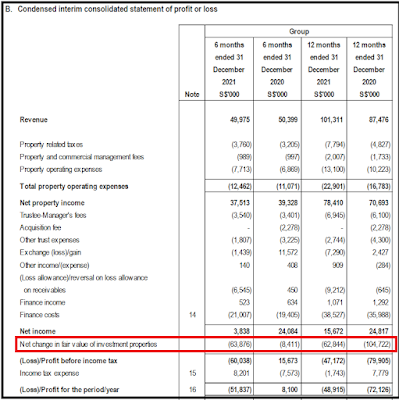
In FY2021, fair value of its shopping malls dropped by <S$62.8Mil>. In FY2020, this fair valuation was <S$105Mil>. Total fair valuation decline over the past 2 years combined is <S$167.8Mil>. Since the valuation methodology is based on discounted future cashflow by Jones Lang LaSalle, this means that expected future cashflow has plunged. This maybe attributable to higher interest rate and also lower occupancy rate [please see 1(b) below].

1(b) Occupancy rate of its mall has dropped further
As at 31 Dec 2021, occupancy rate of the shopping malls have dropped to 93.9% relative to 96.5% as at 31 Dec 2020. This is strange considering that by FY2021, the COVID situation I thought is already better managed in the whole of China. 

1(c) Is the free cashflow available for distribution sustainable on a longer term?
The free cashflow does not seemed sufficient at all and being financed from current pool of existing cash balances. This will dwindle over time. The current distribution by Dasin is unsustainable in the longer run. If based on free cashflow, the sustainable distribution yield will only be +5.84%.  This is where I find it extremely worrying. I will probably do a more in-depth analysis on this enigmatic issue if Dasin survived the upcoming bank loan default.  
 
1(d) Can't help but wonder whether the numbers reflected in its financials and presentation are reliable
In addition, I sometimes wonder whether the numbers presented in Dasin's financial are reliable. 

-Are there also as many tenants still operating in the different malls with good footfall from shoppers?

-Are there also huge unrecorded liabilities that is waiting to pounce on unsuspecting unit-holders? 

-Does the bankers have in possession certain unfavorable information that is why the refusal by some of them to to refinance the syndicated bank loan even after 2 extensions?

However, to be fair, not all signs are gloom and doom with regard to Dasin as I will further elaborate in Paragraph 2 and Paragraph 3 below.

2. Reputable new trust manager and major shareholder-Sino Ocean


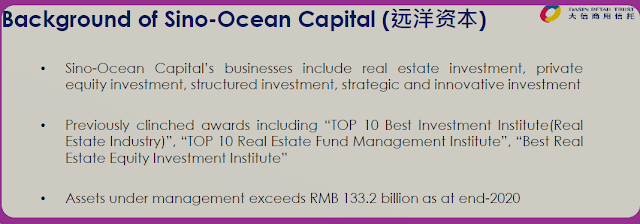
Sino-Ocean Capital is listed on the HKSE. So at least there is a glimmer of hope that the bankers will be willing to re-finance the loan given the better reputation and financial position of Sino-Ocean.

3. NAV of Dasin is at S$1.40 per unit- Market Price/NAV ratio of an incredulous 0.243
If one look out the latest China Retail Focused REIT/BizTrust Comparison by Vince on REIT-TIREMENT, we can do a rough comparative benchmark to similar retail REITs as follow: 
-BHG Retail- 0.59 
-Sasseur REIT- 0.88

If we are conservative, we can just use the lower BHG Retail REIT's ratio of 0.59 as reference benchmark. So, if Dasin managed to survive the bank loan renewal crisis, then its fair market value may have a potential upside of recovering to S$0.826 per unit. This is a whopping 147% potential upside in capital appreciation. Of course, this is just a speculation as I am somehow unable to figure out the root cause of the low free cashflow for Dasin as alluded to paragraph 1(c) as aforesaid mentioned.  This is also subject to the reliability of the financial figures being provided by Dasin with no hidden surprises.
Parting thoughts
The free cashflow evaluation seems to be pointing to a future cut in distribution to unit-holders as it is not sustainable in the longer run since it is being drawn down from available cash and leverage.  Anyway, this intriguing issue is not important right now. The upcoming deadline for renewal of the bank loan is perhaps the crux issue for Dasin now as it will determine whether there will be an immediate rights issue to repay the syndicated bank loan or a forced liquidation of investment properties. Saying that, there is also the possibility that the end of Dasin is once again postponed by the bankers should they choose to kick the can down the road for another 3 months extension on 19th March 2022.